
The Royal London Hospital (London)
United Kingdom /
England /
London /
A11 Whitechapel Road
World
/ United Kingdom
/ England
/ London
World / United Kingdom / England
hospital
Add category


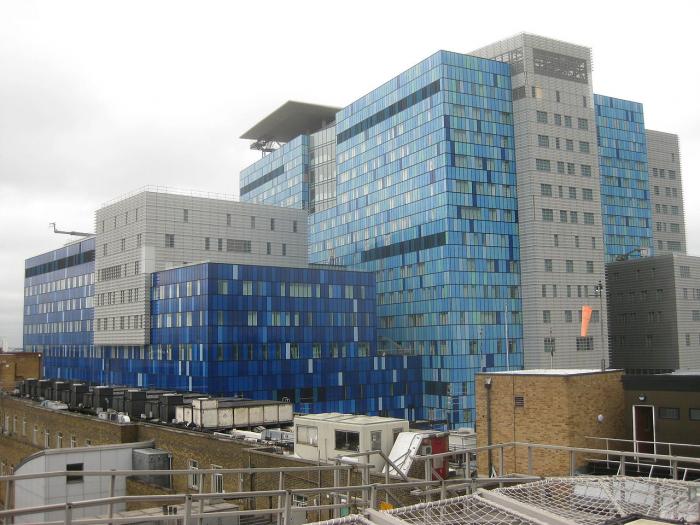
The Royal London Hospital
Whitechapel Road
Whitechapel
London
E1 1BB
www.bartsandthelondon.nhs.uk/aboutus/getting_to_the_roy...
One of London's oldest and best teaching Hospitals.
A landmark building on Whitechapel Road. A world-renowned teaching hospital, first established as a dispensary in 1740 in a few houses just off City Road, and then in Prescot Street; it opened up on its present site in 1757. It has been serving patients in East London ever since. Queen Alexandra was closely associated with the hospital and there is a fine statue of her in the courtyard behind. In more recent years it has added a heliport for an air ambulance and has joined up with Barts to form one health group. A new plan has recently (2006) been approved for modernising the hospital. The ground floor corridors usually have displays of paintings which are changed from time to time. While walking past the hospital one might like to notice the unusual row of Carob trees (St John's bread) which grow in the pavement to the west of the main entrance. The fruit can be clearly seen in winter months.
Historically famous because Dr. Frederick Treves worked here. Treves discovered Joseph Merrick (The Elephant man) being displayed for money in a store across the road from the hospital and gave him care and following a public campaign residence in the hospital.
His skeleton still resides here (Joseph Merrick's, not Frederick Treves').
Curently the Royal London Hospital has a big helicopter pad and has been made more famous in the BBC documentary "Trauma".
Situated in the courtyard behind the Royal London Hospital, Whitechapel Road, there is an impressive statue of the wife of King Edward VII. This illustration shows a detail from the rear of the base of the memorial, showing a visit to the hospital by the King and Queen and the treatment being given by nursing staff a century ago. Queen Alexandra was influential in bringing in into the hospital the Finsen lamp, then a new treatment for tuberculosis of the skin.
Whitechapel Road
Whitechapel
London
E1 1BB
www.bartsandthelondon.nhs.uk/aboutus/getting_to_the_roy...
One of London's oldest and best teaching Hospitals.
A landmark building on Whitechapel Road. A world-renowned teaching hospital, first established as a dispensary in 1740 in a few houses just off City Road, and then in Prescot Street; it opened up on its present site in 1757. It has been serving patients in East London ever since. Queen Alexandra was closely associated with the hospital and there is a fine statue of her in the courtyard behind. In more recent years it has added a heliport for an air ambulance and has joined up with Barts to form one health group. A new plan has recently (2006) been approved for modernising the hospital. The ground floor corridors usually have displays of paintings which are changed from time to time. While walking past the hospital one might like to notice the unusual row of Carob trees (St John's bread) which grow in the pavement to the west of the main entrance. The fruit can be clearly seen in winter months.
Historically famous because Dr. Frederick Treves worked here. Treves discovered Joseph Merrick (The Elephant man) being displayed for money in a store across the road from the hospital and gave him care and following a public campaign residence in the hospital.
His skeleton still resides here (Joseph Merrick's, not Frederick Treves').
Curently the Royal London Hospital has a big helicopter pad and has been made more famous in the BBC documentary "Trauma".
Situated in the courtyard behind the Royal London Hospital, Whitechapel Road, there is an impressive statue of the wife of King Edward VII. This illustration shows a detail from the rear of the base of the memorial, showing a visit to the hospital by the King and Queen and the treatment being given by nursing staff a century ago. Queen Alexandra was influential in bringing in into the hospital the Finsen lamp, then a new treatment for tuberculosis of the skin.
Wikipedia article: http://en.wikipedia.org/wiki/Royal_London_Hospital
Nearby cities:
Coordinates: 51°31'5"N -0°3'33"E
- Springfield university hospital 12 km
- Royal Bethlehem Hospital, Psychiatry 15 km
- Former West Park Hospital 26 km
- Wexham Park Hospital 36 km
- St. Peter's Hospital 36 km
- Broadmoor Hospital 53 km
- Former St. Francis' Mental Hospital 59 km
- Basingstoke and North Hampshire Hospital 78 km
- St James' Hospital 106 km
- The Royal Hospital Haslar 110 km
- Whitechapel 0.3 km
- Mile End New Town 0.6 km
- St. George in the East 0.9 km
- Regent’s canal 1 km
- Stepney 1 km
- Shadwell 1 km
- Ratcliffe 1.3 km
- Mile End 1.4 km
- Tower Hamlets Council 1.7 km
- London Borough of Hackney 3.4 km