
Ctesiphon Arch (Taq Kasra) (Salman Pak (al-Mada'en))
Iraq /
Wasit /
as-Suwayrah /
Salman Pak (al-Mada'en)
World
/ Iraq
/ Wasit
/ as-Suwayrah
, 26 km from center (الصويرة)
World / Iraq / Diyala
palace, arch, monument, archaeological site
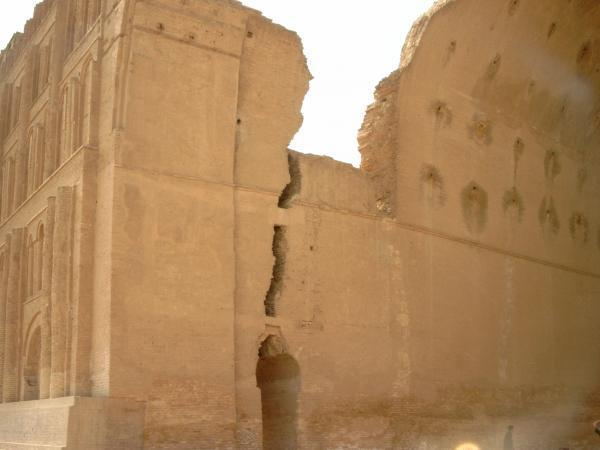
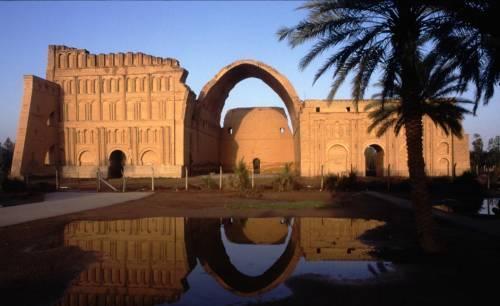
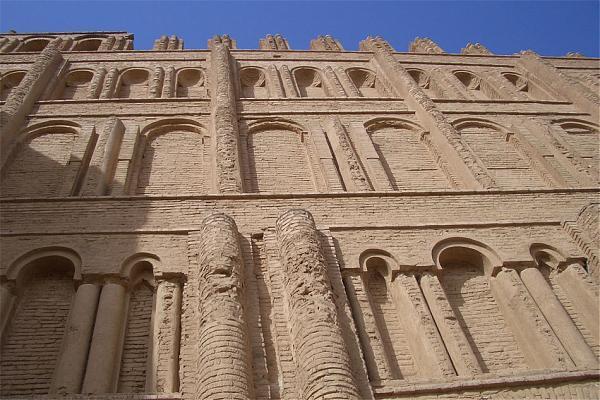
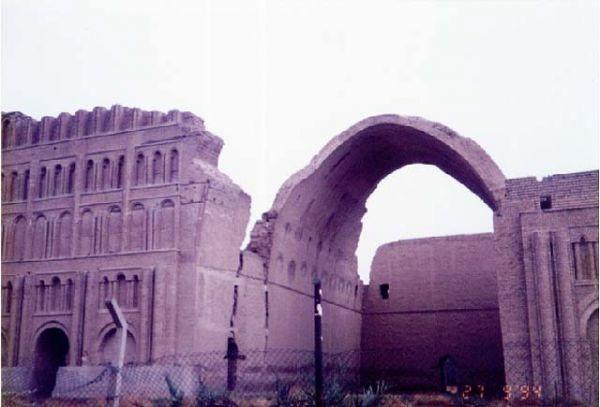
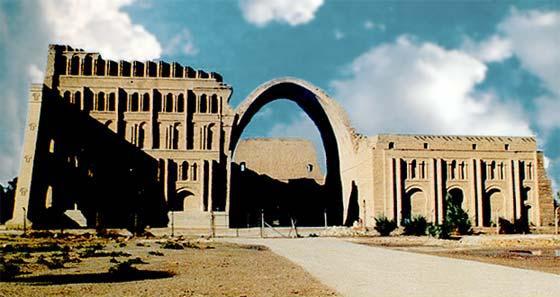
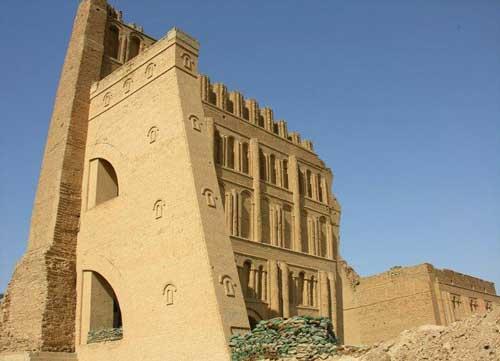
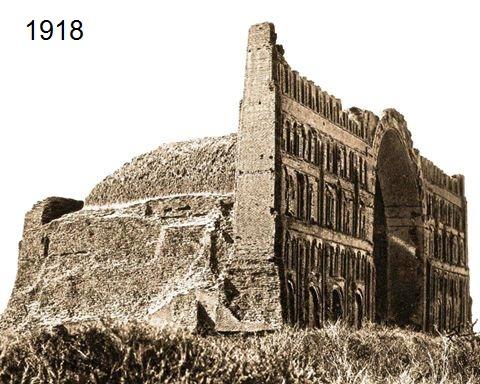
The famous arch of Ctesiphon built nearly fourteen centries ago by Chosrowes I (Taq-i-Kisra طاق كسرى)
Ruins of Sasanian Palace at Seleucia-Ctesiphon/al-Mada'in (6th century). Consists of Iwan 43.50 m deep and 25.50 m wide,
surmounted by brick arch 36 m high. Construction generally associated with the reign of King Kusro I/Khusraw I Anoshirvan
(531-579 CE).
www.islamic-architecture.info/WA-IQ/WA-IQ-019.htm
The arches of the vault were constructed, in fact, over empty space without the use of temporary wooden centering—a technique not uncommon in Mesopotamia, but amazing on such a scale. The lower portion of the vault was built according to the corbel principle. Thin mud bricks were stepped inward in successive horizontal courses, each projecting a bit further over the hall. in Khusrau's palace the bricks had a slight backward slant against the end walls, although the corbel arch, unlike the true arch, exerts no outward thrust but is held up by the sheer weight of these massive walls on each side. At approximately half height the construction changed to the normal arch principle. The successive brick arches which form the vault had staggered joints to provide sufficient bond which, together with the steep parabolic shape of the arch, allowed its construction without complete centering from the ground. The Sassanians were masters of the art and constructed other huge vaults such as the one—now collapsed—at Firuzabad in Iran. The span of the vault at Ctesiphon is 82 feet and at the crown it is 120 feet above the ground.
The vault is open to the east, to make a kind of open porch or iwan common in later Muslim architecture, and the Sassanid builders may have inspired the vaulted entrances of later Persian mosques.
Attached to the vault at Ctesiphon, one wall of the south wing of the palace also remains. On the interior side of this wall can be seen the toothings of smaller vaults for the original two upper floors which have collapsed.
The neo-Persian Empire ended with the fall of the Sassanid dynasty in the 7th century. One of the final blows came in 637 A.D. when Arabs occupied Ctesiphon and Seleucia which they called al-Madam, the "capitals". They used the decaying buildings as quarries for building materials but the great palace still stood and was used for a while as an improvised mosque.
When the Abbasids decided in the 8th century to build their capital at Madinet as-Salam, "the city of peace" (present-day Baghdad), they abandoned what was left of the two cities. Caliph al-Mansur even wanted to destroy the palace of Khusrau but happily, his Persian adviser was able to dissuade him by arguing that demolition costs would be too high.
The river was not subject to such reason, however, and over the centuries it continued to lick at the mud bricks of the palace and add their silt to its delta.
Ruins of Sasanian Palace at Seleucia-Ctesiphon/al-Mada'in (6th century). Consists of Iwan 43.50 m deep and 25.50 m wide,
surmounted by brick arch 36 m high. Construction generally associated with the reign of King Kusro I/Khusraw I Anoshirvan
(531-579 CE).
www.islamic-architecture.info/WA-IQ/WA-IQ-019.htm
The arches of the vault were constructed, in fact, over empty space without the use of temporary wooden centering—a technique not uncommon in Mesopotamia, but amazing on such a scale. The lower portion of the vault was built according to the corbel principle. Thin mud bricks were stepped inward in successive horizontal courses, each projecting a bit further over the hall. in Khusrau's palace the bricks had a slight backward slant against the end walls, although the corbel arch, unlike the true arch, exerts no outward thrust but is held up by the sheer weight of these massive walls on each side. At approximately half height the construction changed to the normal arch principle. The successive brick arches which form the vault had staggered joints to provide sufficient bond which, together with the steep parabolic shape of the arch, allowed its construction without complete centering from the ground. The Sassanians were masters of the art and constructed other huge vaults such as the one—now collapsed—at Firuzabad in Iran. The span of the vault at Ctesiphon is 82 feet and at the crown it is 120 feet above the ground.
The vault is open to the east, to make a kind of open porch or iwan common in later Muslim architecture, and the Sassanid builders may have inspired the vaulted entrances of later Persian mosques.
Attached to the vault at Ctesiphon, one wall of the south wing of the palace also remains. On the interior side of this wall can be seen the toothings of smaller vaults for the original two upper floors which have collapsed.
The neo-Persian Empire ended with the fall of the Sassanid dynasty in the 7th century. One of the final blows came in 637 A.D. when Arabs occupied Ctesiphon and Seleucia which they called al-Madam, the "capitals". They used the decaying buildings as quarries for building materials but the great palace still stood and was used for a while as an improvised mosque.
When the Abbasids decided in the 8th century to build their capital at Madinet as-Salam, "the city of peace" (present-day Baghdad), they abandoned what was left of the two cities. Caliph al-Mansur even wanted to destroy the palace of Khusrau but happily, his Persian adviser was able to dissuade him by arguing that demolition costs would be too high.
The river was not subject to such reason, however, and over the centuries it continued to lick at the mud bricks of the palace and add their silt to its delta.
Wikipedia article: http://en.wikipedia.org/wiki/Taq_Kasra
Nearby cities:
Coordinates: 33°5'37"N 44°34'50"E
- Victory park and lake 36 km
- Balkuwara Palace Complex (Abbasid era) 134 km
- Palace area 188 km
- Ancient city of Dur Sharrukin (Khorsabad) 401 km
- Palace of the Govenor of the Hail Province 672 km
- Old Bayazıt 717 km
- Presidential Palace Grounds 777 km
- Presidential Palace Grounds 856 km
- قصر الملك سلمان نيوم 1065 km
- Qubbah Palace 1302 km
- Ancient Ctesiphon 1.3 km
- Al-Mada'in District 1.7 km
- Ruin of Veh-Ardashir (Coche) 2.6 km
- Air Defence IOC 7.6 km
- Former S-200 (SA-5) Gammon 7.6 km
- al-Khanasah 7.8 km
- تل الذهب 14 km
- Baghdad Governorate (Capital) 29 km
- Babel (Babylon) Governorate 51 km
- Wasit Governorate 98 km