
Normandie (1914) (Newport, Rhode Island)
USA /
Rhode Island /
Newport /
Newport, Rhode Island /
Ocean Avenue, 232
World
/ USA
/ Rhode Island
/ Newport
World / United States / Rhode Island
house, place with historical importance, cottage, estate (manor / mansion land)
Cherry Creek (aka Cherry Neck) Bungalow, now Normandie, the Lucy Wortham James House (1914; Delano & Aldrich [New York], architects):
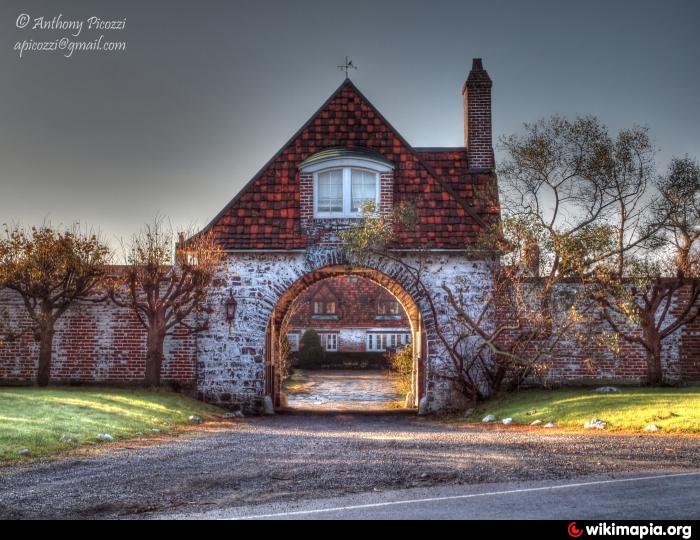
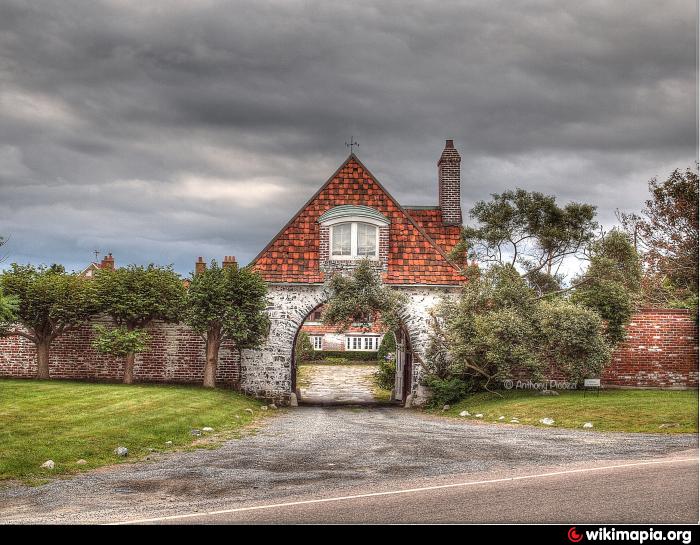
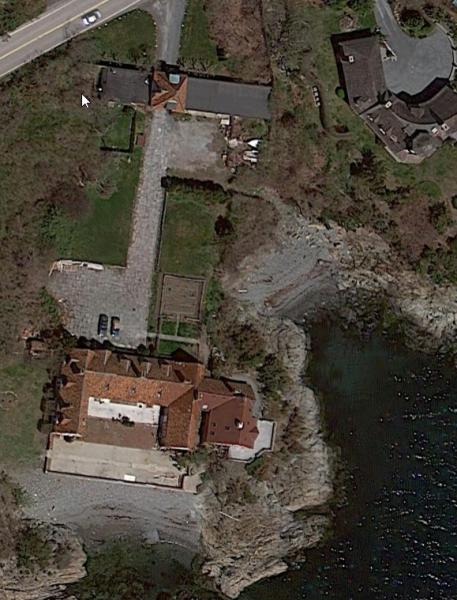
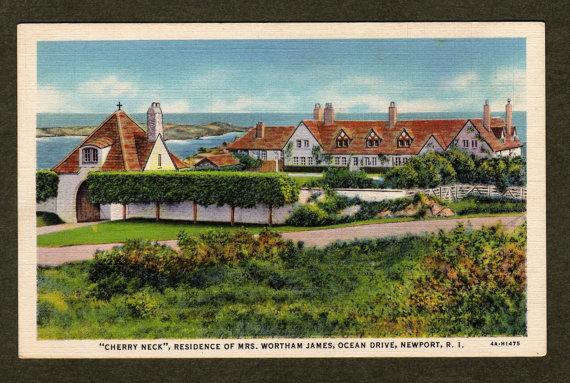
A residential complex in the Norman mode (as the name makes explicit) on an almost 4½-acre parcel with a narrow rectangular-plan gatehouse near the road and an E-plan main house to the south, near the water’s edge; both gatehouse and main house are rendered in whitewashed red brick with orange tile roofs. From the road, the gatehouse appears as a square-plan, hip-roof 1½- story pavilion dominated by a large round-arch passage on its 1st story with barrel-vault dormer on its north roof slope and chimneyed cross gable on its west slope; the walls that extend east and west of the pavilion are, in fact, the blind rear walls of the shed-roof service buildings that flank the central pavilion.
A flagstone driveway extends through the gatehouse to the motor court in front of the main house. The wide, low-slung, high-cross-gable-roof main house has end-gable pavilions at either end, that on the west end flanked immediately to the east by a smaller principal-entrance pavilion, with entrance set within a round relieving arch. Regularly spaced yet picturesquely asymmetrically arranged casement windows dominate the façade’s walls, and 3 large gabled dormers with half-timbering are symmetrically arranged above the façade. On the main house’s south elevation, which rises a full 2 stories, the end pavilions extend beyond central wall plane to form a partially enclosed terrace, with large windows overlooking it, that continues south beyond the pavilions to a low-walled terrace overlooking the water beyond; 5 tall brick chimneys with terra-cotta pots are located on the central section’s ridgeline, east of the ridgeline of the east pavilion, and on the west slope of the west pavilion.
Mrs James (1880-1938) was heir to the fortune amassed by her childless great uncle, R.G. Dun, founder of Dun & Bradstreet, and this house was built in the years immediately after she received her inheritance and divorced her husband.
It is one of the best of the picturesque, smaller-scale, vernacular European-inspired country houses built along the Rhode Island coast in the 2nd, 3rd, and 4th decades of the 20th century; its lowslung profile both blends visually almost naturalistically and suits climatologically this section of rugged coastline. Well received critically following its construction, the house was published in Architectural Record (1923), House Beautiful (1924), and the New York Herald Tribune (1929). With a large living space dominating the center of the plan, it picked up on the programmatic organization that Richard Morris Hunt had used at Indian Spring (see 325 Ocean Avenue); this house influenced directly one other Rhode Island house, George Locke Howe’s design for the T.I. Hare Powels, Hopelands, on Indian Avenue in Middletown, and indirectly Howe’s subsequent design for the G. Pierce Metcalfs, Philmoney, in Exeter
A residential complex in the Norman mode (as the name makes explicit) on an almost 4½-acre parcel with a narrow rectangular-plan gatehouse near the road and an E-plan main house to the south, near the water’s edge; both gatehouse and main house are rendered in whitewashed red brick with orange tile roofs. From the road, the gatehouse appears as a square-plan, hip-roof 1½- story pavilion dominated by a large round-arch passage on its 1st story with barrel-vault dormer on its north roof slope and chimneyed cross gable on its west slope; the walls that extend east and west of the pavilion are, in fact, the blind rear walls of the shed-roof service buildings that flank the central pavilion.
A flagstone driveway extends through the gatehouse to the motor court in front of the main house. The wide, low-slung, high-cross-gable-roof main house has end-gable pavilions at either end, that on the west end flanked immediately to the east by a smaller principal-entrance pavilion, with entrance set within a round relieving arch. Regularly spaced yet picturesquely asymmetrically arranged casement windows dominate the façade’s walls, and 3 large gabled dormers with half-timbering are symmetrically arranged above the façade. On the main house’s south elevation, which rises a full 2 stories, the end pavilions extend beyond central wall plane to form a partially enclosed terrace, with large windows overlooking it, that continues south beyond the pavilions to a low-walled terrace overlooking the water beyond; 5 tall brick chimneys with terra-cotta pots are located on the central section’s ridgeline, east of the ridgeline of the east pavilion, and on the west slope of the west pavilion.
Mrs James (1880-1938) was heir to the fortune amassed by her childless great uncle, R.G. Dun, founder of Dun & Bradstreet, and this house was built in the years immediately after she received her inheritance and divorced her husband.
It is one of the best of the picturesque, smaller-scale, vernacular European-inspired country houses built along the Rhode Island coast in the 2nd, 3rd, and 4th decades of the 20th century; its lowslung profile both blends visually almost naturalistically and suits climatologically this section of rugged coastline. Well received critically following its construction, the house was published in Architectural Record (1923), House Beautiful (1924), and the New York Herald Tribune (1929). With a large living space dominating the center of the plan, it picked up on the programmatic organization that Richard Morris Hunt had used at Indian Spring (see 325 Ocean Avenue); this house influenced directly one other Rhode Island house, George Locke Howe’s design for the T.I. Hare Powels, Hopelands, on Indian Avenue in Middletown, and indirectly Howe’s subsequent design for the G. Pierce Metcalfs, Philmoney, in Exeter
Nearby cities:
Coordinates: 41°27'21"N 71°19'45"W
- 25 Price's Neck Road 0.9 km
- Wrentham House (Indian Spring) 1.1 km
- Avalon 1.3 km
- Berry Hill (1885) 1.4 km
- Edgehill 1.5 km
- Brenton Point State Park - The Reef 2.3 km
- Hammersmith Farm 2.4 km
- "Armsea Hall"/"Annandale Farm" 2.6 km
- Broadlawns 2.6 km
- Shamrock Cliff - OceanCliff 2.7 km
- Gooseneck Cove 0.4 km
- Beacon Hill Estate 0.9 km
- Indian Spring, the LeRoy King House / King-Glover-Bradley Plat 1 km
- Ballard Park (1990) 1.1 km
- Surprise Valley Farm, Swiss Village (SVF Foundation) 1.3 km
- Newport Country Club (1894-95 et seq.) 1.6 km
- Brenton Point State Park - The Reef 2.1 km
- Fort Adams State Park 2.4 km
- Castle Hill Inn & Resort 2.7 km
- Newport County, Rhode Island 13 km
Gooseneck Cove
Beacon Hill Estate
Indian Spring, the LeRoy King House / King-Glover-Bradley Plat
Ballard Park (1990)
Surprise Valley Farm, Swiss Village (SVF Foundation)
Newport Country Club (1894-95 et seq.)
Brenton Point State Park - The Reef
Fort Adams State Park
Castle Hill Inn & Resort
Newport County, Rhode Island
Comments