
Ashokan Edict (Delhi)
| place with historical importance, archaeological site, Ashoka pillar / rock edict
India /
Delhi /
Ni Dilli /
Delhi
World
/ India
/ Delhi
/ Ni Dilli
World / India / Delhi / Delhi
place with historical importance, archaeological site, Ashoka pillar / rock edict
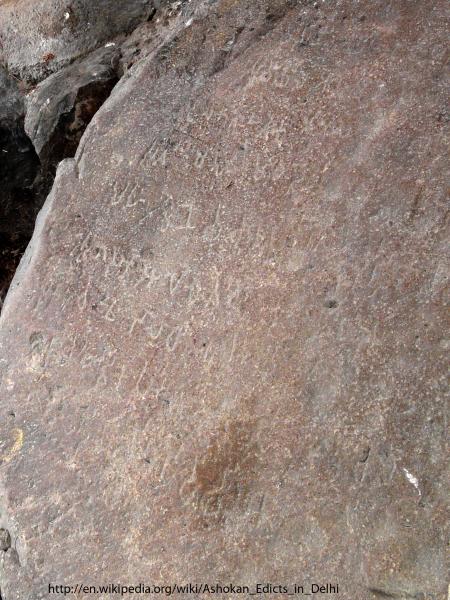
The in-situ rock edict in Delhi was discovered in an engraved form on a small patch of rock exposure in Srinivaspuri near Kalkaji temple, close to Bahapur village in South Delhi. The edict categorized as a “Minor edict” written in Brahmi script was a first person message of Ashoka, which exhorts people to follow the Buddhist way of life. It is inscribed on a rock surface with irregular lines and letter size with a number of lines not clearly decipherable. The edict translated into English reads:
It is two and half years since I became a Buddhist layman. At first no great exertion was made by me but in the last year I have drawn closer to the Buddhist order and exerted myself zealously and drawn in others to mingle with the gods. This goal is not one restricted only to let the people great to exert themselves and to the great but even a humble man who exerts himself can reach heaven. This proclamation is made for the following purpose: to encourage the humble and the great to exert themselves and to let the people who live beyond the borders of the kingdom know about it. Exertion in the cause must endure forever and it will spread further among the people so that it increases one-and-half fold.[6][10]
The rock edict epigraph was discovered on an inclined rock face by a building contractor operating at the site for building a residential colony. Archaeologists immediately examined it on March 26, 1966 and identified it as representing the Minor Rock Edict I of the Ashokan period in the light of its similarity with edicts in 13 other places in different parts of India, such as Barat in Jaipur division (to which Delhi rock edict has close resemblance) and the two pillars in Delhi. The Delhi edict was recorded as the 14th epigraphic version. The inscription covers an area of size 75 centimetres (30 in) length and 77 centimetres (30 in) height of the rock face. There are ten lines of writing of varying length written in Prakrit language in early Brahmi script and lacks uniformity of the aksharas (letters).[2]
One interpretation for the rock edict at Bahapur in Delhi is that it represents the trans-regional trade route of North India as an ancient trade link between the Gangetic Delta and the northwestern part of the Indian subcontinent. The second view is that it marks the site of a temple since it has been found at the base of a rock exposure near the present day Kalkaji temple. It is claimed that at Kalkaji, where the new Kalka Mandir (temple) exists now, was the old location of a temple (one of the five temples in Delhi) built by Pandavas, heroes of the epic Mahabharata period. The Exact location of the edict is the square shape covered place. The letters & lines of this edict are are quite blurred now i.e. their engravings are quite invisible.
It is two and half years since I became a Buddhist layman. At first no great exertion was made by me but in the last year I have drawn closer to the Buddhist order and exerted myself zealously and drawn in others to mingle with the gods. This goal is not one restricted only to let the people great to exert themselves and to the great but even a humble man who exerts himself can reach heaven. This proclamation is made for the following purpose: to encourage the humble and the great to exert themselves and to let the people who live beyond the borders of the kingdom know about it. Exertion in the cause must endure forever and it will spread further among the people so that it increases one-and-half fold.[6][10]
The rock edict epigraph was discovered on an inclined rock face by a building contractor operating at the site for building a residential colony. Archaeologists immediately examined it on March 26, 1966 and identified it as representing the Minor Rock Edict I of the Ashokan period in the light of its similarity with edicts in 13 other places in different parts of India, such as Barat in Jaipur division (to which Delhi rock edict has close resemblance) and the two pillars in Delhi. The Delhi edict was recorded as the 14th epigraphic version. The inscription covers an area of size 75 centimetres (30 in) length and 77 centimetres (30 in) height of the rock face. There are ten lines of writing of varying length written in Prakrit language in early Brahmi script and lacks uniformity of the aksharas (letters).[2]
One interpretation for the rock edict at Bahapur in Delhi is that it represents the trans-regional trade route of North India as an ancient trade link between the Gangetic Delta and the northwestern part of the Indian subcontinent. The second view is that it marks the site of a temple since it has been found at the base of a rock exposure near the present day Kalkaji temple. It is claimed that at Kalkaji, where the new Kalka Mandir (temple) exists now, was the old location of a temple (one of the five temples in Delhi) built by Pandavas, heroes of the epic Mahabharata period. The Exact location of the edict is the square shape covered place. The letters & lines of this edict are are quite blurred now i.e. their engravings are quite invisible.
Nearby cities:
Coordinates: 28°33'30"N 77°15'23"E
- Old Delhi 13 km
- Hapur 50 km
- Meerut 70 km
- Garhmukteswar 84 km
- Hastinapur 98 km
- Gajraula 100 km
- MLA Naresh Yadav ateli 103 km
- Madhogarh Hills 124 km
- Bharatpur city wall 150 km
- Agra 157 km
- Kailash Hills 0.2 km
- Asthakunj Park 0.6 km
- Sriniwaspuri 0.8 km
- East of Kailash 0.8 km
- Dayanand Colony 0.9 km
- Lajpat Nagar-4 1.3 km
- Amar Colony 1.3 km
- Lajpat Nagar-III 1.9 km
- Lajpat Nagar 2 km
- Yamuna Belt 4.9 km
Comments