
The Asmat Museum (Jakarta)
Indonesia /
Jawa Barat /
Depok /
Jakarta
World
/ Indonesia
/ Jawa Barat
/ Depok
World / Indonesia / Jakarta Raya
museum, sculpture
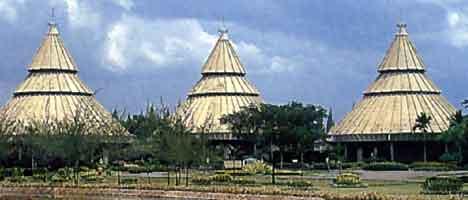
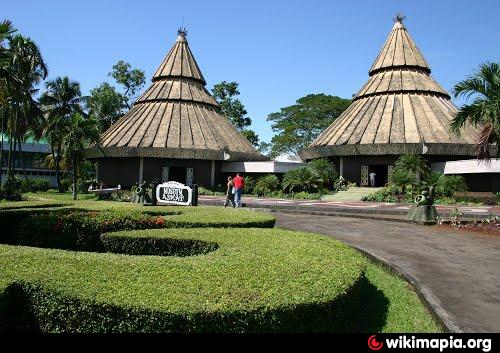
The great interest of foreigners for the specific Asmat carving art, which is so adorable, responded by Madame Tien Soeharto by establishing the Asmat Museum. Situated in the area of the Golden Snail Flower Garden with 6.500 m2 large building.The Museum can be reached by two entrances: on foot through the Golden Snail Flower Garden or by passing the bridge of the Freshwater Aquarium Park.
The museum building imitates the model of the "kariwari" house, a house of worship of the "Tobati-Enggros" tribe, aborigines at the banks of the Sentani Lake in Papua. However, it has been developed into a building with a modern architecture. The building consists of three main structures and two connecting structurers each of which has an octagonal form, giving the impression of a house on stilts. The roof consists of three cones 25 meters high and made of GRC material of which the surface has been given the impression of being covered by sago palm leaves. Various sections of the building are decorated in specific Asmat colours, that is red, white and black.
The three main buildings are used as permanent exhibition of the museum collection, while the two connecting buildings are partly used as permanent exhibition and partly as an administration and an office of the manager of the museum.
The exhibition objects are in the form of cultural items containing courageous values and reflecting the view of life of the Asmat people which is always related to their ancestors. The spiritual ties with the ancestors are actualized in carvings symbolizing various daily objects. To make it easier for visitors to understand the life of the Asmat tribe in its totality, the exhibition is arranged according to the theme.
The exhibition theme of the first building is "Man and his environment", displaying various traditional costumes and jewellery, dioramas of their livelihood (sagu pounding), a boat as a vehicle for the spirit of the ancestors ("wuramon"), statue of the ancestors ("mbis pole") and various omen decorations telling about life symptoms.
The exhibition in the second building has the theme "Man and his Culture", displaying tools to make "sagu", hunting tools, guns, cultural objects and ceremonies, percussion ("tifa"), bamboo blowing music instruments, ("fu") and a stone ax ("si").
The exhibition theme of the third building is "Man and the Product of his creativity", displaying contemporary art as the result of the development of the patterns of traditional art designs. The exhibited objects are the products of modern art by the Asmat people referring to the demand of the market but still firmly planted with the traditional design pattern.
Besides the permanent exhibitions the Asmat Museum occasionally also organizes activities with special themes such as a competition of Asmat Dance Movement Creation and a competition of Colouring Paintings of Various
The museum building imitates the model of the "kariwari" house, a house of worship of the "Tobati-Enggros" tribe, aborigines at the banks of the Sentani Lake in Papua. However, it has been developed into a building with a modern architecture. The building consists of three main structures and two connecting structurers each of which has an octagonal form, giving the impression of a house on stilts. The roof consists of three cones 25 meters high and made of GRC material of which the surface has been given the impression of being covered by sago palm leaves. Various sections of the building are decorated in specific Asmat colours, that is red, white and black.
The three main buildings are used as permanent exhibition of the museum collection, while the two connecting buildings are partly used as permanent exhibition and partly as an administration and an office of the manager of the museum.
The exhibition objects are in the form of cultural items containing courageous values and reflecting the view of life of the Asmat people which is always related to their ancestors. The spiritual ties with the ancestors are actualized in carvings symbolizing various daily objects. To make it easier for visitors to understand the life of the Asmat tribe in its totality, the exhibition is arranged according to the theme.
The exhibition theme of the first building is "Man and his environment", displaying various traditional costumes and jewellery, dioramas of their livelihood (sagu pounding), a boat as a vehicle for the spirit of the ancestors ("wuramon"), statue of the ancestors ("mbis pole") and various omen decorations telling about life symptoms.
The exhibition in the second building has the theme "Man and his Culture", displaying tools to make "sagu", hunting tools, guns, cultural objects and ceremonies, percussion ("tifa"), bamboo blowing music instruments, ("fu") and a stone ax ("si").
The exhibition theme of the third building is "Man and the Product of his creativity", displaying contemporary art as the result of the development of the patterns of traditional art designs. The exhibited objects are the products of modern art by the Asmat people referring to the demand of the market but still firmly planted with the traditional design pattern.
Besides the permanent exhibitions the Asmat Museum occasionally also organizes activities with special themes such as a competition of Asmat Dance Movement Creation and a competition of Colouring Paintings of Various
Nearby cities:
Coordinates: 6°18'20"S 106°53'38"E
- The Taman Museum Purnabhakti Park 1.4 km
- Taman Mini Indonesia Indah (TMII) 2.1 km
- Gunung Tilu - PRAJA PUSAKA 155 km
- CAG Karangsambung 336 km
- Mexolide Land Hotel (Ex Sari Nabati Factory) 342 km
- Ambarawa - Tuntang Railroad 405 km
- pete 435 km
- Museum Sangiran Area 454 km
- Dusun Beran Kepatihan 469 km
- KOMPLEK MONUMEN JENDRAL SUDIRMAN 507 km
- Ceger 0.6 km
- Taman Mini Interchange 1 km
- Bambu Apus 1.4 km
- Wilayah RW 06 Kel. Rambutan 1.5 km
- Lubang Buaya 1.7 km
- Rambutan 2 km
- Ciracas 3.1 km
- Cilangkap 3.5 km
- Jakarta 11 km
- Citarik Fault 1 (Sesar Citarik-1) 19 km