
Monument to Emperor Alexander II (Moscow)
Russia /
Moscow /
Moscow /
Vsekhsvyatsky proyezd
World
/ Russia
/ Moscow
/ Moscow
, 2 km from center (Москва)
World / Russia / Moscow City / Central
monument, 2005_construction




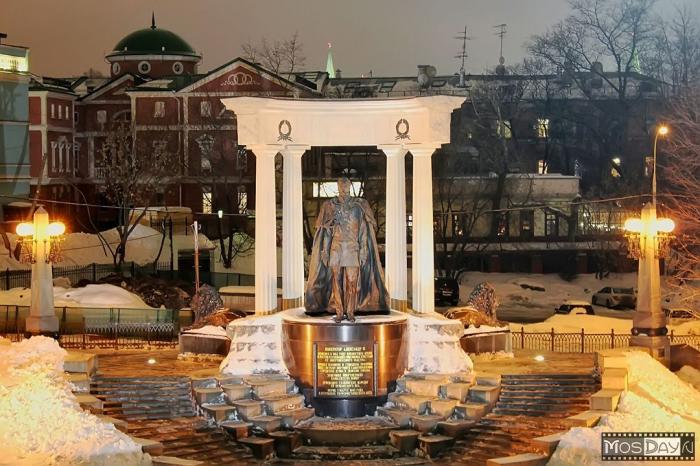
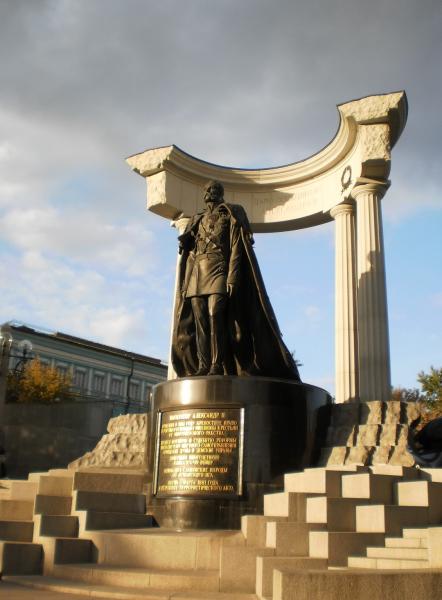
Monument to Emperor Alexander II, the Liberator Tsar, is a memorial of Emperor Alexander II of Russia, situated in the immediate surroundings of the Cathedral of Christ the Saviour was Completed in 2005. The site for the new monument was chosen in part because Alexander helped lay the foundation for the original Christ the Savior Cathedral (destroyed in 1931 by Soviet leader Joseph Stalin).
Alexander II was born in 1818 and crowned on February 19, 1855; his rule was marked by the emancipation of the serfs, along with judicial and military reforms. The emperor was assassinated by terrorists, members of the revolutionary organization Narodnaya Volya. Alexander II is best known for his 1861 order to end serfdom by freeing millions of peasants from centuries of slavery". Alexander freed Slaves from the Ottoman yoke. Under Alexander, the Russian empire expanded with major territorial gains in Central Asia.
The first monument is a life-size bronze sculpture on a square pedestal engraved with the words "To Emperor Alexander II by the love of the people" of Alexander II stood above the Kremlin's Taynitsky Gardens and could easily be seen from the Zamoskvorechye district across the Moscow River.
The canopy is of polished dark red Carelian granite and the top canopy was made of specially fitted gilded bronze sheets with green enamel. Three sides of the monument was surrounded by a gallery with arches and openwork. Thirty-three mosaic portraits of Russia’s rulers from Prince Vladimir to emperor Nicholas II based on sketches by artist Peter Zhukovsky were placed in the gallery's vaults.
The statue was demolished in the summer of 1918 during the Bolshevik revolution. On June 2, 2004 Moscow Mayor Yuri Luzhkov signed a decree about the erection of a new monument to the emperor Alexander II in Moscow. The memorial was designed by professor Alexander Rukavishnikov, a member of the Russian Academy of Arts and national sculptor of Russia. the new monument was inaugurated on June 7, 2005
The monument envisages the full height figure of the Emperor — 5 meters high, standing on a 5 meter pedestal. The new monument is located in a slope, made use of it in such a way that, from one side, the emperor is elevated on a pedestal and, from the other side, it seems that the emperor is standing right on the ground, portraying a man who is just standing and looking into the distance, facing the cathedral.
Alexander II was born in 1818 and crowned on February 19, 1855; his rule was marked by the emancipation of the serfs, along with judicial and military reforms. The emperor was assassinated by terrorists, members of the revolutionary organization Narodnaya Volya. Alexander II is best known for his 1861 order to end serfdom by freeing millions of peasants from centuries of slavery". Alexander freed Slaves from the Ottoman yoke. Under Alexander, the Russian empire expanded with major territorial gains in Central Asia.
The first monument is a life-size bronze sculpture on a square pedestal engraved with the words "To Emperor Alexander II by the love of the people" of Alexander II stood above the Kremlin's Taynitsky Gardens and could easily be seen from the Zamoskvorechye district across the Moscow River.
The canopy is of polished dark red Carelian granite and the top canopy was made of specially fitted gilded bronze sheets with green enamel. Three sides of the monument was surrounded by a gallery with arches and openwork. Thirty-three mosaic portraits of Russia’s rulers from Prince Vladimir to emperor Nicholas II based on sketches by artist Peter Zhukovsky were placed in the gallery's vaults.
The statue was demolished in the summer of 1918 during the Bolshevik revolution. On June 2, 2004 Moscow Mayor Yuri Luzhkov signed a decree about the erection of a new monument to the emperor Alexander II in Moscow. The memorial was designed by professor Alexander Rukavishnikov, a member of the Russian Academy of Arts and national sculptor of Russia. the new monument was inaugurated on June 7, 2005
The monument envisages the full height figure of the Emperor — 5 meters high, standing on a 5 meter pedestal. The new monument is located in a slope, made use of it in such a way that, from one side, the emperor is elevated on a pedestal and, from the other side, it seems that the emperor is standing right on the ground, portraying a man who is just standing and looking into the distance, facing the cathedral.
Wikipedia article: http://en.wikipedia.org/wiki/Monument_to_Alexander_II_(Moscow)
Nearby cities:
Coordinates: 55°44'44"N 37°36'24"E
- Peter the Great Statue 0.8 km
- Monument to Georgiy Dimitrov 1 km
- Monument to Bulat Okudzhava — Russian poet and art song performer 1.2 km
- World Clock Fountain 1.2 km
- Monument to Yuri Dolgorukiy 1.8 km
- A. Pushkin Monument 2.2 km
- Monument to Ivan Krylov' with reliefs with image of heroes of his fable 2.3 km
- Victory Monument 6.5 km
- Ho Chi Minh memorial 6.7 km
- "Tragedy of nations" - monument to the victims of Nazy concentration camps 6.8 km
- Cathedral of Christ the Saviour 0.2 km
- Prechistenskiye Vorota Square 0.3 km
- Gogolevsky Boulevard 0.5 km
- Golden Mile 0.8 km
- Tsentralny Administrative Okrug 1 km
- Arbat District 1.1 km
- Bely Gorod ('The White Town') 1.5 km
- Yakimanka District 1.8 km
- Khamovniki District 2.6 km
- Presnensky District 3.2 km