
Staro-Kalinkin bridge (Saint Petersburg)
Russia /
Sankt Petersburg /
Saint Petersburg
World
/ Russia
/ Sankt Petersburg
/ Saint Petersburg
, 5 km from center (Санкт-Петербург)
World / Russia / Leningrad
interesting place, road bridge, UNESCO World Heritage Site, listed building / architectural heritage, 18th century construction, 1780s construction


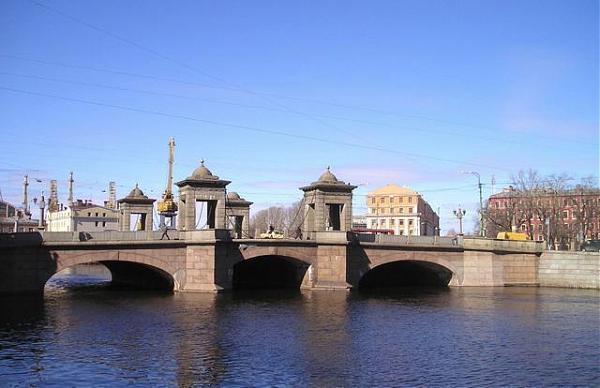


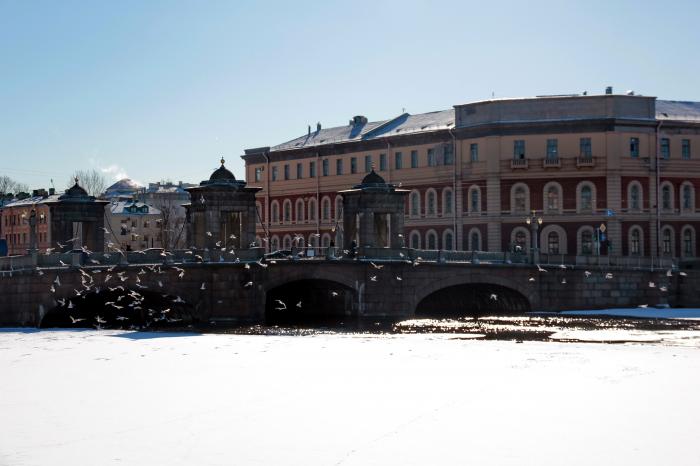
The Staro-Kalinkin Bridge spans the Fontanka River in the alignment of Staro-Peterhof Avenue. It connects Kolomenskoye and Nameless Islands.
The length of the bridge along the rear faces of the abutments is 61.6 meters, the full width is 30.8 meters. This is a stone three—span structure, where the middle span is blocked by a gentle circular arch, and the side ones are stone arches of box outlines.
Four granite towers are made in the form of open gazebos, consisting of weakly rusticated columns of rhombic section. They are crowned with round domes with spherical gilded urns. Memorial plaques marking the start and end dates of construction are installed on the towers.
Railings — metal sections on granite bollards — coincide in pattern with the gratings of the Fontanka River embankment, granite parapets on the postcards.
The bridge got its name from the name of Kalinkina village (a small Finnish village located in these places since the XVII century, the Izhora name is Kaljula or Kallina). The name Kalinkin Bridge was officially assigned to the ferry on August 20, 1739. Then it was called differently: Kalinkovsky (1755), Kalinkinsky (1758-1875), Kalinkin again (1763-1867) and Bolshoy Kalinkin Bridge (1820-1925). Since the 1930s, the ferry was finally renamed Staro-Kalinkin Bridge.
There has been a wooden bridge here since 1733. The length of the bridge reached 250 m . The bridge had a lifting span with overhead structures for opening its canvases in the form of three-span portals with "cranes".
In the 1780s, the construction of the granite embankment of the Fontanka River began, the work was led by engineer-Colonel I.K. Gerard. According to the General Plan for the reconstruction of the Fontanka River, seven bridges were built from 1782 to 1788: Simeonovsky, Anichkov, Chernyshev, Obukhov, Izmailovsky, Semenovsky and, finally, Kalinkin.
The bridges were built according to a standard project, whose creator was the French architect Jean-Rodolphe Perrone. The construction of the Kalinkin Bridge was supervised by engineers I.K. Gerard and P.K. Sukhtelen. Work began in 1786 and was completed in 1788, as evidenced by commemorative plaques on the towers of the bridge. Like other typical bridges on the Fontanka River, Kalinkin Bridge was a three-span stone structure with a wooden double-winged draw span in the center and stone arches on the sides. The bridge supports are stone, lined with granite. Triangular granite ice cutters were built on the supports from below, and four granite towers were built on top, in which lifting mechanisms were located. The bridge was built manually using chains. Sidewalks were separated from the roadway by granite curbs, granite obelisks with lanterns were installed at the entrances to the bridge, and granite benches were installed at the parapets on the bridge's openers.
In 1892-1893, according to the project of architect M.I. Rillo, the bridge was partially reconstructed – it was expanded to 15.2 meters, and the middle wooden lifting part was replaced by a gentle stone arch. Granite towers above the river piers were restored.
In 1907-1908, in connection with the laying of tram tracks on the bridge, its carriageway was expanded with the preservation of granite towers and granite parapets on supports.
In 1965, on the initiative of Lenmosttrest, it was decided to restore the historical appearance of the Old Kalinkin Bridge, to return to it the lost decor. Architect I.N. Benois has developed a restoration project based on archival materials and images of the bridge in painting. Granite parts were returned to the bridge: benches on the parapets of the bridge openings, curbs along the sidewalks and round obelisks at the entrances.
In 1969, metal decorative details were gilded. In 1986-1987, according to the project of architect V.M. Ivanov, lanterns and commemorative plaques on the towers were recreated.
From October 2013 to April 2014, repairs were carried out on the bridge pavement, tram rails and communications.
The Staro-Kalinkin Bridge is the latest bridge across the Fontanka River, accessible to citizens and tourists. Then the Admiralty Shipyards plant begins, on the territory of which the Fontanka River flows into the Gulf of Finland. Traffic flows from Sadovaya Street come to the bridge along the Fontanka River embankment.
en.mostotrest-spb.ru/bridges/staro-kalinkin
The length of the bridge along the rear faces of the abutments is 61.6 meters, the full width is 30.8 meters. This is a stone three—span structure, where the middle span is blocked by a gentle circular arch, and the side ones are stone arches of box outlines.
Four granite towers are made in the form of open gazebos, consisting of weakly rusticated columns of rhombic section. They are crowned with round domes with spherical gilded urns. Memorial plaques marking the start and end dates of construction are installed on the towers.
Railings — metal sections on granite bollards — coincide in pattern with the gratings of the Fontanka River embankment, granite parapets on the postcards.
The bridge got its name from the name of Kalinkina village (a small Finnish village located in these places since the XVII century, the Izhora name is Kaljula or Kallina). The name Kalinkin Bridge was officially assigned to the ferry on August 20, 1739. Then it was called differently: Kalinkovsky (1755), Kalinkinsky (1758-1875), Kalinkin again (1763-1867) and Bolshoy Kalinkin Bridge (1820-1925). Since the 1930s, the ferry was finally renamed Staro-Kalinkin Bridge.
There has been a wooden bridge here since 1733. The length of the bridge reached 250 m . The bridge had a lifting span with overhead structures for opening its canvases in the form of three-span portals with "cranes".
In the 1780s, the construction of the granite embankment of the Fontanka River began, the work was led by engineer-Colonel I.K. Gerard. According to the General Plan for the reconstruction of the Fontanka River, seven bridges were built from 1782 to 1788: Simeonovsky, Anichkov, Chernyshev, Obukhov, Izmailovsky, Semenovsky and, finally, Kalinkin.
The bridges were built according to a standard project, whose creator was the French architect Jean-Rodolphe Perrone. The construction of the Kalinkin Bridge was supervised by engineers I.K. Gerard and P.K. Sukhtelen. Work began in 1786 and was completed in 1788, as evidenced by commemorative plaques on the towers of the bridge. Like other typical bridges on the Fontanka River, Kalinkin Bridge was a three-span stone structure with a wooden double-winged draw span in the center and stone arches on the sides. The bridge supports are stone, lined with granite. Triangular granite ice cutters were built on the supports from below, and four granite towers were built on top, in which lifting mechanisms were located. The bridge was built manually using chains. Sidewalks were separated from the roadway by granite curbs, granite obelisks with lanterns were installed at the entrances to the bridge, and granite benches were installed at the parapets on the bridge's openers.
In 1892-1893, according to the project of architect M.I. Rillo, the bridge was partially reconstructed – it was expanded to 15.2 meters, and the middle wooden lifting part was replaced by a gentle stone arch. Granite towers above the river piers were restored.
In 1907-1908, in connection with the laying of tram tracks on the bridge, its carriageway was expanded with the preservation of granite towers and granite parapets on supports.
In 1965, on the initiative of Lenmosttrest, it was decided to restore the historical appearance of the Old Kalinkin Bridge, to return to it the lost decor. Architect I.N. Benois has developed a restoration project based on archival materials and images of the bridge in painting. Granite parts were returned to the bridge: benches on the parapets of the bridge openings, curbs along the sidewalks and round obelisks at the entrances.
In 1969, metal decorative details were gilded. In 1986-1987, according to the project of architect V.M. Ivanov, lanterns and commemorative plaques on the towers were recreated.
From October 2013 to April 2014, repairs were carried out on the bridge pavement, tram rails and communications.
The Staro-Kalinkin Bridge is the latest bridge across the Fontanka River, accessible to citizens and tourists. Then the Admiralty Shipyards plant begins, on the territory of which the Fontanka River flows into the Gulf of Finland. Traffic flows from Sadovaya Street come to the bridge along the Fontanka River embankment.
en.mostotrest-spb.ru/bridges/staro-kalinkin
Wikipedia article: http://en.wikipedia.org/wiki/Staro-Kalinkin_Bridge
Nearby cities:
Coordinates: 59°54'59"N 30°16'46"E
- Mariinsky Theatre 1.4 km
- Stachek square 1.7 km
- Main building of University of Mines 1.7 km
- Varshavsky Express entertainment centre 1.8 km
- Yusupov Palace on the Fontanka 2 km
- naberezhnaya kanala Griboyedova, 71 2.1 km
- Central Post Office 2.2 km
- Mariinsky palace 2.3 km
- Sennaya square 2.4 km
- House of Tecstiles 2.6 km
- Staro-Peterhofsky prospekt, 6 0.4 km
- Pokrovsky Island 0.7 km
- Construction site 0.7 km
- Admiralty Shipyard (incld. Sudomekh) 0.7 km
- Kolomna Municipal Okrug 0.9 km
- Yekateringofsky Municipal Okrug 0.9 km
- Admiralteysky District 1 km
- Bezymyanny island 3.4 km
- Kirovsky District 5.9 km
- Moskovsky District 10 km