
Vaticano Obelisk, St. Peter's Square (Rome)
Vatican City /
Rome
World
/ Vatican City
/ Vatican City
/ Vatican City
World / Italy / Lazio / Roma
memorial, monument, obelisk
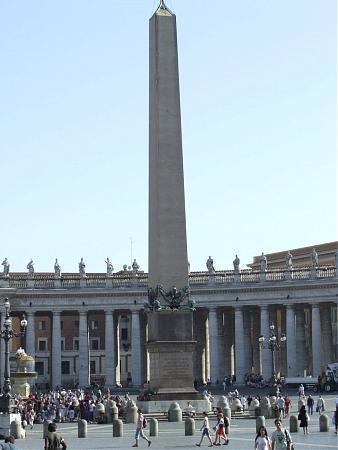
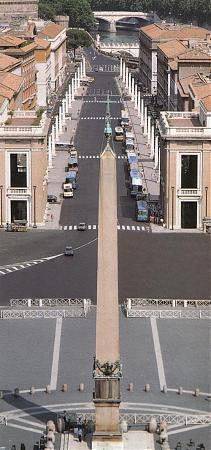
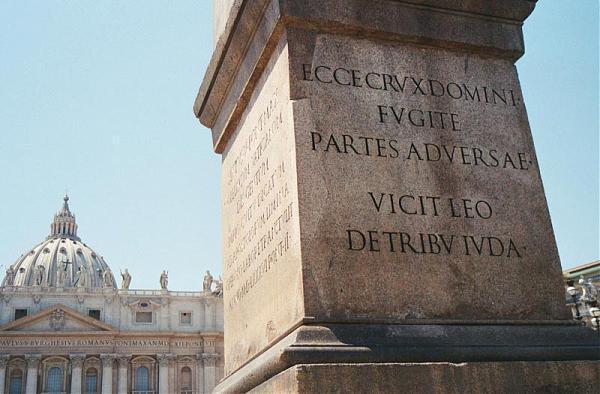
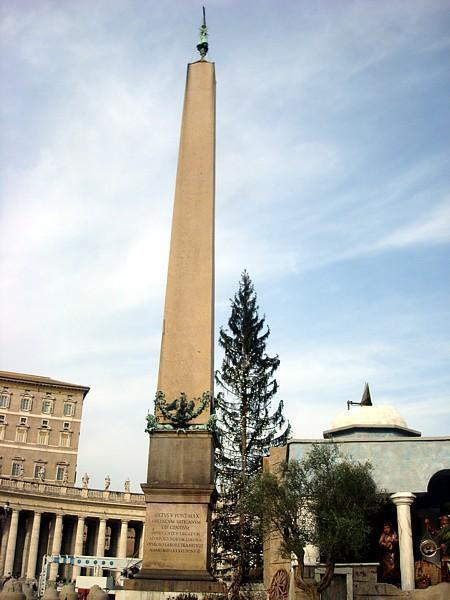
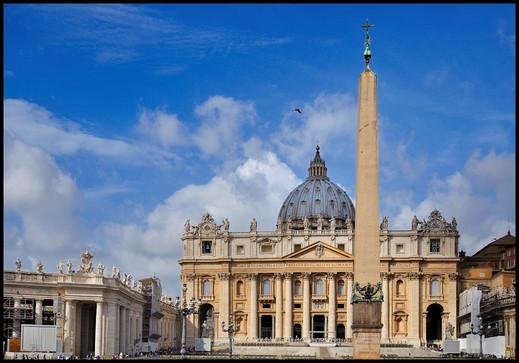
An Egyptian Obelisk from Heliopolis. There are theories why this - like another two, Esquilino and Quirinale - has no hieroglyphs. In 37 AD, Emperor Caligula transported it to Rome, and erected it in the Caligula Circus (later the Nero Circus and then Vatican Circus).
During the Middle Ages, the gilt ball on top of the obelisk was believed to contain the ashes of Julius Caesar. Fontana later removed the ancient metal ball, now in a Rome museum, that stood atop the obelisk and found only dust. Pero Tafur in his Andanças (circa 1440) mentions that many passed between the ground and the "tower" basis "thinking it a saintly thing".
Relocated by Pope Sixtus V in 1586 using a method devised by Domenico Fontana; the first monumental obelisk raised in the modern period, it is the only obelisk in Rome that has not toppled since Roman times. On April 30 of 1586, the operations started - 907 men, 75 horses and 40 cranes were required. The obelisk was raised into position on September 10, and six days later it was placed on the base. On September 26 it was blessed and consecrated.
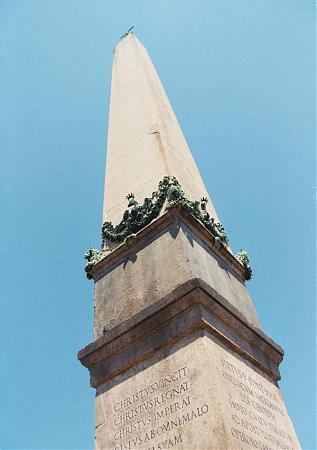
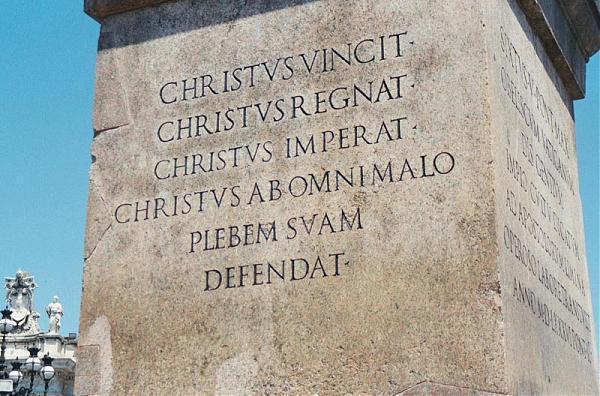
As a pagan monument in the greatest Christian square, it is a symbol of humanity reaching out to Christ. Originally it was inscribed to "Divine Augustus" and "Divine Tiberius" but is now dedicated to the Holy Cross with the inscription "Christus Vincit, Christus Regnat, Christus Imperat. Christus ab omni malo plebem suam defendat."(Christ is the victor, Christ is King, Christ is the ruler, May Christ defend His people from all evil). On The east and west sides are inscribed exorcist formulas. It is topped by a bronze cross.
During the Middle Ages, the gilt ball on top of the obelisk was believed to contain the ashes of Julius Caesar. Fontana later removed the ancient metal ball, now in a Rome museum, that stood atop the obelisk and found only dust. Pero Tafur in his Andanças (circa 1440) mentions that many passed between the ground and the "tower" basis "thinking it a saintly thing".
Relocated by Pope Sixtus V in 1586 using a method devised by Domenico Fontana; the first monumental obelisk raised in the modern period, it is the only obelisk in Rome that has not toppled since Roman times. On April 30 of 1586, the operations started - 907 men, 75 horses and 40 cranes were required. The obelisk was raised into position on September 10, and six days later it was placed on the base. On September 26 it was blessed and consecrated.
As a pagan monument in the greatest Christian square, it is a symbol of humanity reaching out to Christ. Originally it was inscribed to "Divine Augustus" and "Divine Tiberius" but is now dedicated to the Holy Cross with the inscription "Christus Vincit, Christus Regnat, Christus Imperat. Christus ab omni malo plebem suam defendat."(Christ is the victor, Christ is King, Christ is the ruler, May Christ defend His people from all evil). On The east and west sides are inscribed exorcist formulas. It is topped by a bronze cross.
Nearby cities:
Coordinates: 41°54'8"N 12°27'26"E
- Quirinale obelisk (Obelisco del Quirinale e Fontana dei Dioscuri) 2.5 km
- Mussolini Obelisk 3.3 km
- Obelisk of Dogali 3.3 km
- Lateran Obelisk 4.3 km
- Marconi Obelisk 7.7 km
- obelisk 229 km
- Obelisk 664 km
- Obelisk 670 km
- Obelisk to the Bavarians died during Russian campaign of 1812 698 km
- Eternal flame memorial 722 km
- Pontificia Università Urbaniana 0.3 km
- Borgo (rione of Rome) 0.4 km
- Monte del Gallo quarter 0.9 km
- Aurelio 1.2 km
- Gianicolo 1.2 km
- Prati 1.3 km
- Trastevere 1.5 km
- business premis 1.6 km
- Rome historical centre 1.9 km
- Villa Doria Pamphili 2.2 km
Comments