
LLNL Building 391 - Inertial Confinement Fusion Laser Facility (NOVA)
USA /
California /
Livermore /
World
/ USA
/ California
/ Livermore
World / United States / California
science, lab
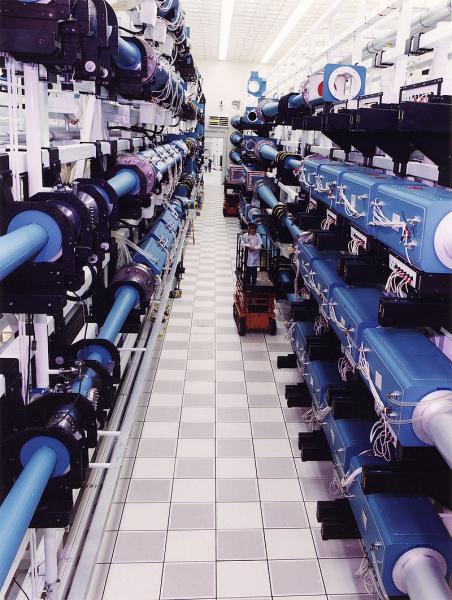
Laser-fusion experiment at Livermore from 1984-1999.
Building 391 is the Inertial Confinement Fusion Laser Facility. The building contains a master oscillator room and film calibration facility; a laser bay and switchyard; a 10-beam target bay; a Nova 2-beam target bay; and Nova power-conditioning and control systems. Radiation and radioactive materials may be encountered in the form of neutrons, X-rays, and possible contamination of the target chamber with tritium.
Building 391, The Inertial Confinement Fusion Laser Facility, is located in the north-central section of the Livermore Site. This 186,594-gross-square-foot building provides laboratories, mechanical utility rooms, and office space for various R&D activities related to lasers. The building houses a variety of support activities for the NIF as well as the stored NOVA components; NOVA operations in Building 391 were terminated in April 1999. The facility has 20 Sea Land containers located to the north of Building 391. There are five groups of four containers stacked two high. The containers are mainly used for storage of parts and equipment. Only one container is used for flammable and corrosive storage. A fenced laydown area on the ground level is between the five groups of containers A number of aboveground tanks are also associated with Building 391 operations. A water purification system is located adjacent to the northwest corner and a standby power generator is located to the north of the facility on the western end. A 500-gallon, double-walled diesel tank supplies the generator. On the northeastern side of the building is a 28,000-gallon liquid nitrogen tank that supplies Building 391 and Building 381 with nitrogen gas.
Major research areas in the facility include beam control and laser diagnostics; laser peening technology; testing and development of cleaning, coating, and diagnostic techniques for large optics; development of fast-streak cameras; operation and testing of flash lamps; testing and assembly of amplifiers; fabrication of submicron-period diffraction gratings for x-rays; use of analytical x-rays; beryllium coating; and performance and reliability of the NIF power conditioning modules.
The primary hazards in Building 391 include fire, hazardous materials, exposure to laser beams and x-rays, high voltage, explosion of components, cryogenic systems, and vacuum and pressure systems.
Because of the many hazards present, Building 391 has several extensive operational and safety controls. These controls include an automatic sprinkler system; electrical equipment designed with shielded cables, connectors, and interlocked housings to prevent inadvertent electrical shock; access to lasers controlled by warning signs, lights, signals, and operational safeguards; engineering and operational safeguards on the vacuum and pressure systems. Operational safety plans are followed for each experiment, and appropriate signs are posted on equipment and access doors.
Building 391 is the Inertial Confinement Fusion Laser Facility. The building contains a master oscillator room and film calibration facility; a laser bay and switchyard; a 10-beam target bay; a Nova 2-beam target bay; and Nova power-conditioning and control systems. Radiation and radioactive materials may be encountered in the form of neutrons, X-rays, and possible contamination of the target chamber with tritium.
Building 391, The Inertial Confinement Fusion Laser Facility, is located in the north-central section of the Livermore Site. This 186,594-gross-square-foot building provides laboratories, mechanical utility rooms, and office space for various R&D activities related to lasers. The building houses a variety of support activities for the NIF as well as the stored NOVA components; NOVA operations in Building 391 were terminated in April 1999. The facility has 20 Sea Land containers located to the north of Building 391. There are five groups of four containers stacked two high. The containers are mainly used for storage of parts and equipment. Only one container is used for flammable and corrosive storage. A fenced laydown area on the ground level is between the five groups of containers A number of aboveground tanks are also associated with Building 391 operations. A water purification system is located adjacent to the northwest corner and a standby power generator is located to the north of the facility on the western end. A 500-gallon, double-walled diesel tank supplies the generator. On the northeastern side of the building is a 28,000-gallon liquid nitrogen tank that supplies Building 391 and Building 381 with nitrogen gas.
Major research areas in the facility include beam control and laser diagnostics; laser peening technology; testing and development of cleaning, coating, and diagnostic techniques for large optics; development of fast-streak cameras; operation and testing of flash lamps; testing and assembly of amplifiers; fabrication of submicron-period diffraction gratings for x-rays; use of analytical x-rays; beryllium coating; and performance and reliability of the NIF power conditioning modules.
The primary hazards in Building 391 include fire, hazardous materials, exposure to laser beams and x-rays, high voltage, explosion of components, cryogenic systems, and vacuum and pressure systems.
Because of the many hazards present, Building 391 has several extensive operational and safety controls. These controls include an automatic sprinkler system; electrical equipment designed with shielded cables, connectors, and interlocked housings to prevent inadvertent electrical shock; access to lasers controlled by warning signs, lights, signals, and operational safeguards; engineering and operational safeguards on the vacuum and pressure systems. Operational safety plans are followed for each experiment, and appropriate signs are posted on equipment and access doors.
Wikipedia article: http://en.wikipedia.org/wiki/Nova_laser
Nearby cities:
Coordinates: 37°41'32"N 121°42'24"W
- Lawrence Livermore National Laboratory/NAS Livermore (site) 1.1 km
- Sandia National Laboratory/Livermore Gunnery Range (site) 1.6 km
- Lawrence Livermore National Laboratory Site 300 12 km
- Lawrence Berkeley National Laboratory 53 km
- SLAC National Accelerator Laboratory 56 km
- SSFL - Test AREA THREE 470 km
- Air Force Propulsion Laboratory 470 km
- SSFL - Test AREA TWO 470 km
- Los Alamos National Laboratory 1381 km
- Kirtland Air Force Base (ABQ/KABQ) 1383 km
- McGrath RentCorp Inc.. 2.2 km
- Beyer Ranch Vineyard (Wente) 3.4 km
- Concannon Vineyard 3.6 km
- Silva Ranch Vineyard (Wente) 4.8 km
- Poppy Ridge Golf Course ( NCGA ) 4.9 km
- Ghielmetti Vineyard (Steven Kent) 5.2 km
- Del Arroyo Vineyards 5.4 km
- Madden Ranch Vineyard 5.6 km
- Golden Hills Wind Farm 6.6 km
- Altamont Pass Wind Farm 8.5 km