
Wreck of USS Ward (DD-139/APD-16)
Philippines /
Eastern Visayas /
Merida /
World
/ Philippines
/ Eastern Visayas
/ Merida
World / Philippines / Leyte / Macarthur
Second World War 1939-1945, military, shipwreck, United States Navy


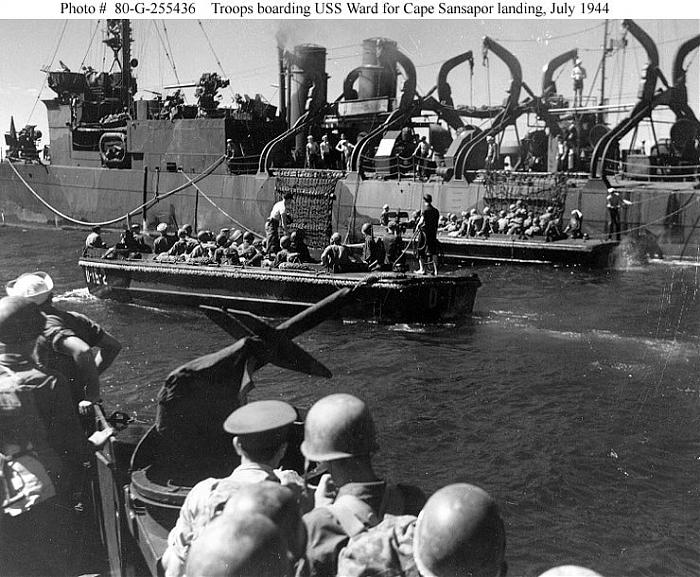


Laid down in May 1917 at the Mare Island Navy Yard as a Wickes Class Destroyer, the USS Ward commissioned into US Navy service as a member of the Pacific Fleet in July 1918. Following her shakedown and training cruises, the Ward and her crew transited the Panama Canal and briefly joined the US Atlantic Fleet in 1919 as part of a US Naval flotilla serving as manned waypoints for a trans-Atlantic crossing being attempted by four US Navy flying boats that summer. After performing her duty, the Ward rejoined the Pacific Fleet in the fall of 1919 and continued her service until her decommissioning into reserve in July 1920.
Gathering war clouds on both the Eastern and Western horizons prompted the US Navy to order the Ward and several of her sisterships recommissioned to bolster US Naval strength, and the Ward officially rejoined the US Pacific Fleet in January 1941 and began Neutrality Patrols around the Hawaiian Islands. On patrol outside the mouth of Pearl Harbor Naval Base at dawn on December 7th, 1941, alert lookouts on the Ward sighted what appeared to be a submarine on the surface just outside the harbor entrance. Flashing a recognition signal to the craft, the Ward’s crew was sent to General Quarters once the sub began to dive beneath the surface. Crewman in her #1 gun turret, located on her bow, were given the order to open fire at 0645hrs and sent the first American shots fired of World War II downrange at the submerging craft. Though their first shot missed, their second shot and one from the Ward’s #3 mount were seen to strike the sub’s conning tower before it disappeared beneath the waves. The Ward’s sonar operators quickly established contact with the undersea threat, allowing her crew to begin depth-charging. After only a few minutes, the crew of the Ward were astonished to see the entire submarine, now clearly a midget submarine, lifted clear of the water’s surface by the blast of her depth charges and crashing back into the water off her Stern. By the time she came about, the Ward had lost sonar contact with the sub, which was assumed to have been sunk in the engagement. The Ward’s Captain quickly relayed his action report ashore, where it was met with some skepticism by US Navy Commanders at Pearl Harbor, as the presence of Japanese Midget Submarines let alone one so far from the nearest Japanese bases seemed laughable. Within two hours and with the US Pacific Fleet in ruins at the hands of Japanese aircraft and at least one other midget submarine, the action report from the Ward was at once deemed credible and overshadowed.
For the Ward’s crew, the action on the morning of December 7th was only the beginning of a frenzied period of deployment, as she was one of the few active surface units available to the US Pacific Fleet in the aftermath of the Pearl Harbor attack. First conducting sweeps of the waters West of Oahu with the Light Cruiser USS Detroit (CL-8) searching for either a Japanese invasion force or the Japanese Carrier force, the Ward and her crew spent much of the next six months engaged in anti-submarine and anti-surface patrols and escorting convoys around the Hawaiian Islands. Duly relieved by an increased number of more modern Destroyers, the Ward and her crew returned stateside and entered the Bremerton Naval Shipyard for a period of overhaul and modernization in mid-1942. As with many of her WWI-era sisterships, the Ward was limited in the amount of modernization which could be undertaken to match the capabilities of the 1941-era Destroyers, so she was ordered to undergo a conversion to an APD, or a High-Speed Amphibious Transport, which would allow her to transport up to a Company sized unit of troops at the expense of two of her boilers and her torpedo tubes. Fully converted and given the hull designation APD-16, the Ward and her crew put to sea for trials in February 1943 and by April she was at the US base at Espiritu Santo in the Solomon Islands, preparing for her first assignment.
Conducting her first Amphibious assault on December 26th, 1943, the Ward and her crew put elements of the 3d Battalion, 7th Marine Regiment ashore at Cape Gloucester, New Britain, then stood off the beaches and provided shore-fire support and anti-aircraft defense for the landing force and troops ashore until early January 1944. The Ward and her crew would eventually repeat their actions at Cape Gloucester at Saidor, Nissan Island, Emirau, Aitape, Biak, Cape Sansapor and Morotai in the New Guinea Theatre through September 1944. After only a brief period of upkeep and liberty for her crew at Manaus, the Ward departed the South Pacific and made for the Philippine Islands as part of the massive US armada bound for Leyte Gulf, arriving in her new theatre of operations in early October 1944. Conducting amphibious landings at Dinagat Island on October 17th as part of the opening phases of the Letye Landings, the Ward put her load of troops ashore then withdrew to screen vital convoys of arms, stores and supplies into and out of the Philippine archipelago and Leyte area for the next month and a half, pausing only to ferry reinforcement troops to the Leyte beachhead.
In concert with the advance of US forces into the Philippine Islands, the Ward shifted her operations Northward from Leyte and after loading men from the Army's 77th Division stood out in convoy for Ormoc Bay on December 6th, 1944. Putting her load of troops into her landing craft at 0445hrs on December 7th, 1944, the Ward’s crew maintained a sharp lookout for the inevitable arrival of Japanese Kamikaze aircraft, a threat they had grown regrettably accustomed to during her Philippine operations. With her troops ashore by 0600hrs, the Ward ended her role in the amphibious landings and took up a defensive anti-aircraft screen over the landing area, waiting only two hours before the first enemy aircraft appeared in the sky approaching from the South at 0825hrs. Quickly identified as a formation of ‘Betty’ twin-engine bombers, the Ward began evasive maneuvers and her crew opened up with her AA armament as the planes drew close. Engaged in a pitched firefight for almost two more hours, the Ward’s crew watched a formation of nine bombers attack and heavily damage the USS Mahan (DD-364) to her South before they loosely reformed and headed straight for the Ward. Engaging the closest three of her attackers, the Ward and her crew threw everything they had at the approaching aircraft, splashing two fore and aft of the ship. The center aircraft was also taken under concentrated fire from the Ward’s AA batteries and within moments was aflame and diving towards the water, however her pilot made a determined effort to keep his plane aloft and aimed it straight for the Ward, successfully impacting her directly amidships at her Starboard waterline and punching through her hull before exploding in her troop compartment at 0946hrs.
The disintegrating aircraft showered the Ward’s internal spaces and deck in burning aviation fuel before one of the planes engines punched through the Ward’s Port side, leaving the ship heavily damaged and aflame. The Ward’s crew kept up their fire on the remaining aircraft overhead as they withdrew from the area, and by 0957 the cease fire was issued and all crew began damage control efforts on the wounded ship. Heavy black smoke poured from the Ward’s troop compartment and within minutes the damaged bulkhead between the troop compartment and her forward boiler room failed, forcing her engineers to abandon their posts and robbing the ship of headway. As she wallowed to a halt, the Ward’s crew lowered her landing craft and attempted to use the craft to fight the fires through the holes punched in her hull, but rapidly falling water pressure and severed communication lines between her bridge and Stern frustrated their efforts. By 1018hrs the order was passed for all non-essential crew to abandon ship as the flames closed in on the Ward’s diesel fuel stores and her 20mm ready ammunition, threatening to cause a massive explosion. Following a low order detonation and the imminent failure of another bulkhead holding back the Ward’s fuel oil, her Captain passed the order to abandon ship at 1024hrs. By 1045hrs the Ward was set adrift, with her entire compliment now aboard nearby ships assisting in firefighting efforts from a distance. At roughly 1100hrs the flames aboard increased in intensity and began cooking off ammunition aboard the Ward, prompting the order from the Commander of Task Group 78.3 to order the ship sunk as a hazard to navigation.
The Destroyer USS O'Brien (DD-725) drew the duty of sending the Veteran Ward to the bottom and commenced firing on the burning vessel until she began to roll onto her Starboard side. With her entire crew, many of whom were aboard ship on December 7th, 1941 when the Ward opened the Second World War, watching from other ships, the USS Ward sank Stern-first at this location at 1130hrs on December 7th, 1944, three years to the day after her war began.
For her service in the Second World War, USS Ward received one Battle Star for her work as a Destroyer and eight Battle Stars as a Fast Amphibious Transport.
www.navsource.org/archives/05/139.htm
www.navsource.org/archives/10/04/04016.htm
Gathering war clouds on both the Eastern and Western horizons prompted the US Navy to order the Ward and several of her sisterships recommissioned to bolster US Naval strength, and the Ward officially rejoined the US Pacific Fleet in January 1941 and began Neutrality Patrols around the Hawaiian Islands. On patrol outside the mouth of Pearl Harbor Naval Base at dawn on December 7th, 1941, alert lookouts on the Ward sighted what appeared to be a submarine on the surface just outside the harbor entrance. Flashing a recognition signal to the craft, the Ward’s crew was sent to General Quarters once the sub began to dive beneath the surface. Crewman in her #1 gun turret, located on her bow, were given the order to open fire at 0645hrs and sent the first American shots fired of World War II downrange at the submerging craft. Though their first shot missed, their second shot and one from the Ward’s #3 mount were seen to strike the sub’s conning tower before it disappeared beneath the waves. The Ward’s sonar operators quickly established contact with the undersea threat, allowing her crew to begin depth-charging. After only a few minutes, the crew of the Ward were astonished to see the entire submarine, now clearly a midget submarine, lifted clear of the water’s surface by the blast of her depth charges and crashing back into the water off her Stern. By the time she came about, the Ward had lost sonar contact with the sub, which was assumed to have been sunk in the engagement. The Ward’s Captain quickly relayed his action report ashore, where it was met with some skepticism by US Navy Commanders at Pearl Harbor, as the presence of Japanese Midget Submarines let alone one so far from the nearest Japanese bases seemed laughable. Within two hours and with the US Pacific Fleet in ruins at the hands of Japanese aircraft and at least one other midget submarine, the action report from the Ward was at once deemed credible and overshadowed.
For the Ward’s crew, the action on the morning of December 7th was only the beginning of a frenzied period of deployment, as she was one of the few active surface units available to the US Pacific Fleet in the aftermath of the Pearl Harbor attack. First conducting sweeps of the waters West of Oahu with the Light Cruiser USS Detroit (CL-8) searching for either a Japanese invasion force or the Japanese Carrier force, the Ward and her crew spent much of the next six months engaged in anti-submarine and anti-surface patrols and escorting convoys around the Hawaiian Islands. Duly relieved by an increased number of more modern Destroyers, the Ward and her crew returned stateside and entered the Bremerton Naval Shipyard for a period of overhaul and modernization in mid-1942. As with many of her WWI-era sisterships, the Ward was limited in the amount of modernization which could be undertaken to match the capabilities of the 1941-era Destroyers, so she was ordered to undergo a conversion to an APD, or a High-Speed Amphibious Transport, which would allow her to transport up to a Company sized unit of troops at the expense of two of her boilers and her torpedo tubes. Fully converted and given the hull designation APD-16, the Ward and her crew put to sea for trials in February 1943 and by April she was at the US base at Espiritu Santo in the Solomon Islands, preparing for her first assignment.
Conducting her first Amphibious assault on December 26th, 1943, the Ward and her crew put elements of the 3d Battalion, 7th Marine Regiment ashore at Cape Gloucester, New Britain, then stood off the beaches and provided shore-fire support and anti-aircraft defense for the landing force and troops ashore until early January 1944. The Ward and her crew would eventually repeat their actions at Cape Gloucester at Saidor, Nissan Island, Emirau, Aitape, Biak, Cape Sansapor and Morotai in the New Guinea Theatre through September 1944. After only a brief period of upkeep and liberty for her crew at Manaus, the Ward departed the South Pacific and made for the Philippine Islands as part of the massive US armada bound for Leyte Gulf, arriving in her new theatre of operations in early October 1944. Conducting amphibious landings at Dinagat Island on October 17th as part of the opening phases of the Letye Landings, the Ward put her load of troops ashore then withdrew to screen vital convoys of arms, stores and supplies into and out of the Philippine archipelago and Leyte area for the next month and a half, pausing only to ferry reinforcement troops to the Leyte beachhead.
In concert with the advance of US forces into the Philippine Islands, the Ward shifted her operations Northward from Leyte and after loading men from the Army's 77th Division stood out in convoy for Ormoc Bay on December 6th, 1944. Putting her load of troops into her landing craft at 0445hrs on December 7th, 1944, the Ward’s crew maintained a sharp lookout for the inevitable arrival of Japanese Kamikaze aircraft, a threat they had grown regrettably accustomed to during her Philippine operations. With her troops ashore by 0600hrs, the Ward ended her role in the amphibious landings and took up a defensive anti-aircraft screen over the landing area, waiting only two hours before the first enemy aircraft appeared in the sky approaching from the South at 0825hrs. Quickly identified as a formation of ‘Betty’ twin-engine bombers, the Ward began evasive maneuvers and her crew opened up with her AA armament as the planes drew close. Engaged in a pitched firefight for almost two more hours, the Ward’s crew watched a formation of nine bombers attack and heavily damage the USS Mahan (DD-364) to her South before they loosely reformed and headed straight for the Ward. Engaging the closest three of her attackers, the Ward and her crew threw everything they had at the approaching aircraft, splashing two fore and aft of the ship. The center aircraft was also taken under concentrated fire from the Ward’s AA batteries and within moments was aflame and diving towards the water, however her pilot made a determined effort to keep his plane aloft and aimed it straight for the Ward, successfully impacting her directly amidships at her Starboard waterline and punching through her hull before exploding in her troop compartment at 0946hrs.
The disintegrating aircraft showered the Ward’s internal spaces and deck in burning aviation fuel before one of the planes engines punched through the Ward’s Port side, leaving the ship heavily damaged and aflame. The Ward’s crew kept up their fire on the remaining aircraft overhead as they withdrew from the area, and by 0957 the cease fire was issued and all crew began damage control efforts on the wounded ship. Heavy black smoke poured from the Ward’s troop compartment and within minutes the damaged bulkhead between the troop compartment and her forward boiler room failed, forcing her engineers to abandon their posts and robbing the ship of headway. As she wallowed to a halt, the Ward’s crew lowered her landing craft and attempted to use the craft to fight the fires through the holes punched in her hull, but rapidly falling water pressure and severed communication lines between her bridge and Stern frustrated their efforts. By 1018hrs the order was passed for all non-essential crew to abandon ship as the flames closed in on the Ward’s diesel fuel stores and her 20mm ready ammunition, threatening to cause a massive explosion. Following a low order detonation and the imminent failure of another bulkhead holding back the Ward’s fuel oil, her Captain passed the order to abandon ship at 1024hrs. By 1045hrs the Ward was set adrift, with her entire compliment now aboard nearby ships assisting in firefighting efforts from a distance. At roughly 1100hrs the flames aboard increased in intensity and began cooking off ammunition aboard the Ward, prompting the order from the Commander of Task Group 78.3 to order the ship sunk as a hazard to navigation.
The Destroyer USS O'Brien (DD-725) drew the duty of sending the Veteran Ward to the bottom and commenced firing on the burning vessel until she began to roll onto her Starboard side. With her entire crew, many of whom were aboard ship on December 7th, 1941 when the Ward opened the Second World War, watching from other ships, the USS Ward sank Stern-first at this location at 1130hrs on December 7th, 1944, three years to the day after her war began.
For her service in the Second World War, USS Ward received one Battle Star for her work as a Destroyer and eight Battle Stars as a Fast Amphibious Transport.
www.navsource.org/archives/05/139.htm
www.navsource.org/archives/10/04/04016.htm
Wikipedia article: http://en.wikipedia.org/wiki/USS_Ward
Nearby cities:
Coordinates: 10°50'58"N 124°33'0"E
- Mactan Benito Ebuen Airbase 87 km
- Battle of Leyte Gulf 99 km
- Wreck of USS St. Lo (CVE-63) 172 km
- Lumbia Airfield (CGY/RPML) 270 km
- Wreck of HIJMS I-45 309 km
- Wreck of USS Eversole (DE-404) 327 km
- Pitu Airbase 1064 km
- lopak sikol (perkebunan moyag) 1134 km
- Peleliu (Beliliou) Island 1144 km
- Death Valley and Bloody Nose Ridge 1146 km
- Wrecks of HIJMS Hamanami, HIJMS Naganami, HIJMS Shimakaze & HIJMS Wakatsuki 2.2 km
- Mahalit, Merida 4.9 km
- Tubod Seventh-day Adventist Church! To Hon. Edgar Bandal & Family 8.8 km
- Ormoc Bay 12 km
- Brgy. Bantigue, Ormoc City 18 km
- Brgy. Ipil, Ormoc City, 18 km
- Camp Downes 18 km
- Brgy. Can-Adieng 19 km
- Ormoc City Proper 19 km
- Cebu 86 km