
Project Gnome test site
USA /
New Mexico /
Loving /
World
/ USA
/ New Mexico
/ Loving
World / United States / New Mexico
nuclear testing area
Add category

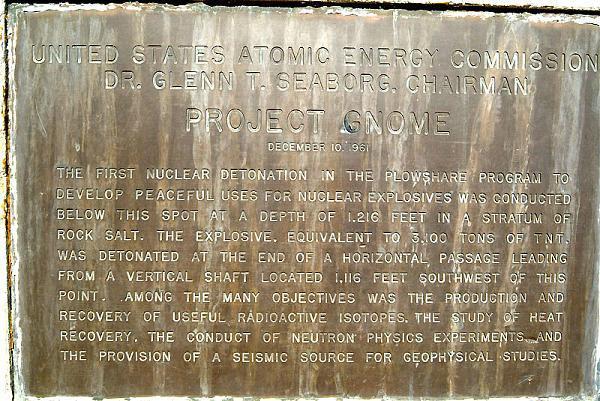
The Project GNOME detonation on December 10, 1961 near Carlsbad, New Mexico was the first nuclear test with the objective of developing nuclear explosives for peaceful applications. Along with expanding the data on an underground nuclear detonation in a salt medium, the primary objectives were to: Study the possibility of converting the heat produced by a nuclear explosion into steam for the production of electric power, Explore the feasibility of recovering radioisotopes for the scientific and industrial applications, and Use the high flux of neutrons produced by the detonation for a variety of measurements that would contribute to scientific knowledge in general and to the reactor development program in particular.
GNOME was detonated at noon local time, December 10, 1961, with a yield of 3.1 kilotons. Although it had been planned as a contained explosion, GNOME vented to the atmosphere. A cloud of steam started to appear at the top of the shaft 2 to 3 minutes after the detonation. Gray smoke, steam, and associated radioactivity emanated from the shaft opening about 7 minutes after detonation. Radioactive materials vented to the atmosphere about 340 meters southwest of ground zero. Within 11 minutes after shot-time, both the shaft and the ventilation lines were issuing large quantities of steam. During the next 30 minutes, the large flow continued and then began to decrease gradually. The highest measured onsite gamma intensity was 1 R/h. This intensity was recorded 1,300 meters northwest of the shaft opening at 7:38pm on shot-day. The highest offsite reading was 1.4 R/h, encountered along Highway 128 one hour after detonation.The surface radioactivity resulting from the escape of steam decayed rapidly. On the following day, a small flow of steam was still detectable. Underground recovery operations began six days after the detonation. These operations were delayed, in part because of the high radiation levels at the shaft opening (for example, 5 R/h at 9:08am the next morning).
When workers reentered that cavity on May 17, 1962, they found temperatures around 140 degrees Fahrenheit but only small amounts of residual radiation. The earlier intense radiation had colored the salt of the cavity wall various shades of blue, green, and violet. ( www.atomictourist.com/gnome.htm )
GNOME was detonated at noon local time, December 10, 1961, with a yield of 3.1 kilotons. Although it had been planned as a contained explosion, GNOME vented to the atmosphere. A cloud of steam started to appear at the top of the shaft 2 to 3 minutes after the detonation. Gray smoke, steam, and associated radioactivity emanated from the shaft opening about 7 minutes after detonation. Radioactive materials vented to the atmosphere about 340 meters southwest of ground zero. Within 11 minutes after shot-time, both the shaft and the ventilation lines were issuing large quantities of steam. During the next 30 minutes, the large flow continued and then began to decrease gradually. The highest measured onsite gamma intensity was 1 R/h. This intensity was recorded 1,300 meters northwest of the shaft opening at 7:38pm on shot-day. The highest offsite reading was 1.4 R/h, encountered along Highway 128 one hour after detonation.The surface radioactivity resulting from the escape of steam decayed rapidly. On the following day, a small flow of steam was still detectable. Underground recovery operations began six days after the detonation. These operations were delayed, in part because of the high radiation levels at the shaft opening (for example, 5 R/h at 9:08am the next morning).
When workers reentered that cavity on May 17, 1962, they found temperatures around 140 degrees Fahrenheit but only small amounts of residual radiation. The earlier intense radiation had colored the salt of the cavity wall various shades of blue, green, and violet. ( www.atomictourist.com/gnome.htm )
Wikipedia article: http://en.wikipedia.org/wiki/Project_Gnome
Nearby cities:
Coordinates: 32°15'45"N 103°51'55"W
- Area 27 1234 km
- Area 7 1238 km
- Yucca Flat 1246 km
- Nuclear Rocket Development Site 1249 km
- Pahute Mesa 1290 km
- Nevada National Security Site 1293 km
- Rocketdyne Santa Susana Field Laboratory (SSFL) 1399 km
- Dawson Forest - a.k.a. Georgia's Area 51 1841 km
- Johnston Atoll 6771 km
- Former French nuclear testing sites of Reggane 9639 km
- Intrepid Potash 14 km
- Intrepid Potash Plant 27 km
- Battle Axe Substation 30 km
- Red Bluff Lake 35 km
- Intrepid Potash Mines 39 km
- National Enrichment Facility 76 km
- Waste Control Specialists 79 km
- Industrial Airpark/ Hobbs Army Airfield 84 km
- Notrees Wind Farm 103 km
- Shafter Lake (dry) 115 km
Comments