
Weapons Storage Area
United Kingdom /
England /
Somerton /
World
/ United Kingdom
/ England
/ Somerton
World / United Kingdom / England
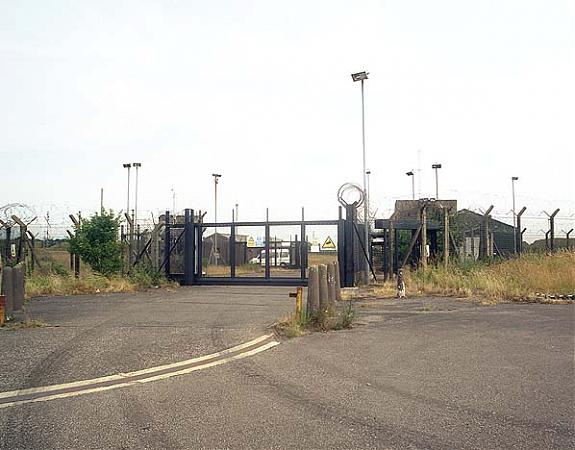
This is the extra secure area where nuclear weapons were stored.
One of the two bomb stores which had housed nuclear weapons. These were located in secure compounds overlooked by octagonal guard towers. They are both used as fireworks stores. They consisted of several parallel rows of large earth/grass mounded magazines. The magazines, commonly known as "igloos", comprised of a rectangular reinforced concrete box, 80' X 22', covered in earth. Entry was through a pair of sliding blast-proof steel doors, often shielded by a detached concrete and earth revetment on the opposite side of the access road. Internally the igloos were featureless except for a large lifting hook set in the ceiling, safety lighting and heating. They offered flexible storage space and could easily accommodate the USAF Strategic Air Command's largest weapon, the Mark 17 hydrogen bomb which was 7.6 metres in length. There were initially 27 igloos but more were added later.
Within each group, one igloo contained an internal reinforced concrete vault with a safe-like door. The vault may have been intended to house separate capsules that contained the fission elements of many 1950s US atomic weapons, which were inserted into the weapon only during times of war. The capsule store at Heyford was unique being a double storey concrete structure with blind metal framed windows designed to give the impression of an insignificant structure.
One of the two bomb stores which had housed nuclear weapons. These were located in secure compounds overlooked by octagonal guard towers. They are both used as fireworks stores. They consisted of several parallel rows of large earth/grass mounded magazines. The magazines, commonly known as "igloos", comprised of a rectangular reinforced concrete box, 80' X 22', covered in earth. Entry was through a pair of sliding blast-proof steel doors, often shielded by a detached concrete and earth revetment on the opposite side of the access road. Internally the igloos were featureless except for a large lifting hook set in the ceiling, safety lighting and heating. They offered flexible storage space and could easily accommodate the USAF Strategic Air Command's largest weapon, the Mark 17 hydrogen bomb which was 7.6 metres in length. There were initially 27 igloos but more were added later.
Within each group, one igloo contained an internal reinforced concrete vault with a safe-like door. The vault may have been intended to house separate capsules that contained the fission elements of many 1950s US atomic weapons, which were inserted into the weapon only during times of war. The capsule store at Heyford was unique being a double storey concrete structure with blind metal framed windows designed to give the impression of an insignificant structure.
Nearby cities:
Coordinates: 51°56'32"N 1°14'42"W
- Munitions Storage Area 0.1 km
- 79th TFS area 0.8 km
- Car storage 0.9 km
- former Officer Housing 1.3 km
- Enlisted Housing Area 1.9 km
- Baseball Pitches 2.1 km
- Various Use Buildings 2.3 km
- Grand Avenue 13 km
- Battle Plantations 14 km
- Pine Field 14 km
- RAF Weston-on-the-Green 7.3 km
- Kirtlington Park 7.9 km
- Bletchingdon Park 9 km
- Glympton House 11 km
- Oxford Cement Works Limestone Quarry 11 km
- Kiddington Hall 12 km
- London Oxford Airport (IATA: OXF, ICAO: EGTK) 13 km
- Out Wood 13 km
- Blenheim Palace 14 km
- The Lake 14 km