
Frank Lloyd Wright design (Gary, Indiana)
USA /
Indiana /
Gary /
Gary, Indiana /
Van Buren Street, 669
World
/ USA
/ Indiana
/ Gary
World / United States / Indiana
residence, Frank Lloyd Wright (architect)
www.chameyer.net/669vanburen.html
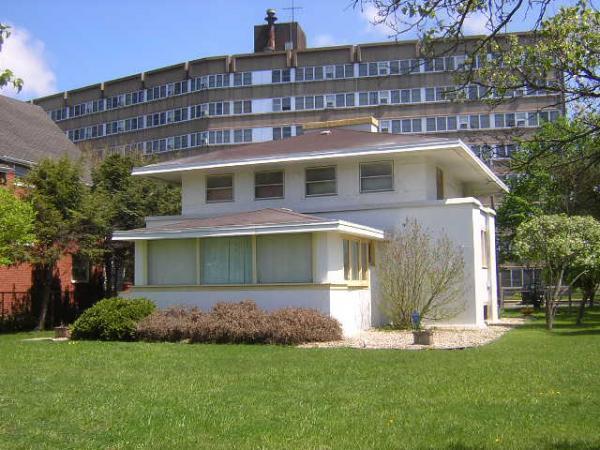
On the northeast corner of Seventh Avenue and Van Buren Street sits a long overlooked Frank LLoyd Wright design. 669 Van Buren, as viewed by its initial appearance on a 1911 Sanborn Fire Insurance Map, is identified as being constructed between 1909 and 1910. This Wright design was sold to Mr. Ingwald Moe and built by his contracting company, General Construction Company.
Before relocating to Gary, Ingwald Moe ran his construction firm out of a downtown Chicago Loop location. Moe likely moved his business to Gary, "America's New Industrial City," to compete for a share of growing construction jobs. Moreover, Moe selected a Wright design for his private residence to illustrate an alternative from prevailing architectural styles as well as to reflect his social status as a successful contractor in both Gary and Chicago. With the construction of 669 Van Buren, Moe initiated what would become almost a decade long professional association with Wright. Seven years later, in 1916, Moe became the unique local representative for the American System-Built scheme of housing, a Wright and Richards Company venture.
669 Van Buren is a precise realization of what Frank LLoyd Wright originally designed for the 1905 Charles Brown residence, located in Evanston, Illinois. The Moe and Brown houses are identical, both having matching scale, massing, and floor layouts. The Moe House differs in that its first floor possesses an exterior stucco application in comparison to the Brown House having wooden board and batten clapboard. The Brown House is noted in Henry-Russell Hitchcock 's In the Nature of Materials as being the "Evanston Model Home." From Hitchcock's citation, one can conclude that this design was the prototype of a projected Prairie style tract development or subdivision. Both the Brown and Moe residences are not the first embodiments of this Wright archetype. A forerunner to both of these designs can be seen in a Wright study for a residential development for E.C. Waller, see plate XLVIII (a) of Ausgeführte Bauten und Entwürfe von Frank Lloyd Wright. The first design on this plate is the initial appearance of this archetype in Wright's oeuvre. This design is characterized as being a two-story single family residence possessing a hipped roof with projecting eaves, front veranda, second story balconettes, double hung windows, and a subtle cruciform layout. For the Brown and Moe houses, Wright shortened the front veranda, making its roof cantilevered, and rotated the main roof 90 degrees. Wright even continued to evolve this design archetype in his designs for the Ingalls and Ziegler residences.
On the northeast corner of Seventh Avenue and Van Buren Street sits a long overlooked Frank LLoyd Wright design. 669 Van Buren, as viewed by its initial appearance on a 1911 Sanborn Fire Insurance Map, is identified as being constructed between 1909 and 1910. This Wright design was sold to Mr. Ingwald Moe and built by his contracting company, General Construction Company.
Before relocating to Gary, Ingwald Moe ran his construction firm out of a downtown Chicago Loop location. Moe likely moved his business to Gary, "America's New Industrial City," to compete for a share of growing construction jobs. Moreover, Moe selected a Wright design for his private residence to illustrate an alternative from prevailing architectural styles as well as to reflect his social status as a successful contractor in both Gary and Chicago. With the construction of 669 Van Buren, Moe initiated what would become almost a decade long professional association with Wright. Seven years later, in 1916, Moe became the unique local representative for the American System-Built scheme of housing, a Wright and Richards Company venture.
669 Van Buren is a precise realization of what Frank LLoyd Wright originally designed for the 1905 Charles Brown residence, located in Evanston, Illinois. The Moe and Brown houses are identical, both having matching scale, massing, and floor layouts. The Moe House differs in that its first floor possesses an exterior stucco application in comparison to the Brown House having wooden board and batten clapboard. The Brown House is noted in Henry-Russell Hitchcock 's In the Nature of Materials as being the "Evanston Model Home." From Hitchcock's citation, one can conclude that this design was the prototype of a projected Prairie style tract development or subdivision. Both the Brown and Moe residences are not the first embodiments of this Wright archetype. A forerunner to both of these designs can be seen in a Wright study for a residential development for E.C. Waller, see plate XLVIII (a) of Ausgeführte Bauten und Entwürfe von Frank Lloyd Wright. The first design on this plate is the initial appearance of this archetype in Wright's oeuvre. This design is characterized as being a two-story single family residence possessing a hipped roof with projecting eaves, front veranda, second story balconettes, double hung windows, and a subtle cruciform layout. For the Brown and Moe houses, Wright shortened the front veranda, making its roof cantilevered, and rotated the main roof 90 degrees. Wright even continued to evolve this design archetype in his designs for the Ingalls and Ziegler residences.
Nearby cities:
Coordinates: 41°35'54"N 87°20'44"W
- Historic Bishop's Residence 0.6 km
- 2675-2683 Waverly Drive 2 km
- 2600-2614 West 6th Avenue 2 km
- 2714-2722 West 6th Avenue 2.1 km
- 2616-2624 West 6th Avenue 2.1 km
- 2638-2646 West 6th Avenue 2.1 km
- 2732-2746 West 6th Avenue 2.2 km
- Little Red School House 10 km
- 3501-3527 Main Street 10 km
- 3516 Main Street 10 km
- Downtown West 0.5 km
- Lincoln Street Residential District 0.6 km
- Horace Mann 1.7 km
- Emerson 1.7 km
- Midtown 1.9 km
- Ambridge 2.4 km
- U.S. Steel Gary Works 2.6 km
- Tolleston 2.9 km
- Pulaski 3.4 km
- Lake County, Indiana 15 km