
Piazza del Popolo (Rome)
Vatican City /
Rome /
Piazza del Popolo
World
/ Vatican City
/ Vatican City
/ Vatican City
World / Italy / Lazio / Roma
square, monument, architecture - Do not use this category, interesting place

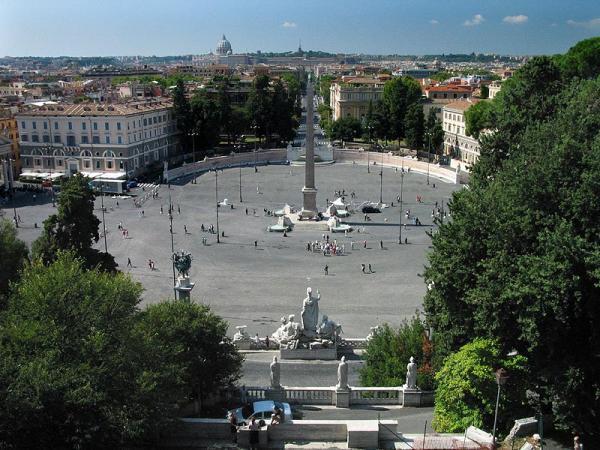


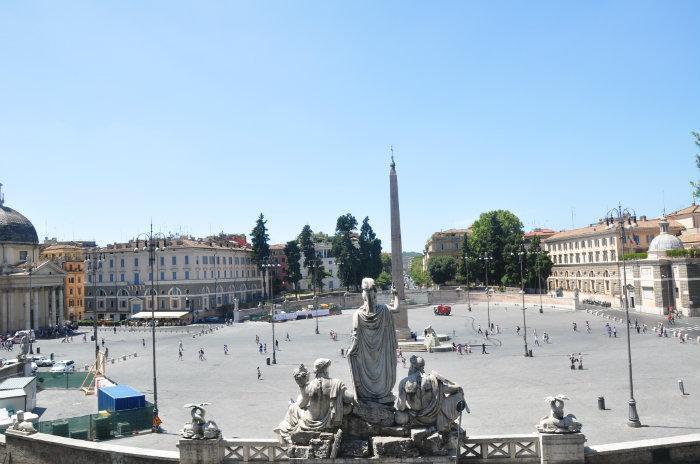
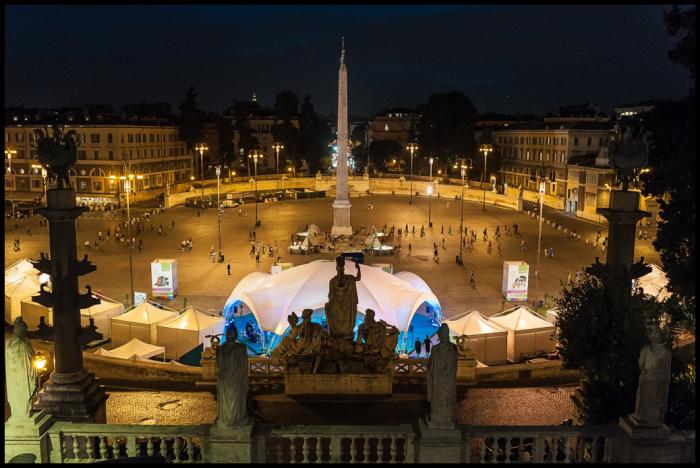
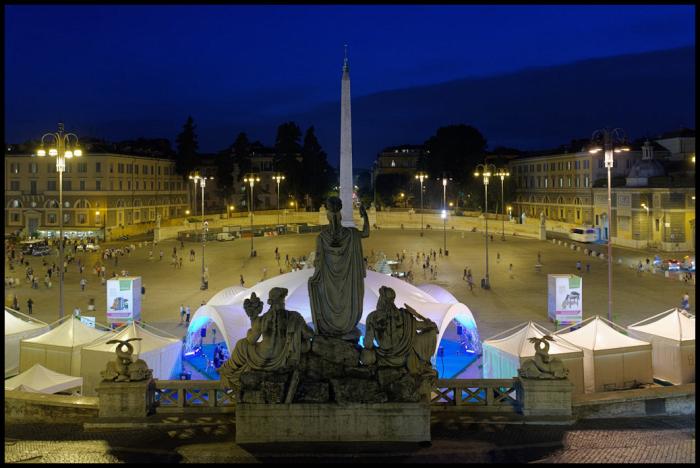
The Piazza lies inside the northern gate in the Aurelian Walls, once the Porta Flaminia of ancient Rome, and now called Porta del Popolo. This was the starting point of the Via Flaminia, the road to Ariminum (modern Rimini) and the most important route to the north. At the same time, before the age of railroads, it was the traveller's first view of Rome upon arrival. For centuries, the Piazza del Popolo was a place for public executions, the last of which took place in 1826.
The layout of the piazza today was designed in neoclassical style between 1811 and 1822 by the architect Giuseppe Valadier,[1] who demolished some insignificant buildings and haphazard high screening walls to form two semicircles, reminiscent of Bernini's plan for St. Peter's Square, replacing the original cramped trapezoidal square centred on the Via Flaminia. Valadier's Piazza del Popolo, however, incorporated the verdure of trees as an essential element; he conceived his space in a third dimension, expressed in the building of the viale that leads up to the balustraded overlook from the Pincio.
The fountains by Giovanni Ceccarini (1822-23), with matching compositions of a central figure flanked by two attendant figures, stand on each side of the Piazza to the east and west, flanked by neoclassical statues of The Seasons (1828). Neptune with two Tritons,stands on the west side, Neptune with his trident is accompanied by two dolphins. Rome between the Tiber and the Aniene on the east side, against the steep slope of the Pincio, represents the terminal mostra of the aqueduct. Dea Roma armed with lance and helmet, and in front is the she-wolf feeding Romulus and Remus.
The layout of the piazza today was designed in neoclassical style between 1811 and 1822 by the architect Giuseppe Valadier,[1] who demolished some insignificant buildings and haphazard high screening walls to form two semicircles, reminiscent of Bernini's plan for St. Peter's Square, replacing the original cramped trapezoidal square centred on the Via Flaminia. Valadier's Piazza del Popolo, however, incorporated the verdure of trees as an essential element; he conceived his space in a third dimension, expressed in the building of the viale that leads up to the balustraded overlook from the Pincio.
The fountains by Giovanni Ceccarini (1822-23), with matching compositions of a central figure flanked by two attendant figures, stand on each side of the Piazza to the east and west, flanked by neoclassical statues of The Seasons (1828). Neptune with two Tritons,stands on the west side, Neptune with his trident is accompanied by two dolphins. Rome between the Tiber and the Aniene on the east side, against the steep slope of the Pincio, represents the terminal mostra of the aqueduct. Dea Roma armed with lance and helmet, and in front is the she-wolf feeding Romulus and Remus.
Wikipedia article: http://en.wikipedia.org/wiki/Piazza_del_Popolo
Nearby cities:
Coordinates: 41°54'38"N 12°28'34"E
- Piazzale Flaminio 0.3 km
- Piazza di Spagna 0.6 km
- Piazza Cavour 0.8 km
- Piazza Giuseppe Mazzini 1.3 km
- Saepta Julia 1.3 km
- Saint Peter's Square 1.9 km
- Piazza del Colosseo 2.5 km
- Piazza Vittorio Emanuele II 2.7 km
- Piazzale San Giovanni in Laterano 3.5 km
- Piazza Guglielmo Marconi 8.5 km
- Campo Marzio IV 0.5 km
- Villa Borghese Park 0.7 km
- Rome historical centre 0.9 km
- Colonna 1.1 km
- Gardens of Mole Adriana 1.1 km
- Ponte 1.3 km
- Borgo (rione of Rome) 1.5 km
- Prati 1.6 km
- Municipio II 2.1 km
- Aurelio 3 km