
Buonconsiglio Castle (Trento)
Italy /
Trentino-Alto Adige /
Trento
World
/ Italy
/ Trentino-Alto Adige
/ Trento
World / Italy / Trentino-Alto Adige / Trento
tower, castle, museum


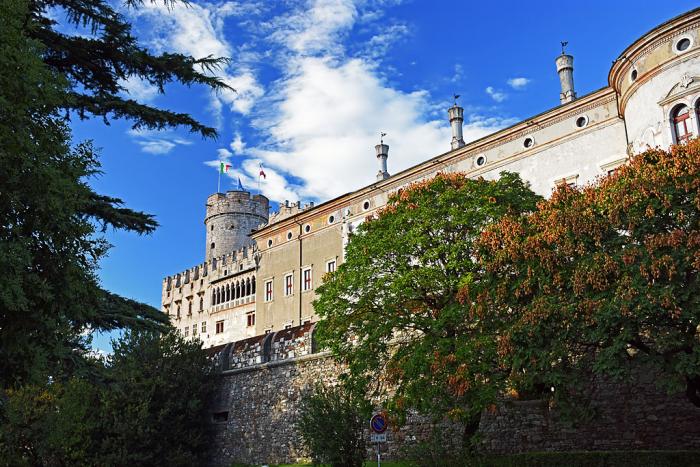
Castelvecchio - Magno Palazzo - Aquila Tower - Giunta Albertiana - Garden
Buonconsiglio Castle, consisting of different buildings constructed against the thirteenth century city walls, was the residence of the prince-bishops of Trento from the second half of the XIII century until the secularisation of the principality in 1803.
Buonconsiglio Castle is a vast architectonic complex consisting of different buildings that were mainly constructed in the period between the middle of the thirteenth century to the end of the seventeenth century. The main interventions, which took place to modify and extend the buildings in later periods, are distinctly visible on the side of the castle that faces the city.
Castelvecchio
Castelvecchio, along with the Augustus Tower, is the oldest nucleus of the Buonconsiglio complex. It arose as a fortification sheltered by the city walls in the XIII century. It soon became the bishop’s residence, undergoing many architectonic interventions over the centuries that progressively modified its primitive appearance as military fortress.
Aquila Tower
This tower may be reached along the covered walkway built in the curtain walls. The tower was built above the ominous city gate looking to the east (towards Aquileia) and owes its present aspect to its transformation commissioned by Prince-bishop George of Liechtenstein at the end of the XIV century.
Magno Palazzo
The Magno Palazzo is the Renaissance residence commissioned in the first decades of 1500 by Bernardo Cles, Prince-bishop of Trento from 1514 to 1539. The realisation of the palace, which was built as an independent structure in respect to that of Castelvecchio, was carried out in 1536 when Ferdinand I of Austria visited Trento.
Giunta Albertiana
The Giunta Albertiana was built to connect Castelvecchio with the Magno Palazzo. Its name comes from Prince-bishop Alberto Poia who ordered its construction in the late seventeenth century, following the same sixteenth century architectonic lines of Cles’ palace.
Garden
According to contemporary sources, a splendid and large fountain with an ingenious series of automated sprays from an artificial tufa grotto watered the medicinal and fruit-bearing plants.
Buonconsiglio Castle, consisting of different buildings constructed against the thirteenth century city walls, was the residence of the prince-bishops of Trento from the second half of the XIII century until the secularisation of the principality in 1803.
Buonconsiglio Castle is a vast architectonic complex consisting of different buildings that were mainly constructed in the period between the middle of the thirteenth century to the end of the seventeenth century. The main interventions, which took place to modify and extend the buildings in later periods, are distinctly visible on the side of the castle that faces the city.
Castelvecchio
Castelvecchio, along with the Augustus Tower, is the oldest nucleus of the Buonconsiglio complex. It arose as a fortification sheltered by the city walls in the XIII century. It soon became the bishop’s residence, undergoing many architectonic interventions over the centuries that progressively modified its primitive appearance as military fortress.
Aquila Tower
This tower may be reached along the covered walkway built in the curtain walls. The tower was built above the ominous city gate looking to the east (towards Aquileia) and owes its present aspect to its transformation commissioned by Prince-bishop George of Liechtenstein at the end of the XIV century.
Magno Palazzo
The Magno Palazzo is the Renaissance residence commissioned in the first decades of 1500 by Bernardo Cles, Prince-bishop of Trento from 1514 to 1539. The realisation of the palace, which was built as an independent structure in respect to that of Castelvecchio, was carried out in 1536 when Ferdinand I of Austria visited Trento.
Giunta Albertiana
The Giunta Albertiana was built to connect Castelvecchio with the Magno Palazzo. Its name comes from Prince-bishop Alberto Poia who ordered its construction in the late seventeenth century, following the same sixteenth century architectonic lines of Cles’ palace.
Garden
According to contemporary sources, a splendid and large fountain with an ingenious series of automated sprays from an artificial tufa grotto watered the medicinal and fruit-bearing plants.
Wikipedia article: http://en.wikipedia.org/wiki/Buonconsiglio_Castle
Nearby cities:
Coordinates: 46°4'15"N 11°7'37"E
- Segheria Veneziana di Coredo 31 km
- Vittoriale degli italiani 66 km
- Santa Giulia Cultural Complex 91 km
- Ducal Palace 104 km
- Head Quarter and factory of Moto Guzzi 141 km
- Villa Balbianello 149 km
- Villa Erba 161 km
- Museo della Scienza e della Tecnologia "Leonardo da Vinci" 166 km
- Certosa di Pavia 179 km
- Volandia Aerospace Museum 194 km
- Historical Center 0.3 km
- Trento 1.7 km
- Calceranica al Lago Municipality 12 km
- Calliano Municipality 12 km
- Besenello Municipality 13 km
- Centa San Nicolò 14 km
- Caldonazzo Municipality 15 km
- Nomi Municipality 15 km
- Folgaria Municipality 19 km
- Lavarone Municipality 19 km