
Casa Romana
Greece /
Dodekanisos /
Kos /
World
/ Greece
/ Dodekanisos
/ Kos
, 0 km from center (Κως)
World / Turkey / Mugla
museum, Roman Empire, historical building


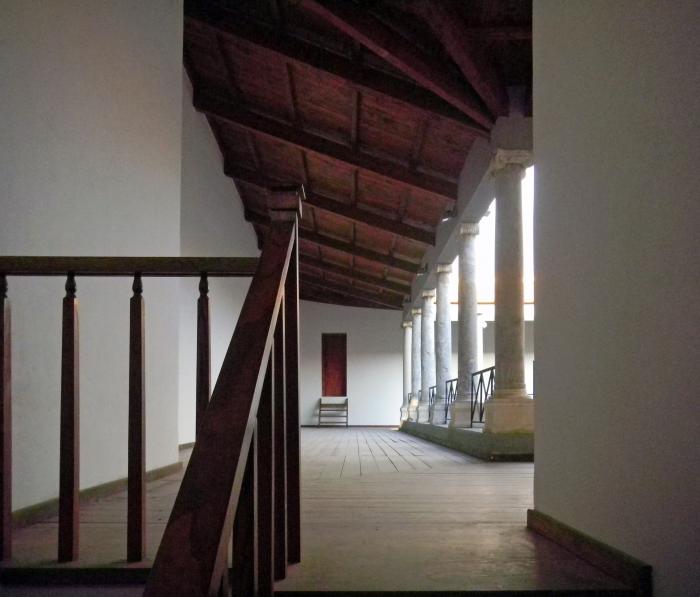

In the ancient city of Kos, Casa Romana ("Roman House") occupied a prominent: it was indeed on the south side of the main street through the city from east to west, the decumanus maximus, close to the thermal central (the baths west ), and a short distance from the southern end of the antique market (agora) of Kos.
Casa Romana is a Roman residence which was brought to light after the devastating earthquake that struck the island of Kos 23 April 1933. The ruins were excavated between 1934 and 1936 by the Italian archaeologist Luciano Laurenzi, who named the building "Casa Romana", the name by which he is known to this day. After completion of the excavation, the residence was largely reconstructed from 1938 to 1940, according to the standards of the time, with a concrete structure.
Casa Romana had been built on the ruins of earlier buildings of the Hellenistic period. The walls belonging to this prior construction can still be seen on the lower portions of the outer sides of the building. In the second century BC, most likely after the destructive earthquake of 142, Casa Romana acquired the characteristics that we see today all buildings prior periods were collected and reconstructed to form a luxurious residence occupying an entire block building (insula). This residence became the property of a family belonging to the wealthy aristocracy of the island of Kos . It covered a total area of 2300 m² and containing more than 37 parts, which is the largest Roman villa in Greece. Casa Romana gives an idea of spacious elegance that the rich people of Kos could aspire.
What we see today is the villa of the third century AD: a large patrician house - as those of Pompeii - organized around three distinct areas defined by three courtyards or atria:
This combination of marble and water basins was that the house remains cool inside even during the hottest days. Rooms for the reception of the guests were arranged around these courses, the floors were covered with slabs of marble or sumptuous mosaics, and the walls were covered with marble slabs, a sign of great wealth.
An important element in the decoration of the residence was a small group of statues, dating from the second to first century BC, and now on display at the Archaeological Museum of Kos . Sculptures, including themes suggested the creation of an artificial world built in the natural (nymphs half naked sitting on a rock, a satyr, Cupid, Aphrodite, et cetera), Were used for the decoration of the peristyle residence; they gave their owner the aura of an art collector, proclaiming his high social status.
Private spaces are not frills, although their design does not take into account the elements of a flamboyant ostentation. These are the areas west of the peristyle, around a hall that opened onto the porch, it was private rooms decorated with plant motifs murals, or, in the case of another room, representation of Cupid. Finally, the residence has other parts to service function, like the play, in the north-east corner of the house, which was the laundry tubs with marble and carved into a drainage system, or parts the west coast, which were equipped with an oven.
Casa Romana was destroyed by a powerful earthquake, perhaps that of 465 AD, which marked the end of the ancient world, it was never inhabited again, except for its southern part - which was not included in the building restored by the Italians. This part of the residence included areas of modest dimensions that had not any luxurious character, reflecting the social changes that had occurred.
During World War II, Casa Romana was used as a hospital by the Italians could still see the red crosses painted on the outside to deter Anglo-American bombing.
The restoration of the 1930s had already begun to deteriorate and the Casa Romana was closed to the public from 2005 to 2009 for major renovations.
Casa Romana is a Roman residence which was brought to light after the devastating earthquake that struck the island of Kos 23 April 1933. The ruins were excavated between 1934 and 1936 by the Italian archaeologist Luciano Laurenzi, who named the building "Casa Romana", the name by which he is known to this day. After completion of the excavation, the residence was largely reconstructed from 1938 to 1940, according to the standards of the time, with a concrete structure.
Casa Romana had been built on the ruins of earlier buildings of the Hellenistic period. The walls belonging to this prior construction can still be seen on the lower portions of the outer sides of the building. In the second century BC, most likely after the destructive earthquake of 142, Casa Romana acquired the characteristics that we see today all buildings prior periods were collected and reconstructed to form a luxurious residence occupying an entire block building (insula). This residence became the property of a family belonging to the wealthy aristocracy of the island of Kos . It covered a total area of 2300 m² and containing more than 37 parts, which is the largest Roman villa in Greece. Casa Romana gives an idea of spacious elegance that the rich people of Kos could aspire.
What we see today is the villa of the third century AD: a large patrician house - as those of Pompeii - organized around three distinct areas defined by three courtyards or atria:
This combination of marble and water basins was that the house remains cool inside even during the hottest days. Rooms for the reception of the guests were arranged around these courses, the floors were covered with slabs of marble or sumptuous mosaics, and the walls were covered with marble slabs, a sign of great wealth.
An important element in the decoration of the residence was a small group of statues, dating from the second to first century BC, and now on display at the Archaeological Museum of Kos . Sculptures, including themes suggested the creation of an artificial world built in the natural (nymphs half naked sitting on a rock, a satyr, Cupid, Aphrodite, et cetera), Were used for the decoration of the peristyle residence; they gave their owner the aura of an art collector, proclaiming his high social status.
Private spaces are not frills, although their design does not take into account the elements of a flamboyant ostentation. These are the areas west of the peristyle, around a hall that opened onto the porch, it was private rooms decorated with plant motifs murals, or, in the case of another room, representation of Cupid. Finally, the residence has other parts to service function, like the play, in the north-east corner of the house, which was the laundry tubs with marble and carved into a drainage system, or parts the west coast, which were equipped with an oven.
Casa Romana was destroyed by a powerful earthquake, perhaps that of 465 AD, which marked the end of the ancient world, it was never inhabited again, except for its southern part - which was not included in the building restored by the Italians. This part of the residence included areas of modest dimensions that had not any luxurious character, reflecting the social changes that had occurred.
During World War II, Casa Romana was used as a hospital by the Italians could still see the red crosses painted on the outside to deter Anglo-American bombing.
The restoration of the 1930s had already begun to deteriorate and the Casa Romana was closed to the public from 2005 to 2009 for major renovations.
Nearby cities:
Coordinates: 36°53'23"N 27°17'18"E
- Sagalassos (Pisidian) 299 km
- Ancient Maronia 473 km
- Battle of Pydna (June 22, 168 BC) 562 km
- Byzantine Walls 563 km
- Ruins of Anazarbus 765 km
- Caesarea Maritima 849 km
- Sīrrūs/Cyrrhus/Qal‘at Nabī Hūrī 861 km
- Fortification Wall 916 km
- Ancient Arzan 1250 km
- Mons Claudianus Quarries 1262 km
- Harbour 0.7 km
- Atlantis Hotel 2.6 km
- Cape Skandari 2.8 km
- Kipriotis Kos Complex ***** 3.7 km
- Kipriotis Panorama Aqualand **** 3.8 km
- Kipriotis Village Resort 4* 4.2 km
- Cape Psalidi Protected Area 4.7 km
- Kos 17 km
- Gulf of Gökova 48 km
- Muğla Province 107 km