
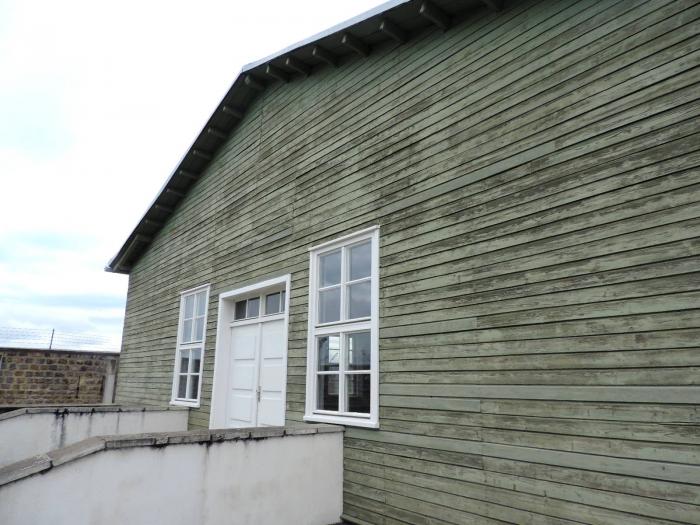
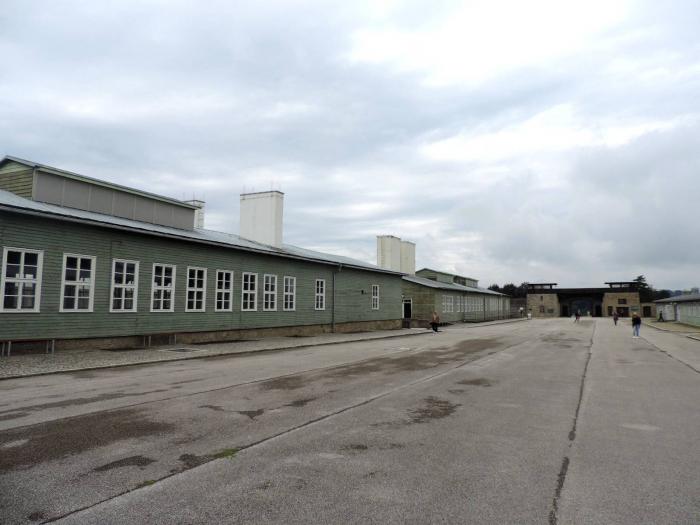
Kitchen Barracks
Austria /
Oberosterreich /
Enns /
World
/ Austria
/ Oberosterreich
/ Enns
World / Austria / Oberösterreich
Second World War 1939-1945, concentration camp




The average daily ration consisted of:
Mornings: approx. half a litre of extract soup with a little bit of fat added or half a litre of thin black, mostly unsweetened ersatz coffee;
Lunchtime: between three quarters of a litre and one litre of stew made from water, grated fodder beet or other vegetable, potatoes, approx. 20 grams of meat with some flour and fat added:
Evenings: 300 to 400 grams of bread and approx. 25 grams of cold meat or margarine, jam and curd at weekends.
More often than not the bread was mouldy, and instead of the potatoes there were rotten potato peels. Some detainees were given even smaller rations – especially Jewish detainees and Soviet prisoners of war, as well as most sick detainees and those unfit for work. From 1944 onwards, the food situation drastically deteriorated for everyone. But even at the best of times normal rations amounted to no more than 1,500 calories. Yet at the same time people were subjected to extreme physical labour.
Basically, detainees only had a chance to survive if they found a way to get more food. The SS very carefully established distinctions to suit their purpose: some detainees, especially prisoner functionaries or those who belonged to work commands received higher rations. Amongst them were kitchen staff, gardeners and some workshops, as well as the crematorium unit, i.e. units working directly for the SS or units where the SS wanted to have as few witnesses of their own crimes as possible. These detainees stood a good chance of organising food by stealing or trading clandestinely. Not surprisingly, there were many thefts in the camp, in the kitchen, at mealtimes and whenever detainees did not watch over their modest provisions.
Food parcels sent by relatives were another way of fattening up one’s rations. Again not all detainees were treated the same. Those at the bottom level of the nationalist-racist hierarchy were never given the chance to receive such parcels, others were allowed to only at times. Such permissions were revoked by the SS at their own discretion.
Jan Kosinski, a Polish detainee, recalls.
Early 1943 I received my first food parcel in Mauthausen. The first parcels were formally distributed on the roll-call square. Each parcel was examined carefully and the more nutritious articles, such as dried meat or fat, were immediately seized by the SS. They had removed a round of smoked sausage from my parcel but had left a small piece for me to taste. A jar of lard was half empty. They had left bread and cakes untouched as these had gone mouldy on the way.
Although the parcel in itself was of no value I was very happy and proud. I walked away with the food from “outside” held up high before me. Behind me detainees all skin and bone begging and moaning for a bit of food in different languages. I sat down in front of my block and picked out the titbits from my parcel. Emaciated detainees fought over the mouldy leftovers.
If we did not eat everything at once, our food would be stolen as there was nowhere to store food in the block and we had no keys to our lockers.
As soon as you received a parcel you were immediately bombarded by various thieves reigning in Mauthausen. They claimed protection money in kind, promising to ensure better working conditions. Those who refused to share money or food did not go unnoticed by the Kapos ... many would be beaten unconscious.
Mornings: approx. half a litre of extract soup with a little bit of fat added or half a litre of thin black, mostly unsweetened ersatz coffee;
Lunchtime: between three quarters of a litre and one litre of stew made from water, grated fodder beet or other vegetable, potatoes, approx. 20 grams of meat with some flour and fat added:
Evenings: 300 to 400 grams of bread and approx. 25 grams of cold meat or margarine, jam and curd at weekends.
More often than not the bread was mouldy, and instead of the potatoes there were rotten potato peels. Some detainees were given even smaller rations – especially Jewish detainees and Soviet prisoners of war, as well as most sick detainees and those unfit for work. From 1944 onwards, the food situation drastically deteriorated for everyone. But even at the best of times normal rations amounted to no more than 1,500 calories. Yet at the same time people were subjected to extreme physical labour.
Basically, detainees only had a chance to survive if they found a way to get more food. The SS very carefully established distinctions to suit their purpose: some detainees, especially prisoner functionaries or those who belonged to work commands received higher rations. Amongst them were kitchen staff, gardeners and some workshops, as well as the crematorium unit, i.e. units working directly for the SS or units where the SS wanted to have as few witnesses of their own crimes as possible. These detainees stood a good chance of organising food by stealing or trading clandestinely. Not surprisingly, there were many thefts in the camp, in the kitchen, at mealtimes and whenever detainees did not watch over their modest provisions.
Food parcels sent by relatives were another way of fattening up one’s rations. Again not all detainees were treated the same. Those at the bottom level of the nationalist-racist hierarchy were never given the chance to receive such parcels, others were allowed to only at times. Such permissions were revoked by the SS at their own discretion.
Jan Kosinski, a Polish detainee, recalls.
Early 1943 I received my first food parcel in Mauthausen. The first parcels were formally distributed on the roll-call square. Each parcel was examined carefully and the more nutritious articles, such as dried meat or fat, were immediately seized by the SS. They had removed a round of smoked sausage from my parcel but had left a small piece for me to taste. A jar of lard was half empty. They had left bread and cakes untouched as these had gone mouldy on the way.
Although the parcel in itself was of no value I was very happy and proud. I walked away with the food from “outside” held up high before me. Behind me detainees all skin and bone begging and moaning for a bit of food in different languages. I sat down in front of my block and picked out the titbits from my parcel. Emaciated detainees fought over the mouldy leftovers.
If we did not eat everything at once, our food would be stolen as there was nowhere to store food in the block and we had no keys to our lockers.
As soon as you received a parcel you were immediately bombarded by various thieves reigning in Mauthausen. They claimed protection money in kind, promising to ensure better working conditions. Those who refused to share money or food did not go unnoticed by the Kapos ... many would be beaten unconscious.
Nearby cities:
Coordinates: 48°15'24"N 14°30'4"E
- Former Buchenwald Concentration Camp 388 km
- WWII Auschwitz Restricted Area (Interessengebiet KL Auschwitz) 391 km
- Dora concentration camp 454 km
- Remains of former Treblinka extermination camp 722 km
- Vyartsilya 1849 km
- Yertsevo 2136 km
- Sukhobezvodnoye 2248 km
- Bolshoy Solovetsky Island 2255 km
- Puksoozero 2265 km
- Anzer Island 2270 km
- Roll call area 0.1 km
- Free parking 0.2 km
- Edge of a cliff known as "The Parachutists Wall" 0.3 km
- Wiener Graben stone quarry 0.4 km
- Electrical substation 2.5 km
- Cemetery 4.5 km
- Swimming pool 4.7 km
- Outdoor switchgear 5.5 km
- Railway station 8.2 km
- Catholic Cemetery 12 km