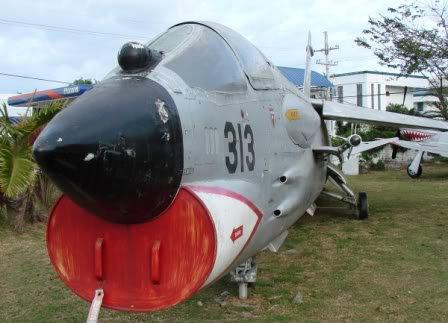
Vought F-8D Crusader (Pasay)

Philippines / Southern Tagalog / Bacoor / Pasay
 aircraft on display  Add category

Bureau Number: 147056
Construction Number: 768
*1963: VF-111 as "NH-108".
*1963: VF-111 as “NH-107“.
*1965: VF-111 as "NE-452".
US Marine Corps.
2/1976: Put into storage at the AMARC bone yard.
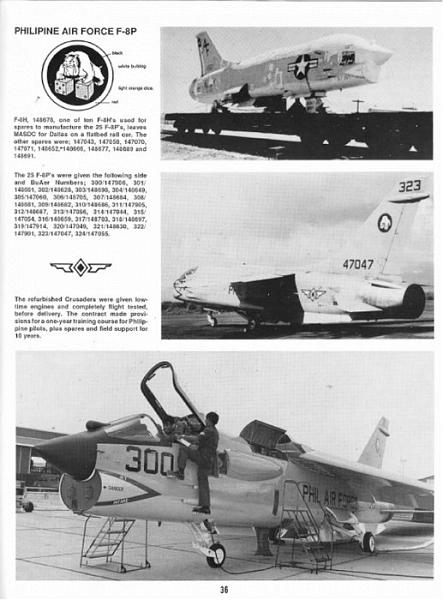
4/1978: Transferred to the Philippine AF as “313”.
Currently on display at Manila-Aquino APT, Philippines.
www.airport-data.com/aircraft/147056.html
Nearby cities:
Coordinates:   14°30'57"N   121°1'12"E

Comments

  • In September 1952, United States Navy announced a requirement for a new fighter. It was to have a top speed of Mach 1.2 at 30,000 ft (9,144.0 m) with a climb rate of 25,000 ft/min (127.0 m/s), and a landing speed of no more than 100 mph (160 km/h).[4] Korean War experience had demonstrated that 0.50 inch (12.7 mm) machine guns were no longer sufficient and as the result the new fighter was to carry a 20 mm (0.79 in) cannon. In response, the Vought team led by John Russell Clark, created the V-383. Unusually for a fighter, the aircraft had a high-mounted wing which allowed for short and light landing gear. The most innovative aspect of the design was the variable-incidence wing which pivoted by 7° out of the fuselage on takeoff and landing (not to be confused with variable-sweep wing). This afforded increased lift due to a greater angle of attack without compromising forward visibility because the fuselage stayed level.[3][4] Simultaneously, the lift was augmented by leading-edge slats drooping by 25° and inboard flaps extending to 30°. The rest of the aircraft took advantage of contemporary aerodynamic innovations with area ruled fuselage, all-moving stabilators, dog-tooth notching at the wing folds for improved yaw stability, and liberal use of titanium in the airframe. Power came from the Pratt & Whitney J57 afterburning turbojet. The armament, as specified by the Navy, consisted primarily of four 20 mm (.79 in) autocannon; the Crusader happened to be the last U.S. fighter designed with guns as its primary weapon.[3] They were supplemented with a retractable tray with 32 unguided Mk 4/Mk 40 Folding-Fin Aerial Rocket (Mighty Mouse FFARs), and cheek pylons for two guided AIM-9 Sidewinder air-to-air missiles.[4] Vought also presented a tactical reconnaissance version of the aircraft called the V-382. Major competition came from the Grumman F-11 Tiger, the upgraded twin-engine McDonnell F3H Demon (which would eventually become the McDonnell Douglas F-4 Phantom II), and lastly, the North American F-100 Super Sabre adopted for carrier use and dubbed the "Super Fury". In May 1953, the Vought design was declared a winner and in June, Vought received an order for three XF8U-1 prototypes (after adoption of the unified designation system in September 1962, the F8U became the F-8). The first prototype flew on 25 March 1955 with John Konrad at the controls. The aircraft exceeded the speed of sound during its maiden flight.[3] The development was so trouble-free that the second prototype, along with the first production F8U-1, flew on the same day, 30 September 1955. On 4 April 1956, the F8U-1 performed its first catapult launch from USS Forrestal. [edit] Crusader IIIIn parallel with the F8U-1s and -2s, the Crusader design team was also working on a larger aircraft with ever greater performance, internally designated as the V-401. Although the Vought XF8U-3 Crusader III was externally similar to the Crusader and sharing with it such design elements as the variable incidence wing, the new fighter was significantly larger and shared few components.
This article was last modified 10 years ago