
Andreeva (Andreyeva) Bay Spent Nuclear Fuel storage site
Russia /
Murmansk /
Zaozyorsk /
World
/ Russia
/ Murmansk
/ Zaozyorsk
, 11 km from center (Заозёрск)
World / Russia / Murmansk
navy, nuclear waste storage

Андреева губа : Andreeva (Andreyeva) Bay
Spent Nuclear Fuel storage site
HIGHLY Radioactive area. Also spelt Andreyeva Bay.
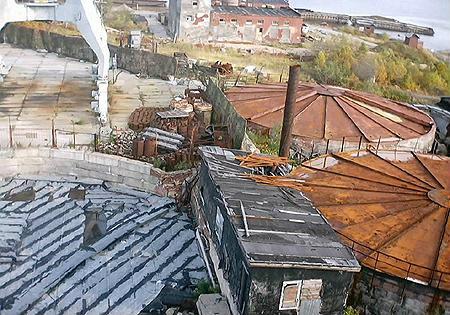
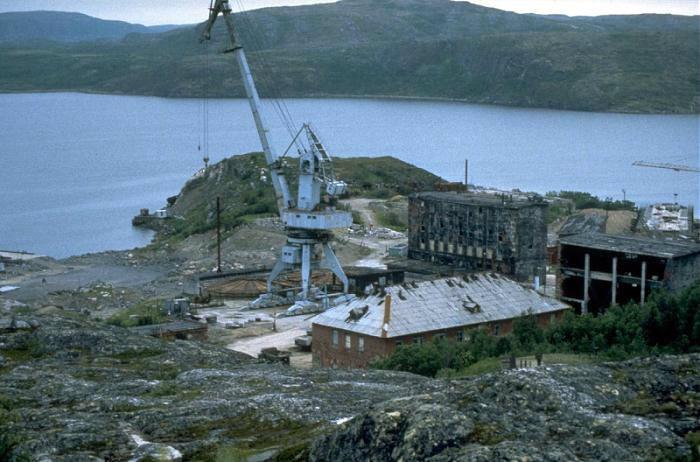
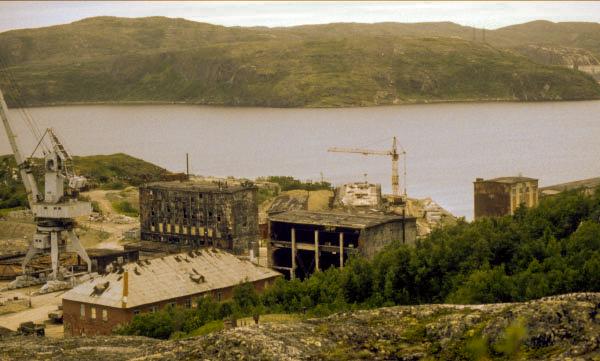
Andreyeva Bay, also known as Installation 928-III, is the largest storage facility in the Northern Fleet for radioactive waste, particularly spent nuclear fuel. Although the storage facility was built in the 1960s, is in need of modernization, and is inaccessible by rail, it remains operational. Reportedly, 21,000 spent fuel rods (equivalent to about 90 nuclear reactors) are stored in three concrete containers, which have been filled to capacity since early 1990.
As a result of the termination of spent fuel transportation to Mayak in 1997, new deliveries of containers of spent nuclear fuel are stored at Andreyeva Bay out in the open and unprotected. TK-11 and TK-18 containers, storing 35 spent fuel rods each, are located on the grounds of the facility and may potentially develop cracks and leak radioactivity.
Thirty-two such containers, which have been stored in the open, are leaking radioactivity. During the summer of 1998, the Norwegian government spent about $800,000 on a project to direct a brook into an underground channel so that it would not run near underground pools and containers storing radioactive materials. Since 2002, Norway, Sweden, and the United Kingdom have initiated assistance projects for Andreyeva Bay. (Source: www.NTI.org)
06/02-2003
At this time, a new storage site for solid radioactive waste has been completed at Andreeva Bay. However, it is still awaiting Minatom's evaluation as to whether it meets safety requirements, and has consequently not yet been commissioned. In addition to the storage sites listed below, there are entire other buildings and areas in Andreeva Bay that are radioactively contaminated and should be treated as radioactive waste during upgrading of the base.
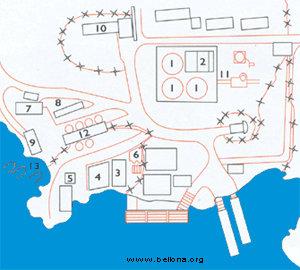
Refer to the site map (picture above) to identify where the
Radioactive waste is stored at the following locations:
3. Site 3 — waste stored in concrete bunker;
4. Site 7 — waste stored in concrete bunker;
5. Site 7a — waste stored both in concrete bunker and in open area;
6. Site 9 — open storage area for containers with waste under construction;
7. Site 67 — concrete bunker for high activity solid waste, filled to capacity, poor technical condition;
8. Site 67a — concrete bunker for high activity solid waste;
9. Site 7d — built in the 1990s to store high activity filtering material used in reactors. Seven concrete bunkers are in direct contact with water in the bay. The idea was to reduce the activity of the material by blending it with the seawater. The grids holding the material, which is in the form of small round pellets, have rusted away and the water is washing the pellets out into the bay.
www.bellona.org/navalfleet/articles/28278
Spent Nuclear Fuel storage site
HIGHLY Radioactive area. Also spelt Andreyeva Bay.
Andreyeva Bay, also known as Installation 928-III, is the largest storage facility in the Northern Fleet for radioactive waste, particularly spent nuclear fuel. Although the storage facility was built in the 1960s, is in need of modernization, and is inaccessible by rail, it remains operational. Reportedly, 21,000 spent fuel rods (equivalent to about 90 nuclear reactors) are stored in three concrete containers, which have been filled to capacity since early 1990.
As a result of the termination of spent fuel transportation to Mayak in 1997, new deliveries of containers of spent nuclear fuel are stored at Andreyeva Bay out in the open and unprotected. TK-11 and TK-18 containers, storing 35 spent fuel rods each, are located on the grounds of the facility and may potentially develop cracks and leak radioactivity.
Thirty-two such containers, which have been stored in the open, are leaking radioactivity. During the summer of 1998, the Norwegian government spent about $800,000 on a project to direct a brook into an underground channel so that it would not run near underground pools and containers storing radioactive materials. Since 2002, Norway, Sweden, and the United Kingdom have initiated assistance projects for Andreyeva Bay. (Source: www.NTI.org)
06/02-2003
At this time, a new storage site for solid radioactive waste has been completed at Andreeva Bay. However, it is still awaiting Minatom's evaluation as to whether it meets safety requirements, and has consequently not yet been commissioned. In addition to the storage sites listed below, there are entire other buildings and areas in Andreeva Bay that are radioactively contaminated and should be treated as radioactive waste during upgrading of the base.
Refer to the site map (picture above) to identify where the
Radioactive waste is stored at the following locations:
3. Site 3 — waste stored in concrete bunker;
4. Site 7 — waste stored in concrete bunker;
5. Site 7a — waste stored both in concrete bunker and in open area;
6. Site 9 — open storage area for containers with waste under construction;
7. Site 67 — concrete bunker for high activity solid waste, filled to capacity, poor technical condition;
8. Site 67a — concrete bunker for high activity solid waste;
9. Site 7d — built in the 1990s to store high activity filtering material used in reactors. Seven concrete bunkers are in direct contact with water in the bay. The idea was to reduce the activity of the material by blending it with the seawater. The grids holding the material, which is in the form of small round pellets, have rusted away and the water is washing the pellets out into the bay.
www.bellona.org/navalfleet/articles/28278
Wikipedia article: http://en.wikipedia.org/wiki/Andreev_Bay_nuclear_accident
Nearby cities:
Coordinates: 69°27'9"N 32°21'10"E
- Polyarninskiy Shipyard 49 km
- The Red Forest 2014 km
- NZHK tailings 2941 km
- JNFL Nuclear Fuel Cycle Facilities 6471 km
- DOE Hanford Site -- Hanford Nuclear Reservation 6906 km
- DOE Hanford Site - Environmental Restoration Disposal Facility (ERDF) 6922 km
- Area 5 Radioactive Waste Management Complex (Doomtown) 7921 km
- Bluewater disposal cells 7922 km
- Manzano Base 7933 km
- US Nuclear Dump Site 7942 km
- Zapadnaya Litsa 0.9 km
- Territory fenced "thorn" from the tower. 2.1 km
- Ostrov Lopatkiny (Lopatkiny Islands) 2.3 km
- Nerpichya Naval Base 2.6 km
- SLBM Depot 3.2 km
- Bolshaya Lopatka Naval Base 3.3 km
- Motovsky Gulf 19 km
- Guba Ara (Still Bay) 21 km
- Ura Bay 29 km
- Rybachy Peninsula 35 km