
Islington Scout Centre (London)
United Kingdom /
England /
London /
A1 Holloway Road, 319-321
World
/ United Kingdom
/ England
/ London
World / United Kingdom / England
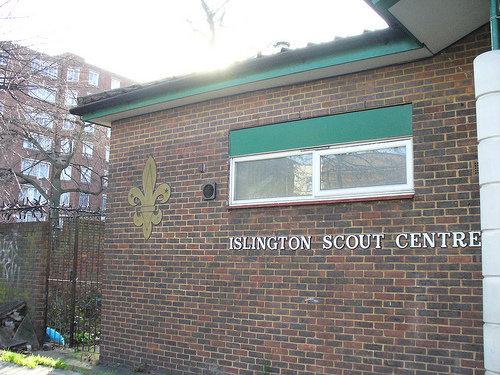
1907 saw the beginings of the Scout Movement. It was in July, 1907 that Robert Baden Powell (BP) held his experimental camp on Brownsea Island, in Poole Harbour, to test out his ideas on Scouting on twenty boys from varying backgrounds. His first ideas on the subject had been published in "Aids to Scouting", a military manual, some years earlier. Following the success of this camp he set out his further ideas in "Scouting for Boys" which was originally published in six fortnightly parts, the first appearing on bookstalls in January 1908 at fourpence (Old Money!) a copy. At this time there was no Scouting organisation - only the idea. The fortnightly parts met with remarkable popularity and, not suprisingly, their author BP was inundated with letters and enquires from "Scout" patrols which had sprung up all over the country.
The next important step which led towards establishing the Movement came with the weekly publication of "The Scout" which first appeared on April 18th 1908. This was largely in response to all the enquires about scouting and provided information on how to set up troops, uniforms etc. This weekly magazine (20 pages for 1 penny) also included adventure yarns of the type found in the "Boys Own Paper" and the like. The sppearence of "The Scout" further encouraged the formation of more Scout Patrols. Having formed their patrols the boys went looking for adults to be their "Scoutmasters" - this certainly happened in Islington and elsewhere. Thereby BP's scheme for young people originally aimed at the schools, churches, The Boys Brigade, the Church Lads Brigade and the YMCA (all of which predated the Scout Movement) bacame a spontaneous Movement in its own right.
Some of the very first Scout Troops were formed in the Islington area. But since in the early days of 1908 there was no central organisation , the numbering of Troops was somewhat erratic. Obviously with the growth of these early Troops some form of central organisation became inevitable and in the Autumn of 1908, district committees were set up in the major areas where Scouting was flourishing. An Islington Boy Scouts Committee was formed on 17th October 1908 comprising the leaders from four of the original Islington troops and Islington numbers were allocated (1st, 2nd, 3rd, 4th Islington). This committee was to be the forerunner of what was to become the Islington Local Association, later Islington Boy Scouts Association (IBSA) and in more recent times the Islington District Council. in the following year (1909) a North London Scout Council (comprising several North London districts) was formed and the original Islington Troops were re-registered with "North London" numbers (1 - 40) drawn from a hat.
The next important step which led towards establishing the Movement came with the weekly publication of "The Scout" which first appeared on April 18th 1908. This was largely in response to all the enquires about scouting and provided information on how to set up troops, uniforms etc. This weekly magazine (20 pages for 1 penny) also included adventure yarns of the type found in the "Boys Own Paper" and the like. The sppearence of "The Scout" further encouraged the formation of more Scout Patrols. Having formed their patrols the boys went looking for adults to be their "Scoutmasters" - this certainly happened in Islington and elsewhere. Thereby BP's scheme for young people originally aimed at the schools, churches, The Boys Brigade, the Church Lads Brigade and the YMCA (all of which predated the Scout Movement) bacame a spontaneous Movement in its own right.
Some of the very first Scout Troops were formed in the Islington area. But since in the early days of 1908 there was no central organisation , the numbering of Troops was somewhat erratic. Obviously with the growth of these early Troops some form of central organisation became inevitable and in the Autumn of 1908, district committees were set up in the major areas where Scouting was flourishing. An Islington Boy Scouts Committee was formed on 17th October 1908 comprising the leaders from four of the original Islington troops and Islington numbers were allocated (1st, 2nd, 3rd, 4th Islington). This committee was to be the forerunner of what was to become the Islington Local Association, later Islington Boy Scouts Association (IBSA) and in more recent times the Islington District Council. in the following year (1909) a North London Scout Council (comprising several North London districts) was formed and the original Islington Troops were re-registered with "North London" numbers (1 - 40) drawn from a hat.
Nearby cities:
Coordinates: 51°33'13"N -0°6'52"E
- Highbury Studios (Vizion7) 0.2 km
- Penn Road Open Space 0.3 km
- Lister Mews 0.3 km
- Parkhurst Court 0.5 km
- 384-402 The Arcade 0.6 km
- Beaux Arts Building 0.9 km
- Mingard Walk, 8-31 1 km
- Eburne Road, 1-24 1 km
- Royal Northern Gardens 1 km
- Central Square 1.1 km
- Lower Holloway 0.3 km
- London Borough of Islington 0.8 km
- The Andover Estate 1.1 km
- Tufnell Park 1.1 km
- Highbury 1.1 km
- Finsbury Park 1.2 km
- Upper Holloway 1.8 km
- Kentish Town 2.1 km
- Camden Council 3.3 km
- London Borough of Barnet 9 km