
Portus Julius
Italy /
Campania /
Pozzuoli /
World
/ Italy
/ Campania
/ Pozzuoli
World / Italy / Campania / Napoli
ruins, navy, Roman Empire, sunken

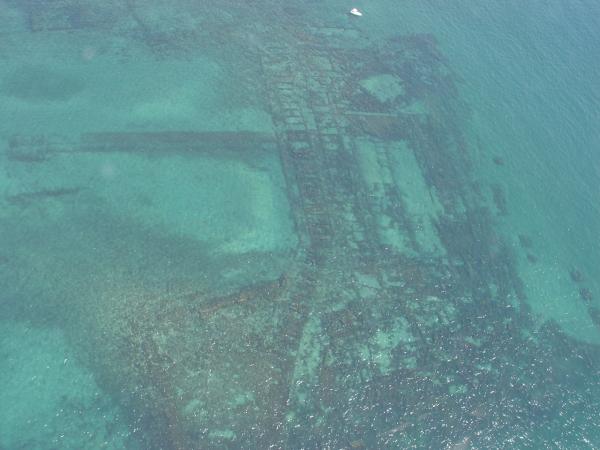
The Portus Julius ("Iulius" in Latin) was the home base to the Imperial Roman western fleet, an impressive armada of warships known collectively as the "classis Misenensis", named after neighboring Misenum, modern Cape Miseno. The port itself was named in honor of the Caesar who commissioned its construction.
Portus offered a comprehensive array of administrative naval services: warehouses for the storage of food and supplies, cisterns for potable water, dry docks for hull maintenance and workshops for the repairing of sails. Other, more personal needs were equally provided for: recreational facilities, the Temple of Poseidon, and discreet brothels.
It was from this location that galleys were dispatched on the orders of Naval praefect Pliny the Elder to evacuate the horrified inhabitants of Pompeii and Herculaneum during the catastrophic 79 AD eruption of Mount Vesuvius. Pliny himself joined in the rescue effort, ultimately dying of sulfuric asphyxiation. (The first image above is taken with a southeastern view: if you lifted the camera slightly, the charred peaks of Vesuvius would be seen looming in the distance.)
With the passing of millennia, the original complex has submerged due to volcanic-driven liquefaction; the emptying of lava from subterranean chambers has caused the ground level to collapse. The substantial remains are today a popular destination with divers and are administered under the aegis of the Archaeological Park of Baia (ancient Baiae).
For more information, follow the URL below.
Portus offered a comprehensive array of administrative naval services: warehouses for the storage of food and supplies, cisterns for potable water, dry docks for hull maintenance and workshops for the repairing of sails. Other, more personal needs were equally provided for: recreational facilities, the Temple of Poseidon, and discreet brothels.
It was from this location that galleys were dispatched on the orders of Naval praefect Pliny the Elder to evacuate the horrified inhabitants of Pompeii and Herculaneum during the catastrophic 79 AD eruption of Mount Vesuvius. Pliny himself joined in the rescue effort, ultimately dying of sulfuric asphyxiation. (The first image above is taken with a southeastern view: if you lifted the camera slightly, the charred peaks of Vesuvius would be seen looming in the distance.)
With the passing of millennia, the original complex has submerged due to volcanic-driven liquefaction; the emptying of lava from subterranean chambers has caused the ground level to collapse. The substantial remains are today a popular destination with divers and are administered under the aegis of the Archaeological Park of Baia (ancient Baiae).
For more information, follow the URL below.
Wikipedia article: http://en.wikipedia.org/wiki/Portus_Julius
Nearby cities:
Coordinates: 40°49'40"N 14°5'40"E
- Ruins of Villa Pausilypon 8.4 km
- Herculaneum 21 km
- Funicular railway, former 28 km
- Villa Jovis 33 km
- Ruins of Pompeii 34 km
- Praedia of Julia Felix 35 km
- San Severino Castle 56 km
- Castle 84 km
- Conza 104 km
- Velia 116 km
- Portus Julius, Roman-Era Shoreline 0.2 km
- Lake Avernus 1.9 km
- Pozzuoli Municipality 2.4 km
- Campi Flegrei 2.9 km
- Astroni crater 5 km
- Cape Miseno 5.1 km
- Bagnoli 6.8 km
- Napoli 13 km
- Gulf of Naples 17 km
- Campania 59 km