
Pochtamtsky Bridge (Saint Petersburg)
Russia /
Sankt Petersburg /
Saint Petersburg
World
/ Russia
/ Sankt Petersburg
/ Saint Petersburg
, 2 km from center (Санкт-Петербург)
World / Russia / Leningrad
footbridge, 1820s construction, suspension bridge
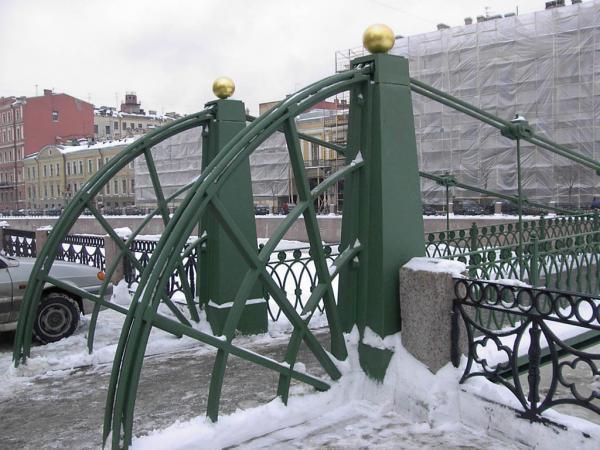




The Pochtamtsky pedestrian bridge spans the Moika River in the alignment of Bolshaya Morskaya Street and Laundry Lane and connects Kazan and 2nd Admiralty Islands. This is a single—span chain hanging structure, its length is 39 meters, width is 2.5 meters. This is the only suspension bridge in St. Petersburg, where the original structure, created in the first quarter of the XIX century, has been preserved (or rather, restored).
Interestingly, the railings of the bridge are not attached to the pylons, which provides the structural elements with freedom of movement and makes them more durable.
At the end of the XVIII century, a 4-span wooden bridge of a beam system with wooden abutments and intermediate supports sheathed with boards was built here. By the beginning of the XIX century, it was dilapidated and required replacement.
In 1823-1824, according to the project and under the supervision of the engineer of the Railway Corps V. Von Tretter, the bridge was rebuilt into a pedestrian single-span hanging. It was built simultaneously with the Panteleimon chain road bridge over the Fontanka River. The bridge structure consisted of sagging chains made of forged iron fixed in coastal cast-iron obelisks-pylons with fan-shaped sectors, which held the wooden superstructure by means of suspended rods of circular cross-section. Forged iron chains were attached to the obelisks-pylons with special hinged locks. Obelisks were completed with gilded balls.
The bridge began to be operated by turnout: local residents, without waiting for the completion of construction, began to cross the Sink on the bridge under construction. Some parts of the bridge, including the railing, were not installed at that time, and the bridge was being completed during operation. When pedestrians were moving, the bridge swayed violently due to its slight rigidity. To prevent uneven swinging, cast—iron turnstiles - cruciform turntables for regulating pedestrian traffic were installed at the entrances of the bridge.
To lighten the weight of the bridge in 1902, iron wrought-iron grilles were removed from it and lighter, simple patterns were installed.
Due to the progressive deformations of the superstructure in 1905, wooden supports were brought under the superstructure, the bridge ceased to be suspended. The hanging single-span bridge was turned into a three-span beam-split system.
In 1953, the wooden superstructure was replaced with metal I-beams. Only the sagging chains have been preserved as an ornament, reminding of its former role. The restored river supports were sheathed with boards.
In 1956, on the initiative of the chief engineer of Lenmosttrest P.P. Stepnov, the original cast-iron grating was restored again according to the project of architect A.L. Rotach.
In 1968, the gilding of the balls on the obelisks was restored.
In 1981-1983, according to the project of engineers of the Leningrad Engineering Project B.B. Dvorkin and R.R. Shipov, the suspension bridge was restored in its former form. The new metal superstructure was manufactured at the Ship Repair Plant in Petrokreposti, chains — at the Gunboat Factory, and fan-shaped sectors – pylons - at the Kirov plant. The bulkhead of the old abutments of the bridge was carried out. Unnecessary intermediate supports were dismantled. The bridge became suspended again. The restoration of the bridge was carried out by the forces of the Lenmosttrest RSU under the leadership of Chief Engineer D.M. Labutin.
On February 02, 2001, presumably due to a sharp drop in air temperature, a link of the outdoor chain on the lower side was destroyed. The crossing was closed for repairs, and on 02/14/2001 the bridge was opened to traffic.
In 2003, the bridge was overhauled according to the project of CJSC Stroyproekt Institute, engineer Yu.B. Devichinsky. During the repair, the chains were completely replaced — they were forged at the Admiralty Shipyards plant, increasing the diameter by 1.5 times. The rigidity beam has been improved, railings, pylons and decorative details have been restored. At the time of repair, the superstructure was completely dismantled, the work was carried out on the basis of the contractor — the Mostspetsmontazh company. On December 29, 2003, the renovated Pochtamtsky Bridge was put into operation.
In 1822-1827, seven chain suspension bridges were built in St. Petersburg, of which only three have survived to this day: the Bank and the Bridge of Four Lions across the Catherine Canal (now the Griboyedov Canal) and the Pochtamtsky Bridge over the Moika. At the same time, the Bank and Lion Bridges are actually girder bridges, where the chains perform only a decorative function.
Thus, only the Pochtamtsky Bridge has reached us in its historical design.
en.mostotrest-spb.ru/bridges/pochtamtskij
Interestingly, the railings of the bridge are not attached to the pylons, which provides the structural elements with freedom of movement and makes them more durable.
At the end of the XVIII century, a 4-span wooden bridge of a beam system with wooden abutments and intermediate supports sheathed with boards was built here. By the beginning of the XIX century, it was dilapidated and required replacement.
In 1823-1824, according to the project and under the supervision of the engineer of the Railway Corps V. Von Tretter, the bridge was rebuilt into a pedestrian single-span hanging. It was built simultaneously with the Panteleimon chain road bridge over the Fontanka River. The bridge structure consisted of sagging chains made of forged iron fixed in coastal cast-iron obelisks-pylons with fan-shaped sectors, which held the wooden superstructure by means of suspended rods of circular cross-section. Forged iron chains were attached to the obelisks-pylons with special hinged locks. Obelisks were completed with gilded balls.
The bridge began to be operated by turnout: local residents, without waiting for the completion of construction, began to cross the Sink on the bridge under construction. Some parts of the bridge, including the railing, were not installed at that time, and the bridge was being completed during operation. When pedestrians were moving, the bridge swayed violently due to its slight rigidity. To prevent uneven swinging, cast—iron turnstiles - cruciform turntables for regulating pedestrian traffic were installed at the entrances of the bridge.
To lighten the weight of the bridge in 1902, iron wrought-iron grilles were removed from it and lighter, simple patterns were installed.
Due to the progressive deformations of the superstructure in 1905, wooden supports were brought under the superstructure, the bridge ceased to be suspended. The hanging single-span bridge was turned into a three-span beam-split system.
In 1953, the wooden superstructure was replaced with metal I-beams. Only the sagging chains have been preserved as an ornament, reminding of its former role. The restored river supports were sheathed with boards.
In 1956, on the initiative of the chief engineer of Lenmosttrest P.P. Stepnov, the original cast-iron grating was restored again according to the project of architect A.L. Rotach.
In 1968, the gilding of the balls on the obelisks was restored.
In 1981-1983, according to the project of engineers of the Leningrad Engineering Project B.B. Dvorkin and R.R. Shipov, the suspension bridge was restored in its former form. The new metal superstructure was manufactured at the Ship Repair Plant in Petrokreposti, chains — at the Gunboat Factory, and fan-shaped sectors – pylons - at the Kirov plant. The bulkhead of the old abutments of the bridge was carried out. Unnecessary intermediate supports were dismantled. The bridge became suspended again. The restoration of the bridge was carried out by the forces of the Lenmosttrest RSU under the leadership of Chief Engineer D.M. Labutin.
On February 02, 2001, presumably due to a sharp drop in air temperature, a link of the outdoor chain on the lower side was destroyed. The crossing was closed for repairs, and on 02/14/2001 the bridge was opened to traffic.
In 2003, the bridge was overhauled according to the project of CJSC Stroyproekt Institute, engineer Yu.B. Devichinsky. During the repair, the chains were completely replaced — they were forged at the Admiralty Shipyards plant, increasing the diameter by 1.5 times. The rigidity beam has been improved, railings, pylons and decorative details have been restored. At the time of repair, the superstructure was completely dismantled, the work was carried out on the basis of the contractor — the Mostspetsmontazh company. On December 29, 2003, the renovated Pochtamtsky Bridge was put into operation.
In 1822-1827, seven chain suspension bridges were built in St. Petersburg, of which only three have survived to this day: the Bank and the Bridge of Four Lions across the Catherine Canal (now the Griboyedov Canal) and the Pochtamtsky Bridge over the Moika. At the same time, the Bank and Lion Bridges are actually girder bridges, where the chains perform only a decorative function.
Thus, only the Pochtamtsky Bridge has reached us in its historical design.
en.mostotrest-spb.ru/bridges/pochtamtskij
Wikipedia article: http://en.wikipedia.org/wiki/Pochtamtsky_Bridge
Nearby cities:
Coordinates: 59°55'49"N 30°18'2"E
- Krasnoarmeysky bridge 1.4 km
- Gorstkin bridge 1.5 km
- Kolomensky Footbridge 1.5 km
- Zhdanovsky Bridge 2.7 km
- Ioannovsky Brige 2.7 km
- Ippodromny bridge 2.7 km
- Second Elagin Bridge 5.6 km
- Krasny Sudostroitel Bridge 6.4 km
- Pedestrian bridge 12 km
- Field path and pedistrian bridge over Ohta river 16 km
- Admiralteysky Municipal Okrug 0.2 km
- Admiralty Island 0.5 km
- Kazanskiy Island 0.6 km
- Spassky Island 1.1 km
- Municipal Okrug 7 1.1 km
- Kolomna Municipal Okrug 1.3 km
- Admiralteysky District 1.4 km
- Bezymyanny island 1.7 km
- Vasil'yevsky island 3.3 km
- Vasileostrovsky District 3.3 km