
Kyzova Archipelago
Russia /
Arhangelsk /
Solovetskiy /
World
/ Russia
/ Arhangelsk
/ Solovetskiy
, 62 km from center (Соловецкий)
World / Russia / Karelia
archipelago, invisible

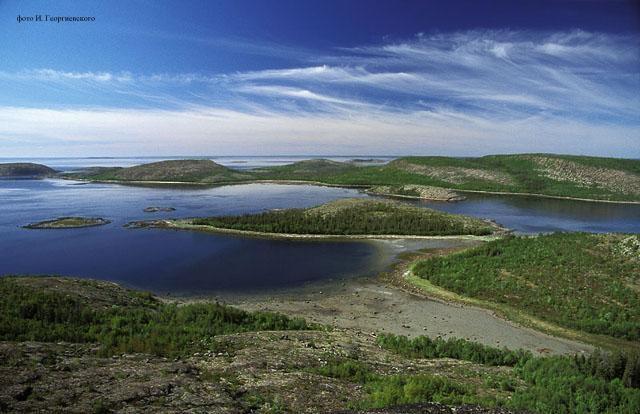

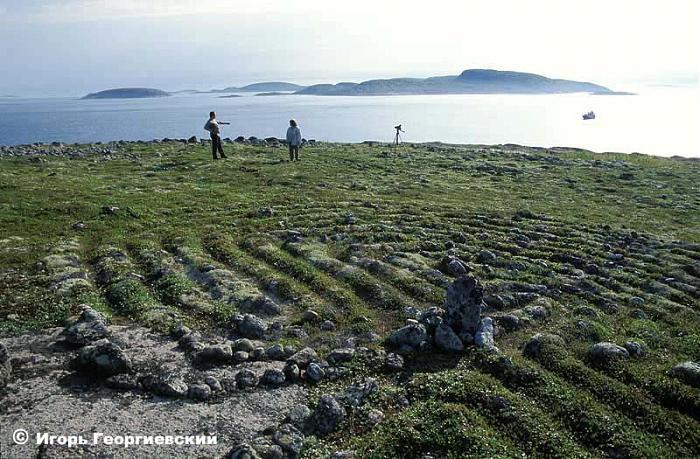


Kyzova Archipelago a unique combination of striking beauty of natural landscapes and numerous monuments of antiquity. It found about 800 different additions of stone (ancient sites, religious complexes drevnesaamskogo population, which appeared in the White Sea 2-2,5 thousand years ago, as well as an abundance of sacred stones - Sade), the area is occupied by 2% throughout the archipelago. Found on the body of a large German and Russian Body Sejdiu and idols have no equal either in their original buildings, or on diversity or on the quantitative composition of the whole of the vast territory that was occupied protosaamskimi tribes at the turn of our era. It protosaamskoy stage, for lack of other versions, often credited with megalithic structures of the North.
Amazingly, Seydy found in Finland and in Norway, and Sweden, and Britain, and Canada, and Alaska. Similar megalithic structures can be found in other countries of the world. And this may be one indication of what is now an uninhabited archipelago Body, was once part of a single civilization. The hallmark of Seyda - extreme, volatility plays. Ancient megalitostroiteli possessed stones in places where nature vested them with "force". It is known that activating, Seyda have acoustic and light effects, based on the phenomenon of resonance and piezoelectric krartsitov. By hypothesis, the researchers, the most favorable period for the life of the builders Sade - 7 - 4 BC, it was during this period was marked by a warm climate. Subsequently, the degradation of culture poizoshla Sejdiu and its replacement with a culture of labyrinths.
Set on the body consists mostly of "average" Sade, but a large number of crowned hats, are also present Saida "tables". Interesting features stand out Sayyid complexes on the islands of the archipelago Kem - in German body design are of several types: Sejdiu and stones, "caps", the stones laid out on the rocks of human visual bezsistemno, but clearly man-made stones set in girth "butting stones, as well as stone-heap embankments and small masonry, riding the lake, line Sejdiu, Saida tables here along with the sanctuary was opened and the settlement of 2-W millennium BC Speaking about the phenomena seydovyh plateau can not circumvent the system location Sejdiu. They are always located in spectacular locations and combined in certain systems, orentiruyas on geology and landscape.
Set in German body, where according to legend Seydy described as "petrified Germans" (historically - the Swedes are not just annoying Solovetsky Monastery), was investigated in the late 1960's archaeologist IM mullahs. Seid Plateau in German Body size is 350 to 110 - 160 m. It is located 150-300 (according to different sources) cult stones. Which IM Mullo divides into three groups;
1 - "Seydy" stones substituted for three or four feet from the tops stand at the foot of which were often run in colored stones, often quartz - perhaps offering;
2 - stone-idols have some chelovekopodobie (mostly in the form of stone tops - "head");
3 - ordinary stones, but with the tops, sometimes zoomorphic.
On the plateau ("Bald Mountain") Island Russian body also has about 300 seids, among which is found and a rare type of "phallic stones" - the menhirs, backed on both sides of the boulders that have counterparts in Finland and among the megaliths Canadian Archipelago. In addition, the Russian body found two plate design called "tombs", but no trace of human remains or implements.
It started with a body of research complexes Sejdiu.
Arhipelag Body - protected areas, which are valuable natural landscapes, unique flora and fauna and unique Neolithic monuments. In the sea near the bodies can be found ringed seal, bearded seal (the biggest seal of the Arctic waters) and beluga whale-. On the coast, dominated, of course, seagulls. There are also ptarmigan, auk, guillemot, common eider, etc.
In order to preserve natural and cultural heritage in 1991 there was formed the state of the reserve, which in 1994 received the status of a wetland of international importance in 1993, marked protective zones of archaeological sites.
www.ticrk.ru/ru/gallery_6218.html
Amazingly, Seydy found in Finland and in Norway, and Sweden, and Britain, and Canada, and Alaska. Similar megalithic structures can be found in other countries of the world. And this may be one indication of what is now an uninhabited archipelago Body, was once part of a single civilization. The hallmark of Seyda - extreme, volatility plays. Ancient megalitostroiteli possessed stones in places where nature vested them with "force". It is known that activating, Seyda have acoustic and light effects, based on the phenomenon of resonance and piezoelectric krartsitov. By hypothesis, the researchers, the most favorable period for the life of the builders Sade - 7 - 4 BC, it was during this period was marked by a warm climate. Subsequently, the degradation of culture poizoshla Sejdiu and its replacement with a culture of labyrinths.
Set on the body consists mostly of "average" Sade, but a large number of crowned hats, are also present Saida "tables". Interesting features stand out Sayyid complexes on the islands of the archipelago Kem - in German body design are of several types: Sejdiu and stones, "caps", the stones laid out on the rocks of human visual bezsistemno, but clearly man-made stones set in girth "butting stones, as well as stone-heap embankments and small masonry, riding the lake, line Sejdiu, Saida tables here along with the sanctuary was opened and the settlement of 2-W millennium BC Speaking about the phenomena seydovyh plateau can not circumvent the system location Sejdiu. They are always located in spectacular locations and combined in certain systems, orentiruyas on geology and landscape.
Set in German body, where according to legend Seydy described as "petrified Germans" (historically - the Swedes are not just annoying Solovetsky Monastery), was investigated in the late 1960's archaeologist IM mullahs. Seid Plateau in German Body size is 350 to 110 - 160 m. It is located 150-300 (according to different sources) cult stones. Which IM Mullo divides into three groups;
1 - "Seydy" stones substituted for three or four feet from the tops stand at the foot of which were often run in colored stones, often quartz - perhaps offering;
2 - stone-idols have some chelovekopodobie (mostly in the form of stone tops - "head");
3 - ordinary stones, but with the tops, sometimes zoomorphic.
On the plateau ("Bald Mountain") Island Russian body also has about 300 seids, among which is found and a rare type of "phallic stones" - the menhirs, backed on both sides of the boulders that have counterparts in Finland and among the megaliths Canadian Archipelago. In addition, the Russian body found two plate design called "tombs", but no trace of human remains or implements.
It started with a body of research complexes Sejdiu.
Arhipelag Body - protected areas, which are valuable natural landscapes, unique flora and fauna and unique Neolithic monuments. In the sea near the bodies can be found ringed seal, bearded seal (the biggest seal of the Arctic waters) and beluga whale-. On the coast, dominated, of course, seagulls. There are also ptarmigan, auk, guillemot, common eider, etc.
In order to preserve natural and cultural heritage in 1991 there was formed the state of the reserve, which in 1994 received the status of a wetland of international importance in 1993, marked protective zones of archaeological sites.
www.ticrk.ru/ru/gallery_6218.html
Nearby cities:
Coordinates: 64°56'29"N 35°10'4"E
- Åland Islands 936 km
- Tyuleniy Archipelago 2391 km
- Baku Archipelago 2890 km
- Sporades Islands 2930 km
- Cyclades 3081 km
- Saronic Islands 3105 km
- Dodecanese 3112 km
- Balearic Islands 3513 km
- Farasan Islands 5346 km
- Lakshadweep Islands,India 6521 km
- Nemetskij Kuzov Island 0.8 km
- Russkij Kuzov Island 2 km
- Bolshoy Solovetsky Island 28 km
- Solovetsky Islands 37 km