
FEU Science Building (Manila)
Philippines /
National Capital Region /
Manila
World
/ Philippines
/ National Capital Region
/ Manila
World / Philippines / Metropolitan Manila / Manila
cultural heritage / national heritage, Art Deco (architecture), educational building
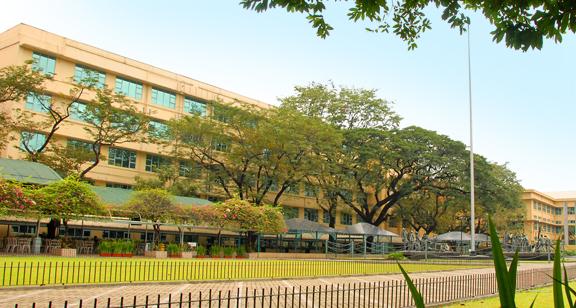
The Science Building houses various classrooms and facilities for natural sciences: chemistry, physics, and biology laboratories. Since it caters mostly to health-related courses under the Institute of Health Sciences and Nursing, it also has areas for molecular research, anatomy, and physiological studies. The building is also home to the university's main research center and an herbarium. Tied with FEU's student culture is its infamous cafeteria dubbed "Tayuman", for the lack of seating options, which has served students quick on-the-go type of meals for decades.
The last to be designed by National Artist Architect Pablo Antonio Sr., the building was completed in 1951 in what is considered a transition of styles between Art Deco and the post World War II International Style. It bears an overall symmetrical design with curved edges connecting to adjacent buildings. A bridgeway on its rear-end towards the Nicanor Reyes Hall creates a direct connection from the second floor of the building to the university library. The bridgeway itself exudes art deco extravaganza as it features striking geometric slabs of concrete, shaping what appears to be floating hand rails, connected to the steps but not to each other. This boasts art deco's intricate aesthetic coupled with functionality and purpose.
For its cultural preservation, the Science Building, alongside four others, were honored as honorable mentions of the Asia Pacific Award for Cultural Heritage Conservation by the UNESCO in 2005. They are also bestowed National Cultural Treasures by the National Museum in 2023.
The last to be designed by National Artist Architect Pablo Antonio Sr., the building was completed in 1951 in what is considered a transition of styles between Art Deco and the post World War II International Style. It bears an overall symmetrical design with curved edges connecting to adjacent buildings. A bridgeway on its rear-end towards the Nicanor Reyes Hall creates a direct connection from the second floor of the building to the university library. The bridgeway itself exudes art deco extravaganza as it features striking geometric slabs of concrete, shaping what appears to be floating hand rails, connected to the steps but not to each other. This boasts art deco's intricate aesthetic coupled with functionality and purpose.
For its cultural preservation, the Science Building, alongside four others, were honored as honorable mentions of the Asia Pacific Award for Cultural Heritage Conservation by the UNESCO in 2005. They are also bestowed National Cultural Treasures by the National Museum in 2023.
Nearby cities:
Coordinates: 14°36'12"N 120°59'10"E
- PUP Main Academic Building 2.6 km
- Concordia College Main Building 2.9 km
- St. La Salle Hall 4.3 km
- Grade School Building 8 km
- ISM Main Building 9 km
- Rizal Hall 10 km
- STI College Building 15 km
- Baras National High School 33 km
- GMATHS Senior High School Buildings 34 km
- Brent International School Building 35 km
- Far Eastern University 0.1 km
- Quiapo Underpass 0.1 km
- Manila City Jail 0.3 km
- Nazarene Catholic School 0.5 km
- Quiapo 0.5 km
- San Miguel 1.1 km
- Santa Cruz 1.6 km
- Sampaloc 1.7 km
- Tondo 3.4 km
- Manila Bay 22 km
Comments