
Central Seminary and The Dominican Residences (Manila)
Philippines /
National Capital Region /
Manila /
Gonzales Drive
World
/ Philippines
/ National Capital Region
/ Manila
World / Philippines / Cavite / Alfonso
department of theology, cultural heritage / national heritage
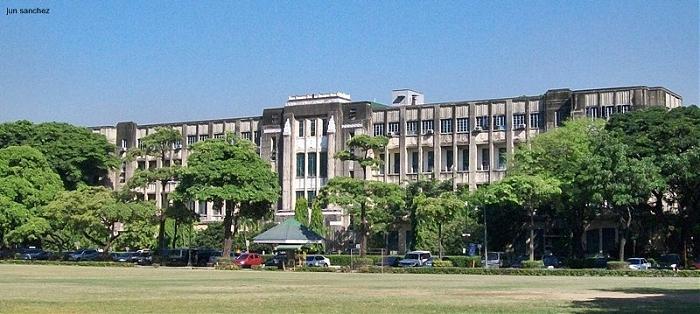
Universidad de Santo Tomás Central del Seminario
The history of the Central Seminary can rightly be traced back to the establishment of the University in 1611. The Colegio of Santo Tomas originally offered those courses which were required as preparation for the priesthood. Consequently, many of its students applied for Holy Orders. In the 18th and 19th centuries, however, additional faculties were opened (Canon Law and Civil Law in 1734, and Medicine and Pharmacy in 1871) which caused an increase in the enrollment of lay students. At the same time, the number of candidates for the priesthood decreased significantly. This compelled the Archbishop of Manila to request in 1894 that special privileges be given to clerics, and in particular that they be provided with separate living quarters. Since the other four dioceses of the Philippines were at the time suffragan dioceses of Manila, the archbishop was in fact asking the University to open a national or central seminary.
The termination of the Spanish Royal Patronage in 1896, and the slow and painful reorganization of the Philippine Church in the first three decades of the present century, delayed the plans of establishing a national seminary at UST. It was only on November 27, 1928 when the Central Seminary was formally erected as an integral part of the University of Santo Tomas. By the end of 1933, the Seminary was transferred from Intramuros to the new campus of the University at Sampaloc. In the same year, the seminary was withdrawn from the immediate jurisdiction of the Rector Magnificus and placed under the direction of its own Rector.
The new Seminary Building soon proved to be too small to accommodate the increasing number of seminarians. A spacious annex was built in 1956 which raised the capacity of the Seminary to 145 places. The new building has its own chapel and gymnasium, bowling alleys and swimming pool. Two basketball courts and two tennis courts in the grounds complement the sports facilities.
The Central seminary Building was recently declared a National Cultural Treasure by the National Museum last January 25, 2010 together with other prominent landmarks like the Main Building, UST Open Field and the Arch of the Centuries.
The history of the Central Seminary can rightly be traced back to the establishment of the University in 1611. The Colegio of Santo Tomas originally offered those courses which were required as preparation for the priesthood. Consequently, many of its students applied for Holy Orders. In the 18th and 19th centuries, however, additional faculties were opened (Canon Law and Civil Law in 1734, and Medicine and Pharmacy in 1871) which caused an increase in the enrollment of lay students. At the same time, the number of candidates for the priesthood decreased significantly. This compelled the Archbishop of Manila to request in 1894 that special privileges be given to clerics, and in particular that they be provided with separate living quarters. Since the other four dioceses of the Philippines were at the time suffragan dioceses of Manila, the archbishop was in fact asking the University to open a national or central seminary.
The termination of the Spanish Royal Patronage in 1896, and the slow and painful reorganization of the Philippine Church in the first three decades of the present century, delayed the plans of establishing a national seminary at UST. It was only on November 27, 1928 when the Central Seminary was formally erected as an integral part of the University of Santo Tomas. By the end of 1933, the Seminary was transferred from Intramuros to the new campus of the University at Sampaloc. In the same year, the seminary was withdrawn from the immediate jurisdiction of the Rector Magnificus and placed under the direction of its own Rector.
The new Seminary Building soon proved to be too small to accommodate the increasing number of seminarians. A spacious annex was built in 1956 which raised the capacity of the Seminary to 145 places. The new building has its own chapel and gymnasium, bowling alleys and swimming pool. Two basketball courts and two tennis courts in the grounds complement the sports facilities.
The Central seminary Building was recently declared a National Cultural Treasure by the National Museum last January 25, 2010 together with other prominent landmarks like the Main Building, UST Open Field and the Arch of the Centuries.
Nearby cities:
Coordinates: 14°36'33"N 120°59'17"E
- Christ the King Church and Seminary 4.6 km
- Presbyterian Theological Seminary 30 km
- Oblates of St. Joseph Seminary and College 74 km
- Oblates of Saint Joseph College Seminary 74 km
- Sorsogon Penafrancia Seminary 373 km
- Saint Anthony Minor Seminary Compound 378 km
- Sacred Heart Seminary 580 km
- Seminario de San Jose 592 km
- St. Francis Xavier College Seminary 976 km
- Seminari Tinggi Katholik Hati Kudus Yesus Pineleng 1528 km
- Football Field 0.1 km
- Plaza Benavides 0.2 km
- University of Santo Tomas 0.2 km
- University of Santo Tomas Athletic Field and Open Spaces 0.2 km
- Kapatiran-Kaunlaran Foundation, Inc. 0.4 km
- Far Eastern University 0.6 km
- NLEx - Midblock Toll Plaza 0.9 km
- Santa Cruz 1 km
- Sampaloc 1.2 km
- Manila Bay 23 km
Comments