
Vysotsk
Russia /
Leningrad /
Vysotsk /
World
/ Russia
/ Leningrad
/ Vysotsk
, 2 km from center (Высоцк)
World / Russia / Leningrad
city
Add category


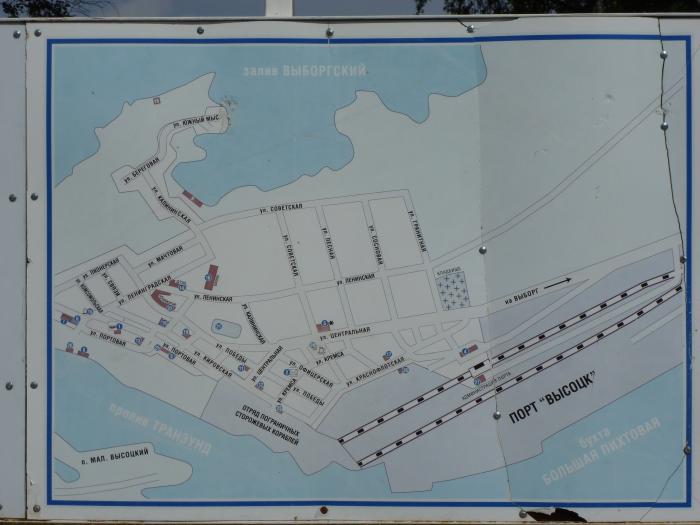


Town and a seaport in Vyborgsky District of Leningrad Oblast, Russia, located on the Karelian Isthmus, on the eastern shore of the Vyborg Bay, 12 kilometers (7.5 mi) southwest of Vyborg and 159 kilometers (99 mi) northwest of St. Petersburg. It hosts a base of the Russian Baltic Fleet and, since 2004, an oil terminal. Population: 1,244 (2010 Census).
The Trångsund Fortress (lit. narrow strait) was built by the order of Peter the Great in the beginning of the 18th century after the Tsardom of Russia had captured the area from Sweden during the Great Northern War. In 1812, Trongzund was included by Alexander I into the newly created Grand Duchy of Finland. Between 1918 and 1940, the town was part of Viipuri Province of independent Finland under the name Uuras. As a result of the Winter War and subsequent Moscow Peace Treaty, it was occupied by the Soviet Union in 1940 and became a part of Vyborgsky District of the Karelo-Finnish SSR. In 1941, during the Continuation War, it was liberated by Finnish troops and returned to Finland. In June 1944, the town was occupied by the Red Army and was annexed to the Soviet Union according to the Moscow Armistice and Paris Peace Treaty. On November 24, 1944, it was transferred to Leningrad Oblast. In July 1948, the town was renamed Vysotsk in honor of the Soviet machine gunner Kuzma Demidovich Vysotsky, who was killed in the area on March 4, 1940 during the final days of the Winter War. Vysotsk may be considered one of the cradles of radio, as it was there that Alexander Popov conducted his pioneering experiments in 1897 and 1902.
The Trångsund Fortress (lit. narrow strait) was built by the order of Peter the Great in the beginning of the 18th century after the Tsardom of Russia had captured the area from Sweden during the Great Northern War. In 1812, Trongzund was included by Alexander I into the newly created Grand Duchy of Finland. Between 1918 and 1940, the town was part of Viipuri Province of independent Finland under the name Uuras. As a result of the Winter War and subsequent Moscow Peace Treaty, it was occupied by the Soviet Union in 1940 and became a part of Vyborgsky District of the Karelo-Finnish SSR. In 1941, during the Continuation War, it was liberated by Finnish troops and returned to Finland. In June 1944, the town was occupied by the Red Army and was annexed to the Soviet Union according to the Moscow Armistice and Paris Peace Treaty. On November 24, 1944, it was transferred to Leningrad Oblast. In July 1948, the town was renamed Vysotsk in honor of the Soviet machine gunner Kuzma Demidovich Vysotsky, who was killed in the area on March 4, 1940 during the final days of the Winter War. Vysotsk may be considered one of the cradles of radio, as it was there that Alexander Popov conducted his pioneering experiments in 1897 and 1902.
Wikipedia article: http://en.wikipedia.org/wiki/Vysotsk
Nearby cities:
Coordinates: 60°37'5"N 28°35'3"E
- Saint Petersburg 62 km
- Espoo (City) 226 km
- Kangasala 275 km
- Tampere 302 km
- Ylöjärvi 320 km
- Petrozavodsk 329 km
- Sastamala 352 km
- Alavus centre 360 km
- Arkhangelsk 754 km
- Nizhny Novgorod 984 km
- Kozliny island 2.1 km
- Maly Vysotsky Island 2.4 km
- JSC "Vysotsk" Lukoil-2 "" 2.7 km
- Dolgunets island 3.4 km
- Malaya Pikhtovaya bay 3.7 km
- Maysky island 3.8 km
- Vysotskoye dachas 4.1 km
- Medyanskaya bay 4.6 km
- Vyborg Bay 5.7 km
- Lоhaniemi peninsula 5.8 km