
Rossgarten Gate (Kaliningrad)
Russia /
Kaliningrad /
Kaliningrad /
ploshchad Marshala Vasilevskogo
World
/ Russia
/ Kaliningrad
/ Kaliningrad
, 3 km from center (Калининград)
World / Russia / Kaliningrad
gate, fortification, city gate, listed building / architectural heritage, 1850s construction, historic landmark, object of cultural heritage of federal importance (Russia)


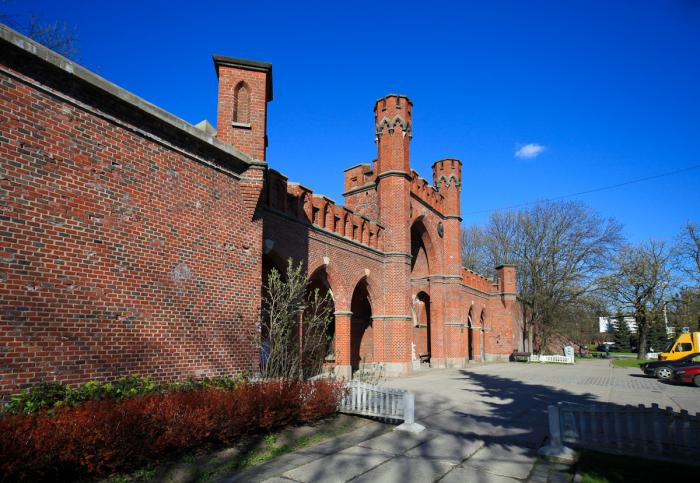
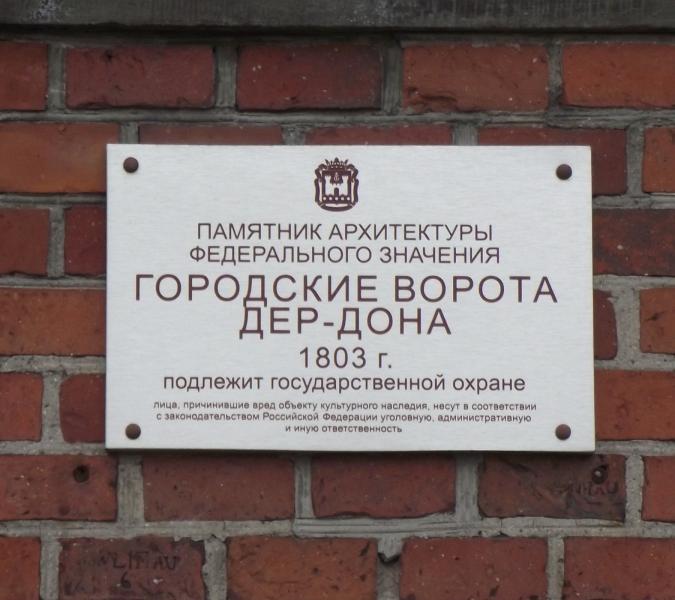
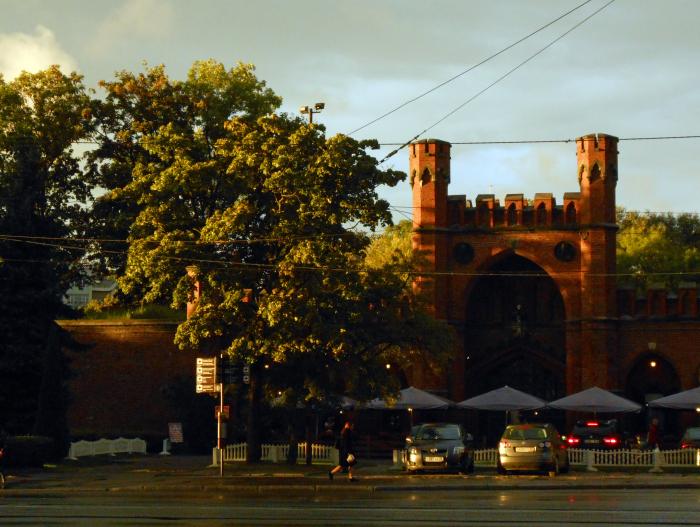
One of the eight surviving city gates of Königsberg. Located on Litovsky Val (Lithuanian Rampart).
Construction period: 1852 – c. 1855
Architects:
Design: Engineer-Hauptmann and Director of Fortress Construction Irfügelbrecht (signature barely legible) and Engineer-Lieutenant von Heil from Königsberg.
Redesigned façade: Privy Supreme Construction Councilor August Stüler, head of the Technical Construction Deputation in Berlin.
Sculptor of the statues: Wilhelm Ludwig Stürmer.
History and Design:
The Rossgarten Gate is one of the most beautiful of all city gates. A design drawing from the Königsberg Fortress Department dated May 1852 has survived, showing the inner part of the structure. Additionally, there are three reworked façade drawings executed by Stüler himself.
On the first drawing from October 1852, he increased the height of the "outer and inner" gates and improved several details (for example, he added small side turrets at the ends, which have been preserved in this form to this day). Most importantly, he increased the number of passages from three (as in the King's Gate) to seven, with the central passage becoming significantly wider.
On the second drawing from April 1853, Stüler worked on the façade on a larger scale, refining several details with greater precision. However, he primarily gave a more elongated appearance to the central section above the passage. Someone (possibly Friedrich Wilhelm IV, as Stüler is known to have discussed his projects with him) must have advised him to give the façade a more Gothic character. This elongation is particularly evident in the fact that the large pointed arch now begins much higher, aligned with the side cornice.
Architectural Description:
Like the King's Gate, the Rossgarten Gate has a single passage 4 meters wide. Casemates on both sides were used as guard rooms. Unlike the King's Gate, pedestrian passages were likely not provided here, as the original parapets still exist on the façade.
Behind the passage lies a so-called zwinger (outer fortification). The walls and vaults are noticeably oversized — a feature that can only be fully appreciated through the drawings.
The long front with seven openings, united at the top by a crown of battlements, is dramatically interrupted in the center by a projecting section above the nearly twice-as-high central opening. With its two corner turrets, this section gives the impression of a tower (only from the side can one see that the "tower" is actually a false front). Stüler attempted to lighten the heaviness of the façade. In front of the massive building, he placed a second wall that dissolves amid the large openings. Using this technique, known only from Gothic ecclesiastical architecture, he achieved a lightness rarely associated with a fortification structure.
Despite this, the military function remained sufficiently, though less overtly, emphasized. To the right and left of the large arch are two portrait medallions depicting great generals of the War of Liberation, which had ended just 30 years earlier — Scharnhorst and Gneisenau.
Post-War History:
During the assault on Königsberg in April 1945, the Rossgarten Gate was in an area of fierce fighting but suffered little damage. For nearly forty years afterward, it remained unused. Only in the early 1980s was the decision made to restore and reconstruct the gate. Since 1996, the building has housed the "Sunstone" fish restaurant.
The building is in good condition, with all details preserved or restored. Even Scharnhorst and Gneisenau still look out with dignity from their medallions.
Construction period: 1852 – c. 1855
Architects:
Design: Engineer-Hauptmann and Director of Fortress Construction Irfügelbrecht (signature barely legible) and Engineer-Lieutenant von Heil from Königsberg.
Redesigned façade: Privy Supreme Construction Councilor August Stüler, head of the Technical Construction Deputation in Berlin.
Sculptor of the statues: Wilhelm Ludwig Stürmer.
History and Design:
The Rossgarten Gate is one of the most beautiful of all city gates. A design drawing from the Königsberg Fortress Department dated May 1852 has survived, showing the inner part of the structure. Additionally, there are three reworked façade drawings executed by Stüler himself.
On the first drawing from October 1852, he increased the height of the "outer and inner" gates and improved several details (for example, he added small side turrets at the ends, which have been preserved in this form to this day). Most importantly, he increased the number of passages from three (as in the King's Gate) to seven, with the central passage becoming significantly wider.
On the second drawing from April 1853, Stüler worked on the façade on a larger scale, refining several details with greater precision. However, he primarily gave a more elongated appearance to the central section above the passage. Someone (possibly Friedrich Wilhelm IV, as Stüler is known to have discussed his projects with him) must have advised him to give the façade a more Gothic character. This elongation is particularly evident in the fact that the large pointed arch now begins much higher, aligned with the side cornice.
Architectural Description:
Like the King's Gate, the Rossgarten Gate has a single passage 4 meters wide. Casemates on both sides were used as guard rooms. Unlike the King's Gate, pedestrian passages were likely not provided here, as the original parapets still exist on the façade.
Behind the passage lies a so-called zwinger (outer fortification). The walls and vaults are noticeably oversized — a feature that can only be fully appreciated through the drawings.
The long front with seven openings, united at the top by a crown of battlements, is dramatically interrupted in the center by a projecting section above the nearly twice-as-high central opening. With its two corner turrets, this section gives the impression of a tower (only from the side can one see that the "tower" is actually a false front). Stüler attempted to lighten the heaviness of the façade. In front of the massive building, he placed a second wall that dissolves amid the large openings. Using this technique, known only from Gothic ecclesiastical architecture, he achieved a lightness rarely associated with a fortification structure.
Despite this, the military function remained sufficiently, though less overtly, emphasized. To the right and left of the large arch are two portrait medallions depicting great generals of the War of Liberation, which had ended just 30 years earlier — Scharnhorst and Gneisenau.
Post-War History:
During the assault on Königsberg in April 1945, the Rossgarten Gate was in an area of fierce fighting but suffered little damage. For nearly forty years afterward, it remained unused. Only in the early 1980s was the decision made to restore and reconstruct the gate. Since 1996, the building has housed the "Sunstone" fish restaurant.
The building is in good condition, with all details preserved or restored. Even Scharnhorst and Gneisenau still look out with dignity from their medallions.
Nearby cities:
Coordinates: 54°43'19"N 20°31'25"E
- old fortress belt from beginning of 19th century 1.3 km
- Fort Nr. 3 (König Friedrich Wilhelm I) 4.7 km
- Fort Nr. 2 (Bronsart) 5.7 km
- Fort Nr. 5 (Friedrich Wilhelm III) 6.3 km
- Fort Nr. 12 (Eulenburg) 7.2 km
- Fort Nr. 11 (Graf Dönhoff) 7.6 km
- Fort Nr. 10 (Kanitz) 7.8 km
- Fort Nr. 9 (Dohna) 8 km
- Fort Nr. 8 8.7 km
- Gvardeysk Prison 36 km
- ulitsa Litovsky Val, 2 0.2 km
- ulitsa Aleksandra Nevskogo, 10 0.3 km
- ploshchad Marshala Vasilevskogo, 2 0.3 km
- Verkhny pond 0.7 km
- Electricity station 1 km
- ulitsa Yuriya Gagarina, 11 1.2 km
- ulitsa Yuriya Gagarina, 2к 1.4 km
- Old town 1.7 km
- Leningradsky District 1.9 km
- Guryevsky municipal district 5.2 km