
Teppe Hasanlu
Iran /
Azarbayejan-e Gharbi /
Naqadeh /
World
/ Iran
/ Azarbayejan-e Gharbi
/ Naqadeh
, 11 km from center (نقده)
World / Iran / West Azarbaijan
archaeological site, tell (mound)




www.hasanlu.org/
www.iranicaonline.org/articles/hasanlu-teppe
Teppe Hasanlu or Tappeh Hassanlu (Persian: تپه حسنلو) is ancient Mannaean city that was destroyed by Urartu in the late 9th century BC.
Hasanlu Tepe consists of a 25m high central "citadel" mound, with massive fortifications and paved streets, surrounded by a low outer town, 8m above the surrounding plain. The entire site, once much larger but reduced in size by local agricultural and building activities, now measures about 600m across, with the citadel having a diameter of about 200 m
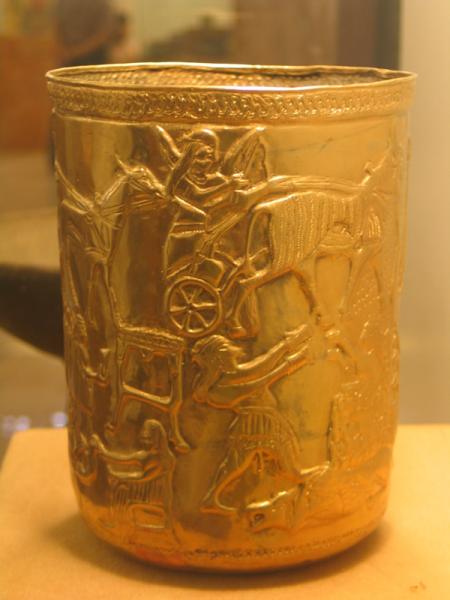
The site is thought to have been inhabited in several stages, the oldest starting from the 6th millennium BCE. It is famous for the Golden Vase found by a team from the University of Pennsylvania led by Robert Dyson, in 1958.
www.youtube.com/watch?v=VhQRIgUHWE4
www.iranicaonline.org/articles/hasanlu-teppe
Teppe Hasanlu or Tappeh Hassanlu (Persian: تپه حسنلو) is ancient Mannaean city that was destroyed by Urartu in the late 9th century BC.
Hasanlu Tepe consists of a 25m high central "citadel" mound, with massive fortifications and paved streets, surrounded by a low outer town, 8m above the surrounding plain. The entire site, once much larger but reduced in size by local agricultural and building activities, now measures about 600m across, with the citadel having a diameter of about 200 m
The site is thought to have been inhabited in several stages, the oldest starting from the 6th millennium BCE. It is famous for the Golden Vase found by a team from the University of Pennsylvania led by Robert Dyson, in 1958.
www.youtube.com/watch?v=VhQRIgUHWE4
Wikipedia article: http://en.wikipedia.org/wiki/Teppe_Hasanlu
Nearby cities:
Coordinates: 37°0'16"N 45°27'29"E
- Zahhak Canyon 154 km
- Ghaterchi Canyon 188 km
- Zangezur National Park 259 km
- Ali-Sadr Cave 312 km
- Kashatagh Province 329 km
- Mount Behistun 336 km
- Tape Zaghe & Tape Ghabrestan & Ghare Tape- 7000 BC 422 km
- Ancient city of Eyvan-e Karkhe 572 km
- Ruin of Gondishapur 593 km
- Great Wall of Gorgan (A Sassanian defence wall and fortification lies on the opposite) 760 km
- Naghadeh plain 3.3 km
- hasanlo Wetland 3.4 km
- Reservoir Dam Hasanlu 4.4 km
- qiblə dağı قیبله داغی 12 km
- Wetland gerda qet 13 km
- مهدی خان داغی mehdixan dağı 17 km
- Dashkhaneh Large pond(Lagoon) 23 km
- Mahabad plain 24 km
- Mahabad Petrochemical 26 km
- Water transfer tunnel from Kani sib Dam to Urmiua Lake - 36 km 27 km