
Espinho Branco
Cape Verde /
Sao Tiago /
Pedra Badejo /
Estrada Nacional Tarrafal - Calheta
World
/ Cape Verde
/ Sao Tiago
/ Pedra Badejo
community, hamlet, invisible

From Wikipedia, the free encyclopedia:
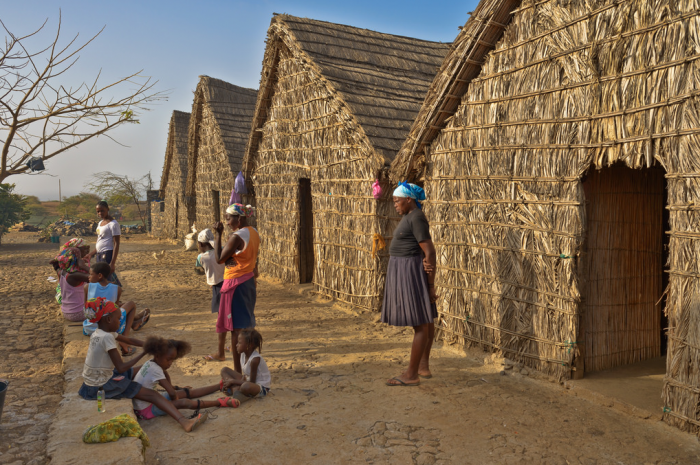
The largest community of Rabelados currently live in Espinho Branco. Their homes are very simple, and they reject elements of modernity such as radio and television, and their culture has a distinct millenarian bent. They are primarily involved in agriculture, fishing, and handcrafts. Their religious ceremonies take place on Saturdays or Sundays. On those days they do not work, but travel long distances on foot to ceremonial locations, and fast until mid-afternoon.
The number of Rabelados is decreasing, as the older generation dies off. The youth have distanced themselves from the religious rites and are rarely found practicing their predecessors' customs. The head of the community, Nho Agostinho, died in 2006. The current leader is Moisés Lopes Pereira, and the Espinho Branco community numbers some 2,000 individuals.
The community has recently become more open to the outside world, and academic studies of the community. Academic Júlio Monteiro wrote his work Os rebelados da ilha de Santiago de Cabo Verde (Centro de Estudos de Cabo Verde, 1974). In 2004 a CD was produced with religious chants of the Rabelados, including traditional themes rarely encountered elsewhere: Cânticos sagrados de Cabo Verde - A litania dos Rabelados (Abidjan/Quintalvideo). The painter Misá has also worked researching the culture and traditions of the community, having guided Rabelado painters, such as Tchetcho, to participate in ARCO, Feira Internacional de Arte Contemporânea de Madrid, in February 2007.
Historically, the Rabelados remained a symbol of resistance and the spirit of Cape Verdean independence against institutional powers.
The largest community of Rabelados currently live in Espinho Branco. Their homes are very simple, and they reject elements of modernity such as radio and television, and their culture has a distinct millenarian bent. They are primarily involved in agriculture, fishing, and handcrafts. Their religious ceremonies take place on Saturdays or Sundays. On those days they do not work, but travel long distances on foot to ceremonial locations, and fast until mid-afternoon.
The number of Rabelados is decreasing, as the older generation dies off. The youth have distanced themselves from the religious rites and are rarely found practicing their predecessors' customs. The head of the community, Nho Agostinho, died in 2006. The current leader is Moisés Lopes Pereira, and the Espinho Branco community numbers some 2,000 individuals.
The community has recently become more open to the outside world, and academic studies of the community. Academic Júlio Monteiro wrote his work Os rebelados da ilha de Santiago de Cabo Verde (Centro de Estudos de Cabo Verde, 1974). In 2004 a CD was produced with religious chants of the Rabelados, including traditional themes rarely encountered elsewhere: Cânticos sagrados de Cabo Verde - A litania dos Rabelados (Abidjan/Quintalvideo). The painter Misá has also worked researching the culture and traditions of the community, having guided Rabelado painters, such as Tchetcho, to participate in ARCO, Feira Internacional de Arte Contemporânea de Madrid, in February 2007.
Historically, the Rabelados remained a symbol of resistance and the spirit of Cape Verdean independence against institutional powers.
Wikipedia article: http://en.wikipedia.org/wiki/Rabelados
Nearby cities:
Coordinates: 15°13'22"N 23°37'17"W
- Trás os Montes 13 km
- Montanha dos Órgãos 15 km
- Móia Móia 29 km
- São Gonçalo 30 km
- São Martinho Pequeno 31 km
- Calabaceira 32 km
- São Tomé 33 km
- Casa Velha 232 km
- Norte Baía (Praia do Norte) 232 km
- Fishermen's settlement and landing beach 232 km
- Mangue de Setes Ribeiras 1.3 km
- Santiago 12 km
- Barrragems de Sanqauihno 13 km
- Figueira das Naus 13 km