Quba Mosque (Medina)

Saudi Arabia / al-Madinah / Medina
 mosque, islam, interesting place
صلاة في مسجد قباء تعدل عمرة

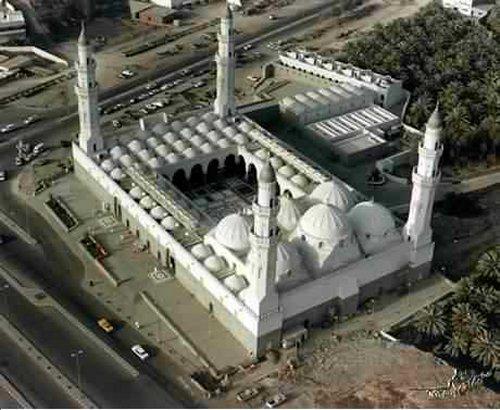
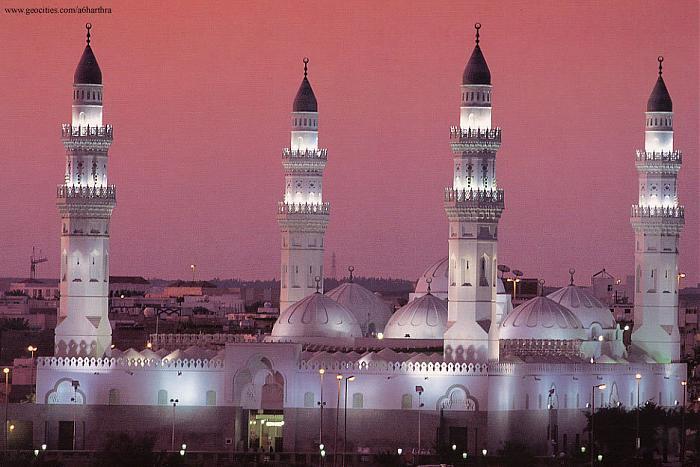
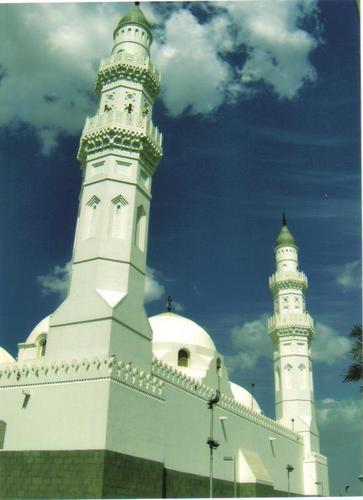
The Quba Mosque, just outside Medina, is the first ever mosque built in the history of Islam. Its first stones were positioned by the Prophet Muhammad (PBUH) during the Hijra (the Migration) from Mecca to Medina and the mosque was completed by his companions. The Prophet (PBUH) spent more than 20 nights in this mosque (after migrating) praying qasr (short prayer) while waiting for Imam Ali whose house was behind this mosque.

The Quba Mosque is the 4th holiest mosque in Islam, after the Masjid al-Haram (Mecca), Masjid al-Nabawi (Medina) and Masjid al-Aqsa (Jerusalem), in order of their holiness. To offer 2 raka'ah of nafl prayers in Masjid Quba is equal to performing one Umrah.

It is mentioned in the Qur'an as the mosque founded on piety and devoutness (Masjid al-Taqwa):

"Certainly a masjid founded on piety from the very first day is more deserving that you should stand in it; in it are men who love that they should be purified; and Allah loves those who purify themselves." (At-Tawbah Sura 9:108).
Nearby cities:
Coordinates:   24°26'21"N   39°37'2"E

Comments

  • One of the peaceful place & all sins of humanity forgive by Allah. BY A.Rasheed Ahmed, M.A, (Arabic) Periyakulam, Tamil Nadu, India.
  • I visited This Masjid In Haj 2006II
  • See http://en.wikipedia.org/wiki/Quba_Mosque for further information in English.
  • In the name of The God of all, Merciful and Compassionate, I pray that peace, justice, mercy, joy, and love may be with all who visit this beautiful and ancient place -- and indeed on all the brothers and sisters in the Human Family worldwide: whether they come here by land or by the miracles of satellite vision and the Internet. Thanks be to Muhammad who first built it (may peace be upon him!), to those who labor to care for it, and to those who have made it available to us far away.
  • haji khalid pervaiz i visited SAUDIA ARABIA in 2006 and returend back on 26 jan 2007
  • Dr. T. V. N. Persaud is Professor of Anatomy, Professor of Pediatrics and Child Health, and Professor of Obstetrics, Gynecology, and Reproductive Sciences at the University of Manitoba, Winnipeg, Manitoba, Canada. There, he was the Chairman of the Department of Anatomy for 16 years. He is well-known in his field. He is the author or editor of 22 textbooks and has published over 181 scientific papers. In 1991, he received the most distinguished award presented in the field of anatomy in Canada, the J.C.B. Grant Award from the Canadian Association of Anatomists. When he was asked about the scientific miracles in the Quran which he has researched, he stated the following: “The way it was explained to me is that Muhammad was a very ordinary man. He could not read, didn’t know [how] to write. In fact, he was an illiterate. And we’re talking about twelve [actually about fourteen] hundred years ago. You have someone illiterate making profound pronouncements and statements and that are amazingly accurate about scientific nature. And I personally can’t see how this could be a mere chance. There are too many accuracies and, like Dr. Moore, I have no difficulty in my mind that this is a divine inspiration or revelation which led him to these statements.”
  • Professor Persaud has included some Quranic verses and sayings of the Prophet Muhammad in some of his books. He has also presented these verses and sayings of the Prophet Muhammad at several conferences.
  • Dr. E. Marshall Johnson is Professor Emeritus of Anatomy and Developmental Biology at Thomas Jefferson University, Philadelphia, Pennsylvania, USA. There, for 22 years he was Professor of Anatomy, the Chairman of the Department of Anatomy, and the Director of the Daniel Baugh Institute. He was also the President of the Teratology Society. He has authored more than 200 publications. In 1981, during the Seventh Medical Conference in Dammam, Saudi Arabia, Professor Johnson said in the presentation of his research paper: “Summary: The Quran describes not only the development of external form, but emphasizes also the internal stages, the stages inside the embryo, of its creation and development, emphasizing major events recognized by contemporary science.”
  • kuba mescidi rasulullahın yatırdığı ilk mescit
  • الله يرزقكم شوفته ونتم ريحين للعمره اوالحج حتى تشعرون بمكانته شىء اخر
  • رزقنا الله صلاة به باذن الله الغامدي من جدة
  • Assalam – O – Alaicum , To All The Muslims Of The World . Whenever Talking About The Religion ISLAM & When You Talk About Creator Always Called The Creator With The Glorious 100 Names Of ALLAH Or ALLAH , But Never Called The Creator With The Name Called GOD , Because There Is No Name Of ALLAH As God , Except The Marvelous 100 Names Of ALLAH . I Respect All Other Religion & Know Whom They Worship Are Called GOD Or Gods . Love You All . Hercules's
  • اهلا بالزوار الكرام في مدينة المصطفى صلى الله عليه وسلم
  • زرت المدينة مرة ونتمنى نسكن فيها بقية عمرى ونموت فيها مع العلم عمري 22
  • ท่านนบี ศ็อลลัลลอฮุอะลัยฮิวะซัลลัม และท่านอบูบักรได้เดินทางออกจากถ้ำซูรรฺ โดยการนำ ทางของอับดุลลอฮฺบินอุรอยกิฏฺ ซึ่งเขาเป็นผู้ชำนาญทางและเป็นคนซื่อสัตย์ ในระหว่างการเดินทางพวกเขาได้พบกับ ซุรอเกาะฮฺบินมาลิก ซึ่งเขาต้องการที่จะได้รับรางวัลเป็นอย่างยิ่ง หลังจากที่พยายามมาตลอดทั้งวัน พวกเขาได้เดินทางเรื่อยมาจนกระทั่งถึงตำบลกุบาอฺ ในวันจันทร์ที่ 12 ตรงกับเดือนร่อบิอุลเอาวัล และท่านได้พำนักอยู่ที่ตำบลกุบาอฺ ณ บ้านของบนีอัมรฺบินเอาฟฺ และอยู่ที่กุบาอฺเป็นเวลา 14 วันในระหว่างนั้นท่านนบี ศ็อลลัลลอฮุอะลัยฮิวะซัลลัมได้สร้างมัสยิด กุบาอฺขึ้น ซึ่งเป็นมัสยิดที่ถูกสร้างขึ้นหลังแรกในอิสลาม ดังที่อัลลอฮฺทรงตรัสในซูเราะฮฺอัตเตาบะฮฺ อายะฮฺที่ 108 ว่า لاَ تَقمْ فِيهِ أَبَداً لَّمَسْجِدٌ أسِّسَ عَلَى التَّقْوَى مِنْ أَوَّلِيَوْمٍ أَحَقّ أَن تَقومَ فِيهِ فِيهِ رِجَالٌ يحِبّونَ أَن يَتَطَهَّرواْوَاللّه يحِبّ الْمطَّهِّرِينَ ความว่า: "มัสยิดซึ่งถูกสร้างขึ้นบนความยำเกรงจากวันแรก สมควรที่สูเจ้าทำการละหมาดในมัสยิดนี้ ในนั้นมีชนซึ่งมีความรักในการทำความสะอาด และอัลลอฮฺทรงรักบรรดาผู้ทำความสะอาด" รายงานจากท่านซะฮฺล บิน หุนัยฟฺ ว่า ท่านนบี ศ็อลลัลลอฮุอะลัยฮิวะซัลลัม ได้กล่าวว่า : "ผู้ใดที่อาบน้ำละหมาดจากบ้านของเขา แล้วเขาได้ไปยังมัสยิดกุบาอฺ แล้วทำการละหมาด เขาจะได้รับผลบุญ เท่ากับการทำอุมเราะฮฺหนึ่งครั้ง" บันทึกโดย อิบนุมาญะฮฺ หลังจากนั้นท่านนบี ศ็อลลัลลอฮุอะลัยฮิวะซัลลัม และเพื่อนของท่านได้เดินทางถึงเมืองอัลมะดีนะฮฺ และทุกๆครั้งที่ผ่านบรรดาบ้านของชาวอัลอันศอร พวกเขาจะเชื้อเชิญให้ท่านพำนัก อยู่กับพวกเขา ท่านจึงกล่าวว่า ปล่อยให้เป็นเรื่องของอูฐมัน มันถูกสั่งใช้มาแล้ว จนกระทั่งอูฐได้มาคุกเข่าหยุดอยู่ในที่ๆเป็นมัสยิดในปัจจุบัน และท่านนบี ศ็อลลัลลอฮุอะลัยฮิวะซัลลัมได้พำนักอยู่กับอบูอัยยูบอัลอันศอรียฺ เป็นเวลา 7 เดือน จนกระทั่งสร้างมัสยิด และห้องนอนของบรรดาอุมมุลมุอฺมินีนแล้วเสร็จ และนี่ชี้ให้เห็นถึงความสำคัญของการสร้างมัสยิดในอัลอิสลาม เพราะท่านร่อซูล ศ็อลลัลลอฮุอะลัยฮิวะซัลลัม ได้เริ่มด้วยกับการสร้างมัสยิดเป็นสิ่งแรก ไม่ว่าจะเป็นที่กุบาอฺ หรือที่อัลมะดีนะฮฺก็ตามทีเพราะมันคือสถานที่ชุมนุมของมุสลิม และเป็นโรงเรียนแห่งแรกในอัลอิสลาม และจะยังคงเป็นเช่นนั้นตลอดไปจนกระทั่ง อัลลอฮฺทรงรับเอาโลกใบนี้ และสิ่งที่อยู่บนมันกลับไป
  • ท่านศาสดากล่าวใว้ ถ้าใครอาบนำ้ละหมาดที่บ้านพัก และเดินทางมาละหมาดที่ มัสยิดแห่งนี้ 2 รอกาอัต จะได้ผลบุญเท่ากับทำอุมเราะฮ์ ครั้งหนึ่ง แซะฮ์บอก
  • Subhan Allah....
  • QUBA:iaitu kampung yang mula-mula sekali menyambut kedatangan nabi diwaktu hijrah dari Makkah.Terletak kira-kira 2 batu dari kota Madinah al Munawarrah,iaitu jalan menuju keMakkah.Disinilah terletaknya masjid yang mula-mula didirikan dengan titik peluh Nabi sendiri,dibantu oleh para sahabat dari kaum muhajirin dan Ansar.Masjid yang dibangunkan atas dasar "Taqwa".Wallahuaklam
  • صلاة في مسجد قباء تعدل عمرة . كان النبي صلى الله عليه وسلم يأتي قباء كل يوم سبت ماشيا وراكبا فيصلي ما شاء الله
  • اتمنى ان ادهب الي المدينة المنورة اشحال نحلم بيها و انحبها بزاف في قلبي ادعولي يارب اروح لها
  • jaime beaucoup les arabe saoudine
  • الله يوفق كل مسلم مؤمن بالله واليوم الاخر ان يصلي في المساجد التي تشد اليها الرحال وان يرزقنا واياكم الصلاة في قباء كان من احب المساجد الى الرسول صلى الله عليه وسلم وهو المسجد المذكور في سورة التوبة لمسجد اسس على التقوى خير..يارب يوفق امة محمد صلى الله عليه وسلم لكل خير وينصرنا على اعدائنا انها عليم بصير وعلى كل شئ قدير
  • Show all comments
This article was last modified 12 years ago