
The Coal Exchange (Cardiff)
| office building, rock/pop music venue
United Kingdom /
Wales /
Cardiff
World
/ United Kingdom
/ Wales
/ Cardiff
World / United Kingdom / Wales
office building, rock/pop music venue
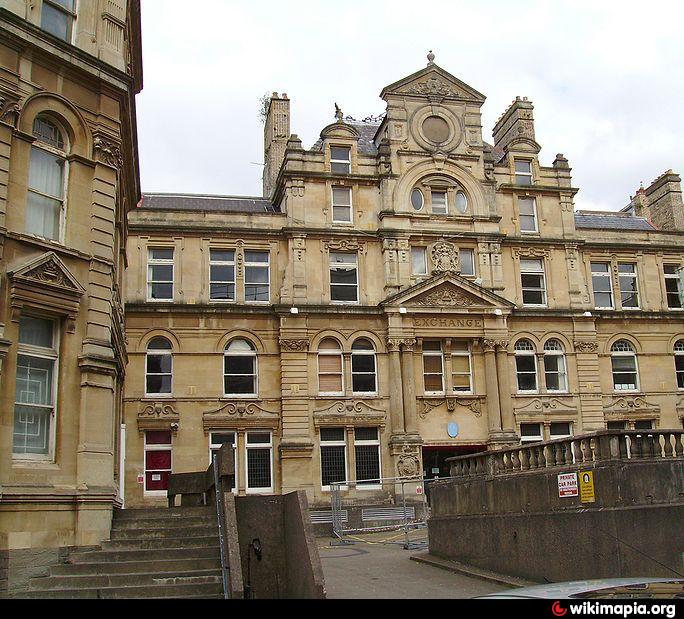
The Coal Exchange is a live music venue in Cardiff, Wales, originally used a market floor for trading in coal. Coal Exchange is situated in Cardiff Bay, near The Point, Cardiff, and is used extensively for live music and other events on the Cardiff music scene. It has a capacity of 1,000.
As Cardiff became the biggest coal port in the world, the building was constructed between 1883 and 1886 by Edwin Seward as a base from which to conduct trade negotiations regarding the coal mines of the South Wales Valleys - most of which was shipped to Cardiff for distribution. The building played an important role in the industrial Cardiff of the 19th century. Paired Corinthian columns, an oak balcony, and rich wood paneling adorn the trading hall, which was reconstructed by Edwin Seward in 1911.
Following its opening, coal owners, ship owners and their agents met daily on the floor of the trading hall where agreements were made by word of mouth and telephone . During the peak trading hour of midday to one o'clock, the floor might have as many as 200 men gesticulating and shouting. It was estimated that up to 10,000 people would pass in and out of the building each day. At one time the price of the world's coal was determined here.
The first £1,000,000 cheque was written at the Coal Exchange during a transaction at the turn of the 20th century in 1901 (equivalent to £77,837,086.09 today). 2500 tonnes of coal were transported to France.
www.coalexchange.co.uk/
www.bbc.co.uk/wales/southeast/sites/coast/pages/7.shtml
As Cardiff became the biggest coal port in the world, the building was constructed between 1883 and 1886 by Edwin Seward as a base from which to conduct trade negotiations regarding the coal mines of the South Wales Valleys - most of which was shipped to Cardiff for distribution. The building played an important role in the industrial Cardiff of the 19th century. Paired Corinthian columns, an oak balcony, and rich wood paneling adorn the trading hall, which was reconstructed by Edwin Seward in 1911.
Following its opening, coal owners, ship owners and their agents met daily on the floor of the trading hall where agreements were made by word of mouth and telephone . During the peak trading hour of midday to one o'clock, the floor might have as many as 200 men gesticulating and shouting. It was estimated that up to 10,000 people would pass in and out of the building each day. At one time the price of the world's coal was determined here.
The first £1,000,000 cheque was written at the Coal Exchange during a transaction at the turn of the 20th century in 1901 (equivalent to £77,837,086.09 today). 2500 tonnes of coal were transported to France.
www.coalexchange.co.uk/
www.bbc.co.uk/wales/southeast/sites/coast/pages/7.shtml
Wikipedia article: http://en.wikipedia.org/wiki/Coal_Exchange
Nearby cities:
Coordinates: 51°27'55"N 3°10'5"W
- Glastonbury Festival Site 52 km
- Knebworth Park 208 km
- Magnetic Hill Concert Site 4427 km
- Tanglewood 5220 km
- The Woodlands of Dover International Speedway 5583 km
- Reggae on the River 8342 km
- Camp Mather 8344 km
- Concord Pavilion 8442 km
- Mountain Winery 8512 km
- Avila Beach Golf Resort 8636 km
- Century Wharf 0.3 km
- Cardiff Bay Wetlands Reserve 0.6 km
- Atlantic Wharf 0.8 km
- Butetown 0.9 km
- Cardiff Yacht Club 0.9 km
- Grangetown 1.1 km
- The Marl 1.1 km
- Cardiff Bay 1.2 km
- Cardiff Bay Retail Park 1.5 km
- Bristol Channel 55 km