
X2 Kilo Class (+ Training) Submarines
Russia /
Primorje /
Vladivostok /
World
/ Russia
/ Primorje
/ Vladivostok
, 4 km from center (Владивосток)
World / Russia / Primor'ye
military, training - dont use this, submarine, draw only border



19th Separate Submarine Battalion (Ulysses Bay)
Subordinate to The "Primorsk"
(Maritime Province) Flotilla (Fokino)
Приморская флотилия
(as of 2008) Comprises in :
x4 Project 877 Paltus (Turbot) :
(NATO Reporting) Kilo Class
Diesel-Electric Attack Submarines.
(+1 converted training submarine)
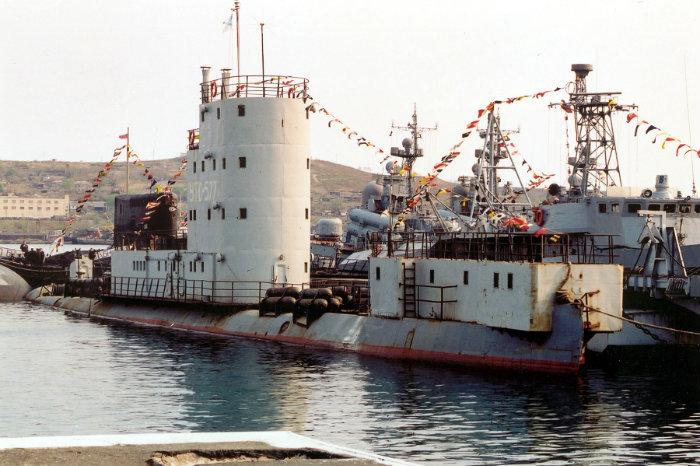
Of which x2 (+ training sub) are seen here -(image dated 18 June 2010) - a third boat being moored independently just to the south, in the centre of the bay, most probably the B-190 'Krasnokamensk'(as per photo above of boat on parade).
B-260 "Чита : Chita" (Read) [1984]
Naming history : from 19.03.2006 - B-260 Chita
Laid down : 22.02.1981, Launched : 23.08.1981, Commissioned 30.12.1981.
(as of 2008) CO : 2nd-Class Captain Andrei Dergousov.
B-345 "Могоча : Mogocha" [1993]
Naming history : from 2009 - B-345 Mogocha
Laid down : 22.04.1993, Launched : 6.10.1993, Commissioned 22.01.1994.
(as of 2008) CO : 2nd-Class Captain Alexander Bardovsky.
B-190 "Краснокаменск : Krasnokamensk" [1993]
Naming history : from 11.12.2007 - B-190 Krasnokamensk
Laid down : 8.05.1992, Launched : 25.09.1992, Commissioned 30.12.1992.
(as of 2008) CO : 2nd-Class Captain Sergei Volkov.
“B-187 " [1991]
Laid down : 7.05.1991, Launched : 5.10.1991, Commissioned 30.12.1991.
In repair
The Kilo class is the NATO reporting name for a military diesel-electric submarine that is made in Russia. The original version of the vessels were designated Project 877 Paltus (Turbot) in Russia. There is also a more advanced version, designated as Improved Kilo in the west, and Project 636 Varshavyanka in Russia. The Kilo will be succeeded by the Lada class submarine, which began sea trials in 2005.
The boats are mainly intended for anti-shipping and anti-submarine operations in relatively shallow waters. Original Project 877 boats are equipped with Rubikon MGK-400 sonar system (with NATO reporting name Shark Gill), which includes a mine detection and avoidance sonar MG-519 Arfa (with NATO reporting name Mouse Roar).
Newer Project 636 boats are equipped with improved MGK-400EM, with MG-519 Afra also upgraded to MG-519EM. The improved sonar systems have reduced the number of operators needed by sharing the same console via automation. Anechoic tiles are fitted on casings and fins to absorb the sonar sound waves of active sonar, which results in a reduction and distortion of the return signal. These tiles also help attenuate sounds that are emitted from the submarine, thus reducing the range by which the sub may be detected by passive sonar.
www.deepstorm.ru/DeepStorm.files/45-92/dts/877/
russian-ships.info/eng/submarines/project_877.htm
Subordinate to The "Primorsk"
(Maritime Province) Flotilla (Fokino)
Приморская флотилия
(as of 2008) Comprises in :
x4 Project 877 Paltus (Turbot) :
(NATO Reporting) Kilo Class
Diesel-Electric Attack Submarines.
(+1 converted training submarine)
Of which x2 (+ training sub) are seen here -(image dated 18 June 2010) - a third boat being moored independently just to the south, in the centre of the bay, most probably the B-190 'Krasnokamensk'(as per photo above of boat on parade).
B-260 "Чита : Chita" (Read) [1984]
Naming history : from 19.03.2006 - B-260 Chita
Laid down : 22.02.1981, Launched : 23.08.1981, Commissioned 30.12.1981.
(as of 2008) CO : 2nd-Class Captain Andrei Dergousov.
B-345 "Могоча : Mogocha" [1993]
Naming history : from 2009 - B-345 Mogocha
Laid down : 22.04.1993, Launched : 6.10.1993, Commissioned 22.01.1994.
(as of 2008) CO : 2nd-Class Captain Alexander Bardovsky.
B-190 "Краснокаменск : Krasnokamensk" [1993]
Naming history : from 11.12.2007 - B-190 Krasnokamensk
Laid down : 8.05.1992, Launched : 25.09.1992, Commissioned 30.12.1992.
(as of 2008) CO : 2nd-Class Captain Sergei Volkov.
“B-187 " [1991]
Laid down : 7.05.1991, Launched : 5.10.1991, Commissioned 30.12.1991.
In repair
The Kilo class is the NATO reporting name for a military diesel-electric submarine that is made in Russia. The original version of the vessels were designated Project 877 Paltus (Turbot) in Russia. There is also a more advanced version, designated as Improved Kilo in the west, and Project 636 Varshavyanka in Russia. The Kilo will be succeeded by the Lada class submarine, which began sea trials in 2005.
The boats are mainly intended for anti-shipping and anti-submarine operations in relatively shallow waters. Original Project 877 boats are equipped with Rubikon MGK-400 sonar system (with NATO reporting name Shark Gill), which includes a mine detection and avoidance sonar MG-519 Arfa (with NATO reporting name Mouse Roar).
Newer Project 636 boats are equipped with improved MGK-400EM, with MG-519 Afra also upgraded to MG-519EM. The improved sonar systems have reduced the number of operators needed by sharing the same console via automation. Anechoic tiles are fitted on casings and fins to absorb the sonar sound waves of active sonar, which results in a reduction and distortion of the return signal. These tiles also help attenuate sounds that are emitted from the submarine, thus reducing the range by which the sub may be detected by passive sonar.
www.deepstorm.ru/DeepStorm.files/45-92/dts/877/
russian-ships.info/eng/submarines/project_877.htm
Wikipedia article: http://en.wikipedia.org/wiki/Kilo_class_submarine
Nearby cities:
Coordinates: 43°4'56"N 131°55'15"E
- Russian Navy Piers (Ulysses Bay) 0.3 km
- Учебный отряд подводного плавания в.ч. 25151-М 1.8 km
- Мilitary unit 3.6 km
- 3828th Logistics Base (Vladivostok) 3.6 km
- 155th Detached Brigade Naval Infantry 8.7 km
- Mt. Holodilnik 8.8 km
- Мilitary unit 10 km
- Fort № 1 10 km
- S-300PM Battery (Rybachiy : Gornostay) 11 km
- Military communication center 34 km
- L-19 submarine's crew monument 0.1 km
- OJSC Eastern Shipyard (Ulysses Bay) 0.2 km
- Ulysses Bay 0.6 km
- Zolotoy Rog (Gold Horn Bay) 2.7 km
- Eastern Bosphorus 4.1 km
- Ussuri Bay 8.9 km
- Amur Bay 15 km