
Buddhist Monastic Complex (Takht Bhai)
Pakistan /
North-West Frontier /
Takhat Bhai /
Takht Bhai
World
/ Pakistan
/ North-West Frontier
/ Takhat Bhai
Världen / Pakistan / / Mardan
Museum, archäologisches Gelände, Buddhismus, Sehenswürdigkeit, Buddhistentempel, college and department of buddhist studies (en), Buddhistisches Kloster, Buddha statue (en)

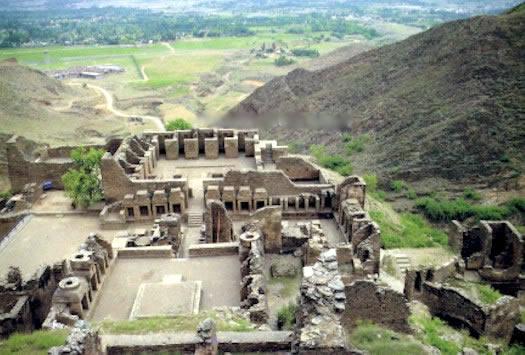
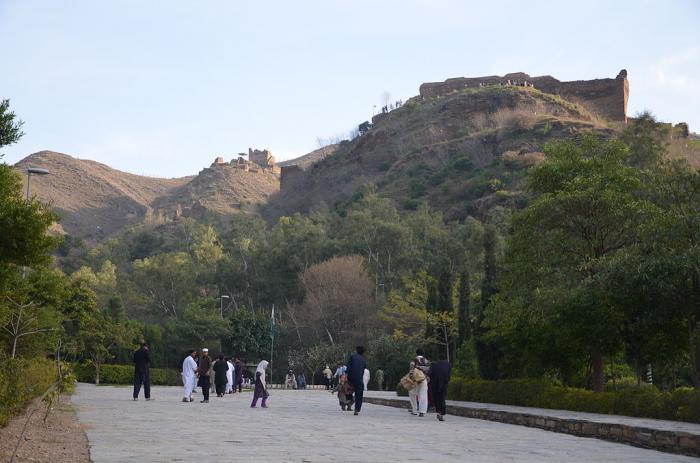
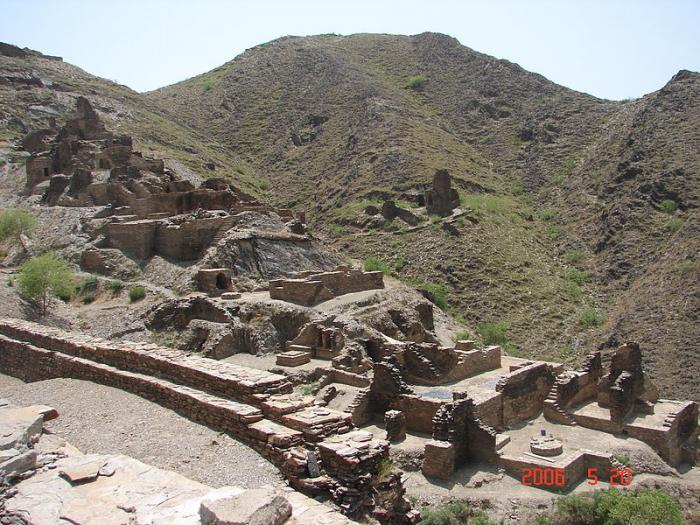
Sir Mortimer Wheeler comments, "Today probably the best known monument in the Peshawar valley is the Buddhist monastery of Takht-Bhai, on a rocky ridge about 10 miles north-east of Mardan. It stands 500 feet above the plain and is approached by a steep and winding path, but the visitor is repaid for his climb by the architectural diversity of the ruins and by their romantic mountain-setting" Takht-Bhai literally means "a spring on a flat (terrace)" and derive its name from the original water spring on the top of the ridge that facilitated the growth of the monastic settlement. It lies on the main road from Mardan to Malakand and onward to Swat. But the actual ridge, on which the monastery is located, is removed about two miles from the main road and is hidden behind the towering cliff in front. It is because of this sequestered position that the monastery is well preserved. But what invader's hands spared, man, in his greed for grabbling sculpture, has removed the best specimen of Buddhist art. A few of them are preserved in the Peshawar Museum. The monastic establishment was not far from an ancient city, now represented by the ruins of Seri Bahlol, a village about two miles south-east of Takht-Bhai. The main monastic area can be approached from two sides. From Seri-Bahlol one could undertake a long walk up the hill on the eastern side, get the water spring first and then reach down the Buddhist establishment. This is rather a long journey. for an easy approach we proceed via Frontier Sugar Mill and park our car just at the ridge, wherefrom we could have a distant view of the standing wall, now almost become a part of the bare rock of Takht-Bhai ridge. When we go up and up the widening path, the beautiful panorama of the Baizai plain presents before us until our eyes catch the emerging peaks of the Malakand hill, and far at a distance we can have a glimpse of the snowy peaks of the Chitral hills.
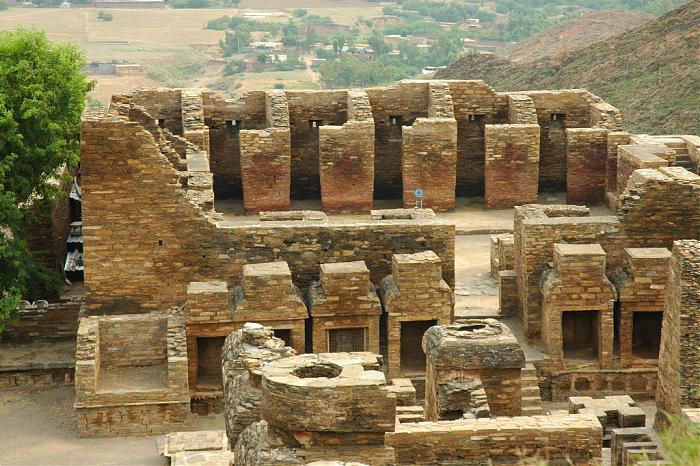
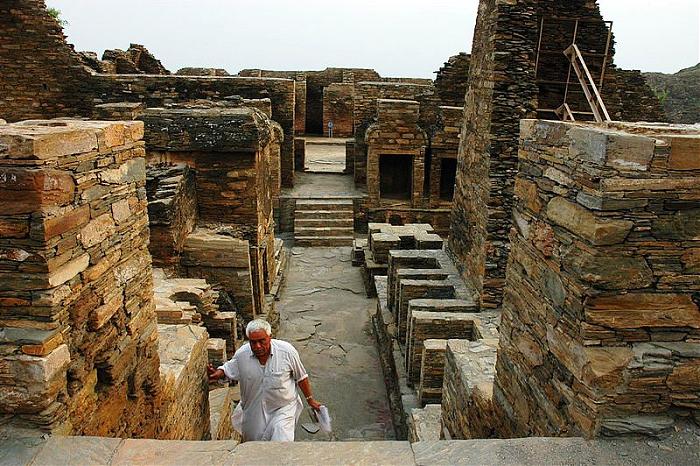
As we go up, we see on our right, a suit of monastic cells and to our left on the farther ridge more groups of buildings crop up. In between the centuries of rain water have cut deep chasm. To day we enter by a back door and ancient time the main approach was from the east through two vaulted corridors, which led up through three stages into this court. The court, which is rectangular, is further enlarged on the east side by several revetments on the slop. The eastern portion is empty but at the far end we have an assembly hall. the western part is full of small votive stupas. Originally there was only one stupa (the biggest in size) at the eastern end. The basement of these stupas has Corinthian pillars, in between which were plastered sculptures, now all gone. These stupas are generally square in plan but we have one octagonal and another circular stupa. Later the biggest stupa had an additional superstructure of two niches obviously to give shelter to two Buddha figures. It appears that at this stage the niches, seen on the three sides of this court, were added. They have been arranged in such a fashion that a north-south passage runs through the middle of the court. To the north is the well-planned monastic shrine on a high terrace. The shrine is unique of its kind. It has a stupa in the middle domes built on corbelled system with copings on the intermediate stage. The monastery has an open court in the middle with lustral bathrooms in a corner and living cells on the sides. It was doubled storied. there is only one double room cell. All others are single. A passage on the east leads to the refectory and also shows the steps for the second story.
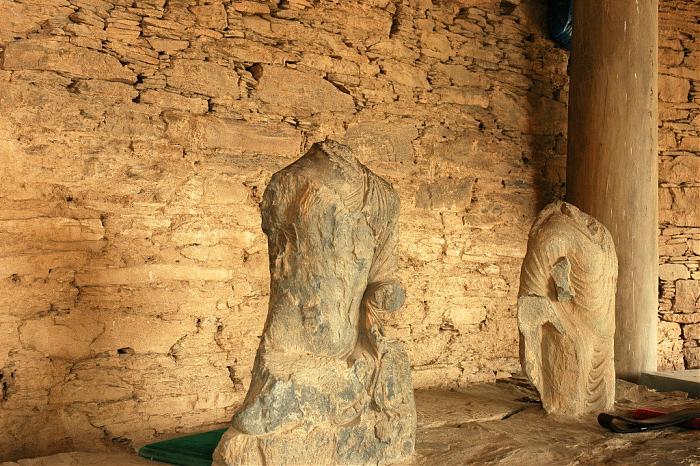
In order to have a glance of the most attractive object at the site we have to climb down and pass along a wooden passage to another stupa complex of a much later date. Two votive stupas are also lying by the side of a main stupa. All of them have preserved fine stucco sculptures. Right in front along the wall can be seen six pairs of large size feet and some broken heads of Buddha’s all in stucco. Nearby are stones sculptures. One of them is an unfinished figure.
We now return to the original stupa court and step down into s new complex of underground cells on either side of a barrel vaulted corridor. The cells, which are seven in number, are dark and are obliviously meant for austere practices, which Buddhism developed latest in its existence.
Unfortunately the excavators have not given us a definite clue to the proper dating of the constructions. One inscription of the time of the Parthian Ruler, Gondophares is said to have been found here. It is dated in the year 103, probably equivalent to AD 45. If this date could be taken as a near proximity to the beginning of the monastic settlement here, the main development phase must in the peak period of the Great Kushanas, 1st-2nd centuries AD. The third stage must be placed in the later Kushana period, 3rd-4th centuries AD. Finally the underground monastic cell complex should probably belong to 5th-6th centuries AD.
Reference: Hassan Dani, Ahmad, Dr; 2002, Peshawar, The Historic City of The Frontier
Sang-e-Meel Publication, Lahore
Shahid Mahmood
As we go up, we see on our right, a suit of monastic cells and to our left on the farther ridge more groups of buildings crop up. In between the centuries of rain water have cut deep chasm. To day we enter by a back door and ancient time the main approach was from the east through two vaulted corridors, which led up through three stages into this court. The court, which is rectangular, is further enlarged on the east side by several revetments on the slop. The eastern portion is empty but at the far end we have an assembly hall. the western part is full of small votive stupas. Originally there was only one stupa (the biggest in size) at the eastern end. The basement of these stupas has Corinthian pillars, in between which were plastered sculptures, now all gone. These stupas are generally square in plan but we have one octagonal and another circular stupa. Later the biggest stupa had an additional superstructure of two niches obviously to give shelter to two Buddha figures. It appears that at this stage the niches, seen on the three sides of this court, were added. They have been arranged in such a fashion that a north-south passage runs through the middle of the court. To the north is the well-planned monastic shrine on a high terrace. The shrine is unique of its kind. It has a stupa in the middle domes built on corbelled system with copings on the intermediate stage. The monastery has an open court in the middle with lustral bathrooms in a corner and living cells on the sides. It was doubled storied. there is only one double room cell. All others are single. A passage on the east leads to the refectory and also shows the steps for the second story.
In order to have a glance of the most attractive object at the site we have to climb down and pass along a wooden passage to another stupa complex of a much later date. Two votive stupas are also lying by the side of a main stupa. All of them have preserved fine stucco sculptures. Right in front along the wall can be seen six pairs of large size feet and some broken heads of Buddha’s all in stucco. Nearby are stones sculptures. One of them is an unfinished figure.
We now return to the original stupa court and step down into s new complex of underground cells on either side of a barrel vaulted corridor. The cells, which are seven in number, are dark and are obliviously meant for austere practices, which Buddhism developed latest in its existence.
Unfortunately the excavators have not given us a definite clue to the proper dating of the constructions. One inscription of the time of the Parthian Ruler, Gondophares is said to have been found here. It is dated in the year 103, probably equivalent to AD 45. If this date could be taken as a near proximity to the beginning of the monastic settlement here, the main development phase must in the peak period of the Great Kushanas, 1st-2nd centuries AD. The third stage must be placed in the later Kushana period, 3rd-4th centuries AD. Finally the underground monastic cell complex should probably belong to 5th-6th centuries AD.
Reference: Hassan Dani, Ahmad, Dr; 2002, Peshawar, The Historic City of The Frontier
Sang-e-Meel Publication, Lahore
Shahid Mahmood
Nearby cities:
Koordinaten: 34°17'9"N 71°56'50"E
- Ruinenfeld von Taxila 100 km
- Bhir Mound 100 km
- Faisal-Moschee 118 km
- Eisfallkegel 229 km
- Mohammed Nadir Shah Mausoleum 253 km
- Dilkusha Palast 255 km
- Shuhada Salaheen 255 km
- Deh Mazang Platz 258 km
- Darul Aman Palast 261 km
- Tajbeg Palast 261 km
Array