
Al Maktoum International Airport (Dubai)
United Arab Emirates /
Dubai /
Dubai
World
/ United Arab Emirates
/ Dubai
/ Dubai
, 30 km from center (دبى)
World / United Arab Emirates
international airport
Add category
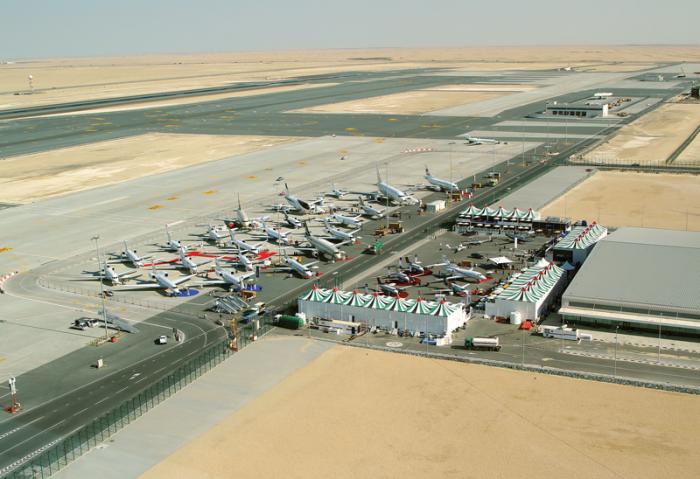

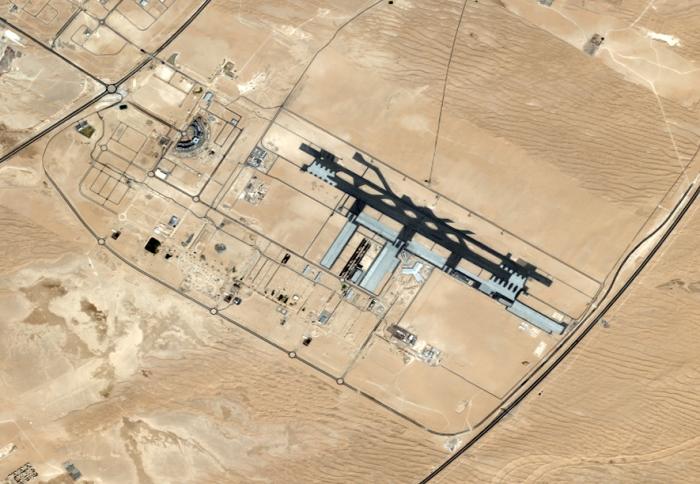
Al Maktoum International Airport (IATA: DWC, ICAO: OMDW) is a major airport in Jebel Ali, Dubai, United Arab Emirates that opened on 27 June 2010. Previous working names have included "Jebel Ali International Airport," "Jebel Ali Airport City" and "Dubai World Central International Airport". It will be officially known as Al Maktoum International Airport. It has been named after the late Sheikh Maktoum bin Rashid Al Maktoum, the former ruler of Dubai. It will be the main part of Dubai World Central, a planned residential, commercial and logistics complex scheme. World Central is the world's first truly integrated logistics platform, with most transport modes, logistics and value added services, including manufacturing and assembly, in a single bonded and Free Zone environment
History
Construction
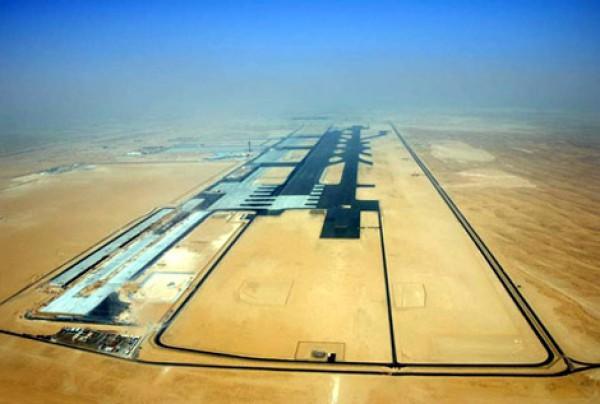
The A380 enabled 4.5 kilometres (2.8 mi) runway was completed within its projected 600 day construction period and subsequently underwent tests and trials over the next six to eight months in order to fulfill its CAT III-C requirements.[citation needed] Construction of the airport's cargo terminal, the Al Maktoum Airport Cargo Gateway, which cost around US$75 million, was 50% complete by the end of 2008. During the first phase of the project, the airport is planned to handle around 200,000 tonnes of cargo per year, with the possibility of increasing to 800,000 tonnes. The passenger terminal at this phase is designed to have a capacity of around five million passengers per year. By 2013, it is planned to be the largest airport in the world in terms of freight handled, moving up to 12 million tonnes per year. The project is expected to be fully built-out and operational by 2017, although the 2009 financial crisis may postpone the completion of the complex by 5 years to 2022
Operations
On 24 February 2010, it was announced that Al Maktoum International Airport was to be opened on 27 June 2010 initially with only one runway open and handling only cargo flights. Passenger operations are expected to begin in late March 2011. The first flight into the airport occurred on 20 June 2010, when an Emirates SkyCargo Boeing 777F landed after a flight from Hong Kong. The flight served as a test for various functions such as air traffic control, movement of aircraft on the ground, and security. According to Emirates, the flight was an "unmitigated success."
Airlines and destinations
At the time of its opening, three cargo service airlines served Al Maktoum International Airport, including RUS Aviation, Aerospace Consortium and European Cargo Services. Fifteen additional airlines have signed a contract to operate flights to the airport
Overview
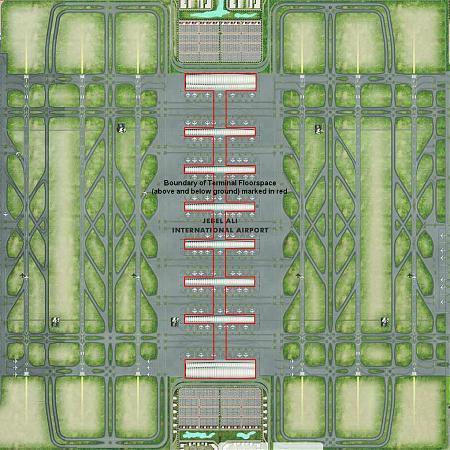
Al Maktoum International Airport layout (2006 model)
At the heart of this huge new community is the Al Maktoum International Airport, planned as the world's largest passenger and cargo hub, ten times larger than Dubai International Airport and Dubai Cargo Village combined.
If completed as planned, the airport will have an annual cargo capacity of 12 million tons, and a passenger capacity of up to 160 million people per year— which would be more than Hartsfield-Jackson Atlanta International Airport, which handled 90 million people in 2008,and is currently the world's busiest passenger airport. Designed for the future, Al Maktoum International Airport proposes to handle all next-generation aircraft, including the Airbus A380 super-jumbo. Up to four aircraft will be able to land simultaneously, 24 hours a day, minimizing in-air queuing.
The airport will include:
• Five parallel runways, 4.5 kilometres (2.8 mi) in length, each separated by a distance of 800 metres (2,600 ft). Six runways were originally planned, but the number was reduced to five in April 2009
• Three passenger terminals, including two luxury facilities; one dedicated to airlines of The Emirates Group, the second to other carriers, and the third dedicated to low cost carriers.
• Multiple concourses
• 16 cargo terminals with a 12 million ton capacity
• Executive and Royal jet centres
• Hotels and shopping malls
• Support and maintenance facilities: the region's only hub for A, B, and C Checks on all aircraft up to A380 specifications
• Over 100,000 parking spaces (probably underground) for airport staff and passengers
• Al Maktoum International Airport and the existing Dubai International Airport will be linked by a proposed high speed express rail system
• Al Maktoum International Airport will also be served by the Dubai Metro and a dedicated Dubai World Central light railway
Facilities
Air Traffic Control Tower at the DWC
The airport is planned to have five 4,500m parallel runways, with a large passenger complex in the middle. Three runways would straddle at one side of the complex while two more would be located at the other side. Furthermore, each runway would have extended asphalted pathways on either side which would allow aircraft to by-pass other runways and taxiways without disturbing aircraft movements of these runways and taxiways. The airport is the biggest section/component of Dubai World Central. If fully built it will be the world’s largest capacity for an airport with 120 million passenger/year capacity and a cargo capacity of 12 million tons/year. Its large runways and the distance between would allow simultaneous take-offs and landings.
Dubai's expectations of an exponential rise in passenger traffic over its skies is built on the presumption that it would become the ideal air hub for transiting travellers from the Asia-Pacific Region, South Asia, Greater Middle-east, Africa, Europe, and Australia (for the Kangaroo route--Australia to Europe/Britain and vice versa).
Upon completion it will be the fourth largest air facility in land area (physical size). Only three other air facilities are/were larger than Dubai World Central:
1. King Fahd International Airport in Dammam, Saudi Arabia (790 square kilometers)
2. Montreal, Canada, the Montréal-Mirabel International Airport (392 square kilometers as originally planned in 1969, but as of December 2006, only about 50 square kilometers)
3. King Khalid International Airport in Riyadh, Saudi Arabia (225 square kilometers)
The air complex would, perhaps, become the most Airbus A380-friendly air facility in the world since all the hard-stand aero bridge gates are capable of accommodating the aircraft, as the master plan model suggests
The facility, however, will initially service cargo airlines. Several large warehouses and hangars line the westernmost part of the airport. These interlinked warehouses and/or hangars will stretch from end-to-end of the westernmost runway. Each of these warehouses and/or hangars are capable of housing A380 aircraft.
The airport will complement Dubai International Airport, some 40 km away. The airport itself is surrounded by a large logistics hub, an ultra-luxurious golf resort (with suburban housing interwoven between greens and fairways), an expansive trade and exhibition facility (3 million square metres of exhibition space—would become the world's largest single exhibition site/location/address/destination), a massive commercial district, and a spacious residential/housing district.
Due to the massive physical scale of the masterplan, others would come to claim that Al Maktoum International Airport would be the most ambitious airport project ever envisioned. The latest estimates by the government of Dubai peg the price tag at US$ 82 billion.[14] This aerotropolis would be US$62 billion more expensive than the next most expensive airport project Hong Kong-Chek Lap Kok International Airport Core Project—which cost the Hong Kong government around US$ 20 billion (in 1997 dollars). This would also make it the most expensive single project in the world, ever (with the possible exceptions of the Dubai Waterfront, The Palm Deira, and New Songdo Intelligent City).
Parking
Dubai World Central (not just the international airport) will have a total of 100,000 parking slots for automobile vehicles for its employees, Dubai residents, tourists, and other users. This will give the air facility the distinction of having the largest parking facility in the world.
History
Construction
The A380 enabled 4.5 kilometres (2.8 mi) runway was completed within its projected 600 day construction period and subsequently underwent tests and trials over the next six to eight months in order to fulfill its CAT III-C requirements.[citation needed] Construction of the airport's cargo terminal, the Al Maktoum Airport Cargo Gateway, which cost around US$75 million, was 50% complete by the end of 2008. During the first phase of the project, the airport is planned to handle around 200,000 tonnes of cargo per year, with the possibility of increasing to 800,000 tonnes. The passenger terminal at this phase is designed to have a capacity of around five million passengers per year. By 2013, it is planned to be the largest airport in the world in terms of freight handled, moving up to 12 million tonnes per year. The project is expected to be fully built-out and operational by 2017, although the 2009 financial crisis may postpone the completion of the complex by 5 years to 2022
Operations
On 24 February 2010, it was announced that Al Maktoum International Airport was to be opened on 27 June 2010 initially with only one runway open and handling only cargo flights. Passenger operations are expected to begin in late March 2011. The first flight into the airport occurred on 20 June 2010, when an Emirates SkyCargo Boeing 777F landed after a flight from Hong Kong. The flight served as a test for various functions such as air traffic control, movement of aircraft on the ground, and security. According to Emirates, the flight was an "unmitigated success."
Airlines and destinations
At the time of its opening, three cargo service airlines served Al Maktoum International Airport, including RUS Aviation, Aerospace Consortium and European Cargo Services. Fifteen additional airlines have signed a contract to operate flights to the airport
Overview
Al Maktoum International Airport layout (2006 model)
At the heart of this huge new community is the Al Maktoum International Airport, planned as the world's largest passenger and cargo hub, ten times larger than Dubai International Airport and Dubai Cargo Village combined.
If completed as planned, the airport will have an annual cargo capacity of 12 million tons, and a passenger capacity of up to 160 million people per year— which would be more than Hartsfield-Jackson Atlanta International Airport, which handled 90 million people in 2008,and is currently the world's busiest passenger airport. Designed for the future, Al Maktoum International Airport proposes to handle all next-generation aircraft, including the Airbus A380 super-jumbo. Up to four aircraft will be able to land simultaneously, 24 hours a day, minimizing in-air queuing.
The airport will include:
• Five parallel runways, 4.5 kilometres (2.8 mi) in length, each separated by a distance of 800 metres (2,600 ft). Six runways were originally planned, but the number was reduced to five in April 2009
• Three passenger terminals, including two luxury facilities; one dedicated to airlines of The Emirates Group, the second to other carriers, and the third dedicated to low cost carriers.
• Multiple concourses
• 16 cargo terminals with a 12 million ton capacity
• Executive and Royal jet centres
• Hotels and shopping malls
• Support and maintenance facilities: the region's only hub for A, B, and C Checks on all aircraft up to A380 specifications
• Over 100,000 parking spaces (probably underground) for airport staff and passengers
• Al Maktoum International Airport and the existing Dubai International Airport will be linked by a proposed high speed express rail system
• Al Maktoum International Airport will also be served by the Dubai Metro and a dedicated Dubai World Central light railway
Facilities
Air Traffic Control Tower at the DWC
The airport is planned to have five 4,500m parallel runways, with a large passenger complex in the middle. Three runways would straddle at one side of the complex while two more would be located at the other side. Furthermore, each runway would have extended asphalted pathways on either side which would allow aircraft to by-pass other runways and taxiways without disturbing aircraft movements of these runways and taxiways. The airport is the biggest section/component of Dubai World Central. If fully built it will be the world’s largest capacity for an airport with 120 million passenger/year capacity and a cargo capacity of 12 million tons/year. Its large runways and the distance between would allow simultaneous take-offs and landings.
Dubai's expectations of an exponential rise in passenger traffic over its skies is built on the presumption that it would become the ideal air hub for transiting travellers from the Asia-Pacific Region, South Asia, Greater Middle-east, Africa, Europe, and Australia (for the Kangaroo route--Australia to Europe/Britain and vice versa).
Upon completion it will be the fourth largest air facility in land area (physical size). Only three other air facilities are/were larger than Dubai World Central:
1. King Fahd International Airport in Dammam, Saudi Arabia (790 square kilometers)
2. Montreal, Canada, the Montréal-Mirabel International Airport (392 square kilometers as originally planned in 1969, but as of December 2006, only about 50 square kilometers)
3. King Khalid International Airport in Riyadh, Saudi Arabia (225 square kilometers)
The air complex would, perhaps, become the most Airbus A380-friendly air facility in the world since all the hard-stand aero bridge gates are capable of accommodating the aircraft, as the master plan model suggests
The facility, however, will initially service cargo airlines. Several large warehouses and hangars line the westernmost part of the airport. These interlinked warehouses and/or hangars will stretch from end-to-end of the westernmost runway. Each of these warehouses and/or hangars are capable of housing A380 aircraft.
The airport will complement Dubai International Airport, some 40 km away. The airport itself is surrounded by a large logistics hub, an ultra-luxurious golf resort (with suburban housing interwoven between greens and fairways), an expansive trade and exhibition facility (3 million square metres of exhibition space—would become the world's largest single exhibition site/location/address/destination), a massive commercial district, and a spacious residential/housing district.
Due to the massive physical scale of the masterplan, others would come to claim that Al Maktoum International Airport would be the most ambitious airport project ever envisioned. The latest estimates by the government of Dubai peg the price tag at US$ 82 billion.[14] This aerotropolis would be US$62 billion more expensive than the next most expensive airport project Hong Kong-Chek Lap Kok International Airport Core Project—which cost the Hong Kong government around US$ 20 billion (in 1997 dollars). This would also make it the most expensive single project in the world, ever (with the possible exceptions of the Dubai Waterfront, The Palm Deira, and New Songdo Intelligent City).
Parking
Dubai World Central (not just the international airport) will have a total of 100,000 parking slots for automobile vehicles for its employees, Dubai residents, tourists, and other users. This will give the air facility the distinction of having the largest parking facility in the world.
Wikipedia article: http://en.wikipedia.org/wiki/Al_Maktoum_International_Airport
Nearby cities:
Coordinates: 24°53'33"N 55°9'40"E
- King Khalid International Airport (IATA: RUH, ICAO: OERK) 864 km
- Isfahan International Airport 941 km
- King Abdulaziz International Airport 1676 km
- Capital International Airport 2373 km
- Sphinx International Airport 2463 km
- Istanbul Airport 3051 km
- Novosibirsk Tolmachevo International Airport 4038 km
- Frankfurt Airport (IATA: FRA / ICAO: EDDF) 4870 km
- Amsterdam Airport Schiphol (IATA: AMS, ICAO: EHAM) 5197 km
- Paris Charles de Gaulle Airport / Aéroport Roissy (CDG/LFPG) 5262 km
- Dubai South 1.4 km
- Dubai South - Commercial District 5.8 km
- Arabian Canal City Phase II 6.1 km
- Arabian Canal 7.8 km
- Jebel Ali Free Zone South 9 km
- Dubai Wholesale City 9 km
- Dubai Industrial Park 10 km
- Al Selal: Dubai Wholesale City Extension 10 km
- Mugatrah 12 km
- Emirate of Dubai 17 km
Comments