
Marikana Platinum Mine
| platinum mine/processing
South Africa /
North West /
Brits /
World
/ South Africa
/ North West
/ Brits
World / South Africa / North West
mine, platinum mine/processing



This is the mining right for the Marikana Platinum Mine which is 100% owned by Lonmin. In December 13, 2017 Sibanye-Stillwater offered 285 million pounds ($383 million) to buy Lonmin in an all-share offer which closed in March 2018, and gave each Lonmin Shareholder 0.967 New Sibanye-Stillwater Shares for each Lonmin Share. Subsequently Sibanye-Stillwater is the owner of Marikana.
Marikana is located on the western limb of the Bushveld Ingeous Complex (BIC). The BIC was intruded about 2,060 million years ago into rocks of the Transvaal Supergroup along an unconformity between the Magaliesberg quartzites (Pretoria Group) and the overlying Rooiberg felsites (a dominantly felsic volcanic precursor). The BIC is one the largest mafic/ultramafic layered intrusions in the world, covering an extent exceeding 66,000km2 and a maximum thickness of 8km. It compromises the largest known Platinum Group Metals resource in the world. The mafic component of the BIC hosts layers rich in PGE’s, nickel, copper, chromium and vanadium. Both the Merensky and UG2 reefs are mined at Marikana, although with depletion of Meresky resources there is a shift, generally on the Western Limb, to more mining on the UG2 reef.
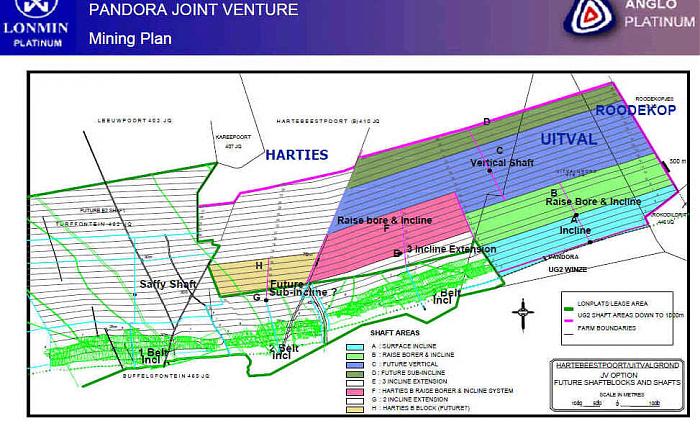
In total there are 12 shaft complexes at Marikana with some being termed "first" generation shafts, and some being termed "second" generation shafts. The first generation shafts use conventional mining methods while the second generation shafts are more or fully mechanised. The first generation shafts are nearing the end of life and production at those shafts is declining. The mine also has several concentrators and a smelter to process the mined ore, making Marikana a fully integrated operation from mine to end product. Marikana also processes ore from the Pandora Mine, which as of December 14, 2017 is 100% owned by Lonmin. Initially the Marikana Saffy shaft will be used to access Pandora.
After ore is mined it is transferred to the Process Division which converts the ore into refined metal. The ore is crushed then the concentrators transform it into a liquefied concentrate which is then sent to the smelter, which converts the concentrate into a metal-rich matte. The matte is transported to the Base Metal Refinery which extracts the base metals, primarily copper and nickel. The final stage in the process is the Precious Metal Refinery which produces refined PGMs.
Marikana is located on the western limb of the Bushveld Ingeous Complex (BIC). The BIC was intruded about 2,060 million years ago into rocks of the Transvaal Supergroup along an unconformity between the Magaliesberg quartzites (Pretoria Group) and the overlying Rooiberg felsites (a dominantly felsic volcanic precursor). The BIC is one the largest mafic/ultramafic layered intrusions in the world, covering an extent exceeding 66,000km2 and a maximum thickness of 8km. It compromises the largest known Platinum Group Metals resource in the world. The mafic component of the BIC hosts layers rich in PGE’s, nickel, copper, chromium and vanadium. Both the Merensky and UG2 reefs are mined at Marikana, although with depletion of Meresky resources there is a shift, generally on the Western Limb, to more mining on the UG2 reef.
In total there are 12 shaft complexes at Marikana with some being termed "first" generation shafts, and some being termed "second" generation shafts. The first generation shafts use conventional mining methods while the second generation shafts are more or fully mechanised. The first generation shafts are nearing the end of life and production at those shafts is declining. The mine also has several concentrators and a smelter to process the mined ore, making Marikana a fully integrated operation from mine to end product. Marikana also processes ore from the Pandora Mine, which as of December 14, 2017 is 100% owned by Lonmin. Initially the Marikana Saffy shaft will be used to access Pandora.
After ore is mined it is transferred to the Process Division which converts the ore into refined metal. The ore is crushed then the concentrators transform it into a liquefied concentrate which is then sent to the smelter, which converts the concentrate into a metal-rich matte. The matte is transported to the Base Metal Refinery which extracts the base metals, primarily copper and nickel. The final stage in the process is the Precious Metal Refinery which produces refined PGMs.
Nearby cities:
Coordinates: 25°40'14"S 27°34'19"E
- Rand Uranium Mine 50 km
- Impala Platinum Mine 58 km
- Kloof Gold Mine 65 km
- Driefontein Division 75 km
- Union Platinum Mine 98 km
- Zondereinde Platinum Mine 105 km
- Tumela Platinum Mine 108 km
- Buffelsfontein Gold Mine - Buffelsfontein 154 km
- AngloGold Ashanti Vaal River Operations 165 km
- Orkney Gold Mine 166 km
- Tailing Impoundment 1.4 km
- Tailing Impoundment 3.2 km
- Marikana Smelter 5.6 km
- Tailing Impoundment 6.7 km
- Buffelsfontein Chrome Smelter 7.6 km
- Mooinooi 9 km
- Tharisa Mine 11 km
- Buffelsfontein 14 km
- Wagpos High School 22 km
- Rooikoppies Lake 25 km