
Soccer City Stadium (Johannesburg)
South Africa /
Gauteng /
Johannesburg /
Soweto Highway
World
/ South Africa
/ Gauteng
/ Johannesburg
World / South Africa / Gauteng
World Cup football stadium, football / soccer stadium, wc soccer 2010


www.soccercity2010.co.za/
he Soccer City Stadium (formerly known as the FNB Stadium) is a stadium located in the Johannesburg suburb of Soweto. It is located next to the South African Football Association headquarters (SAFA House) where both the FIFA offices and the Local Organising Committee for the 2010 FIFA World Cup is housed.
A football-specific stadium, Soccer City currently seats 94,700 people in plastic bucket seats. The stadium has the largest capacity in Africa. Most of the largest football events in South Africa are played at Soccer City and the venue is better suited to these events than nearby Ellis Park, where the final for the Rugby World Cup in 1995 was held. Soweto and the National Exhibition Centre in Nasrec are nearby.
It originally seated 70,000, but has gone extensive re-development in time for the 2010 FIFA World Cup. The stadium will hold the opening match, four more first-round matches, one second-round match, one quarter-final, and the final of the 19th FIFA World Cup.
The Soccer City Stadium in Johannesburg underwent a major upgrade for the 2010 FIFA World Cup, with a new design inspired by traditional African pottery. The upper tier was extended around the stadium to increase the capacity to 91,141 with an extra 99 Executive suites, an encircling roof was constructed, new changing room facilities were developed and new floodlights were installed. The number of suites in this stadium is being increased to 195. The R1.5 billion tender to upgrade the stadium was won by Grinaker-LTA. Soccer City was scheduled for completion in 2009. On January 19, 2007, Grinaker-LTA issued a press statement that mentioned the beginning of the constructions within two weeks.
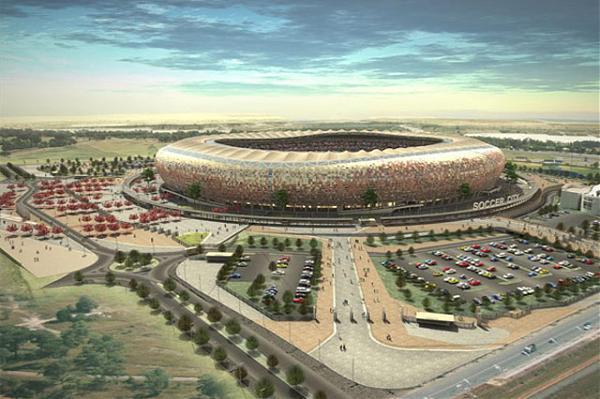
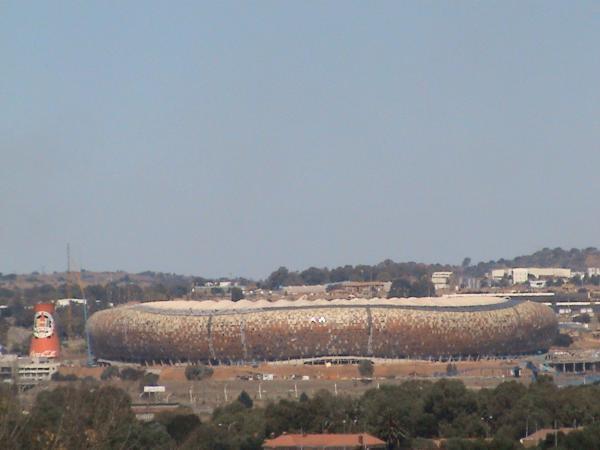
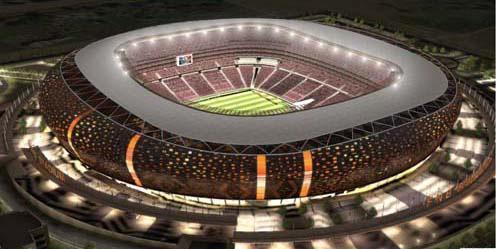
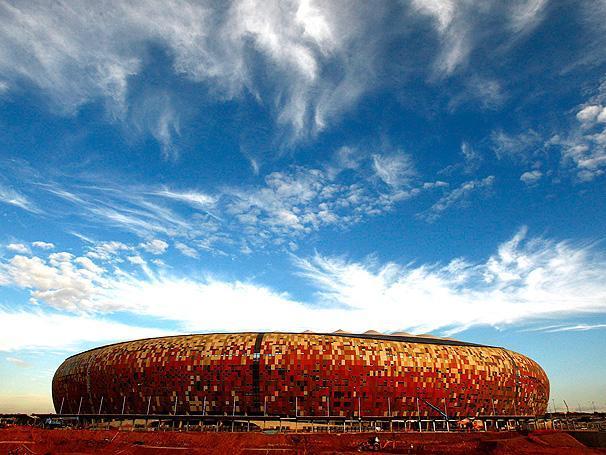
The outside of the stadium is designed to have the appearance of an African cooking pot, the cladding on the outside is a mosaic of fire and earthen colours with a ring of lights running around the bottom of the structure, simulating fire underneath the pot. No spectator will be more than 100 metres (330ft) from the action and there are no restricted views in the stadium.
The stands in Soccer City are articulated by ten black vertical lines, which are aligned geographically with the nine other stadia involved in the 2010 World Cup, and a tenth line is aimed at Berlin's Olympic Stadium, which hosted the previous World Cup final in 2006. This represents the road to the final and it is hoped that after the World Cup, each goal scored at the stadium will be placed in pre-cast concrete panels on a podium so that the full history of the tournament’s scores can be seen for years to come.
he Soccer City Stadium (formerly known as the FNB Stadium) is a stadium located in the Johannesburg suburb of Soweto. It is located next to the South African Football Association headquarters (SAFA House) where both the FIFA offices and the Local Organising Committee for the 2010 FIFA World Cup is housed.
A football-specific stadium, Soccer City currently seats 94,700 people in plastic bucket seats. The stadium has the largest capacity in Africa. Most of the largest football events in South Africa are played at Soccer City and the venue is better suited to these events than nearby Ellis Park, where the final for the Rugby World Cup in 1995 was held. Soweto and the National Exhibition Centre in Nasrec are nearby.
It originally seated 70,000, but has gone extensive re-development in time for the 2010 FIFA World Cup. The stadium will hold the opening match, four more first-round matches, one second-round match, one quarter-final, and the final of the 19th FIFA World Cup.
The Soccer City Stadium in Johannesburg underwent a major upgrade for the 2010 FIFA World Cup, with a new design inspired by traditional African pottery. The upper tier was extended around the stadium to increase the capacity to 91,141 with an extra 99 Executive suites, an encircling roof was constructed, new changing room facilities were developed and new floodlights were installed. The number of suites in this stadium is being increased to 195. The R1.5 billion tender to upgrade the stadium was won by Grinaker-LTA. Soccer City was scheduled for completion in 2009. On January 19, 2007, Grinaker-LTA issued a press statement that mentioned the beginning of the constructions within two weeks.
The outside of the stadium is designed to have the appearance of an African cooking pot, the cladding on the outside is a mosaic of fire and earthen colours with a ring of lights running around the bottom of the structure, simulating fire underneath the pot. No spectator will be more than 100 metres (330ft) from the action and there are no restricted views in the stadium.
The stands in Soccer City are articulated by ten black vertical lines, which are aligned geographically with the nine other stadia involved in the 2010 World Cup, and a tenth line is aimed at Berlin's Olympic Stadium, which hosted the previous World Cup final in 2006. This represents the road to the final and it is hoped that after the World Cup, each goal scored at the stadium will be placed in pre-cast concrete panels on a podium so that the full history of the tournament’s scores can be seen for years to come.
Wikipedia article: http://en.wikipedia.org/wiki/Soccer_City
Nearby cities:
Coordinates: 26°14'5"S 27°58'57"E
- Ellis Park Stadium (Coca-Cola Park) 8.8 km
- Loftus Versfeld Stadium 59 km
- Royal Bafokeng Stadium 110 km
- Peter Mokaba Stadium 298 km
- Mbombela Stadium 307 km
- Free State Stadium 365 km
- Moses Mabhida Stadium 499 km
- Nelson Mandela Bay Stadium 887 km
- Cape Town Stadium 1255 km
- Central Rand Mineral Tenure - Crown Mines Fereirra 0.2 km
- Crown Gold Tailings Desposition Site 2.6 km
- Central Rand Mineral Tenure - Langlaagte 3.1 km
- Diepkloof 3.7 km
- Mondeor 4.9 km
- Central Rand Mineral Tenure - CMR Fereirra 5.4 km
- Johannesburg CBD 7.1 km
- Central Rand Mineral Tenure - Robinson Deep 7.1 km
- Central Rand Mineral Tenure - Village Main 7.3 km
- Soweto 9 km
Central Rand Mineral Tenure - Crown Mines Fereirra
Crown Gold Tailings Desposition Site
Central Rand Mineral Tenure - Langlaagte
Diepkloof
Mondeor
Central Rand Mineral Tenure - CMR Fereirra
Johannesburg CBD
Central Rand Mineral Tenure - Robinson Deep
Central Rand Mineral Tenure - Village Main
Soweto
Comments