
Balboa Amusement Producing Company (Long Beach, California)
USA /
California /
Long Beach /
Long Beach, California
World
/ USA
/ California
/ Long Beach
World / United States / California
place with historical importance, interesting place, film/video production studio/facility, historical layer / disappeared object


Historical place of interest. Originally built as California Motion Picture Manufacturing Company (1910-1913) and bought by Balboa Amusement Producing Co (better known as Balboa Studios). from 1913-1918 occupied 8 acres, and had lots on all 4 corners of 6th and Los Alamitos. They also owned an 11 acre backlot in Signal Hill, a short ways away. This was the largest independent film studio outside Hollywood, at the time.
Using his $7,000 inheritance, H. M. Horkheimer purchased from the California Motion Picture Manufacturing Company the studio site being leased at the time to the Edison Film Company. Fred Mace, comedian and director, had also purchased an interest in the Balboa company.
While in existence, Balboa was Long Beach's biggest employer.
Among the many stars who called Balboa home, the biggest was Baby Marie, who as a toddler had many of Balboa's biggest hits and was their highest paid star until her parents pulled her from the studio to start one of their own (which did not have success).
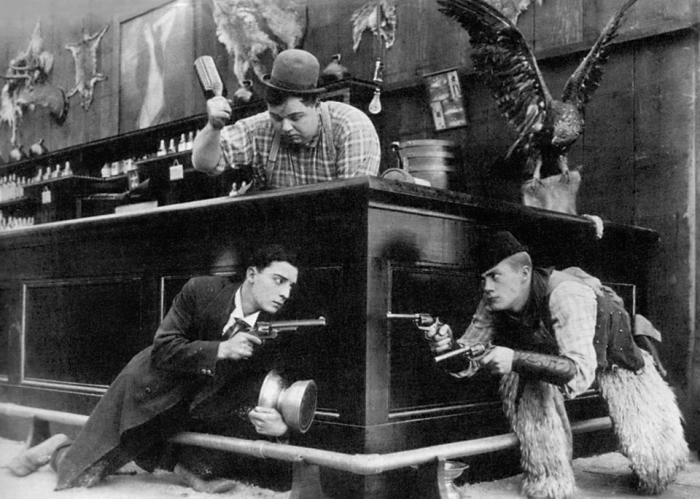
Balboas largest tenant was comedy star Roscoe "Fatty Arbuckle" who Comique Film Corp. Arbuckle brought is team of performers with him, which included popular comedian Al St. John (Arbuckle’s cousin) and Buster Keaton, who would rise to become Hollywood royalty.
For Balboa, there were several fatal blows: losing Pathé as a distributor, a copyright lawsuit brought by famous writer Jack London over the use of his stories, the devastating Influenza of 1918, and eventually the Oil Strike of 1921, the latter having completely altered the economy and face of Long Beach, transforming it into an industrial port and petroleum producing center rather than a seaside resort and entertainment mecca. Above all, several studios, including Balboa, would fail to fathom the necessary marriage between producers and distributors to assure their mutual success and longevity. In retrospect, the most successful studios by the end of the Great War ran their own theater chains and handled their own distribution, providing a steady distribution system for their product.
In 1918 Balboa Amusement Producing Company declared bankruptcy. The studio transitioned to a rental lot, ceasing operations in 1923. The plant was demolished in 1925.
Using his $7,000 inheritance, H. M. Horkheimer purchased from the California Motion Picture Manufacturing Company the studio site being leased at the time to the Edison Film Company. Fred Mace, comedian and director, had also purchased an interest in the Balboa company.
While in existence, Balboa was Long Beach's biggest employer.
Among the many stars who called Balboa home, the biggest was Baby Marie, who as a toddler had many of Balboa's biggest hits and was their highest paid star until her parents pulled her from the studio to start one of their own (which did not have success).
Balboas largest tenant was comedy star Roscoe "Fatty Arbuckle" who Comique Film Corp. Arbuckle brought is team of performers with him, which included popular comedian Al St. John (Arbuckle’s cousin) and Buster Keaton, who would rise to become Hollywood royalty.
For Balboa, there were several fatal blows: losing Pathé as a distributor, a copyright lawsuit brought by famous writer Jack London over the use of his stories, the devastating Influenza of 1918, and eventually the Oil Strike of 1921, the latter having completely altered the economy and face of Long Beach, transforming it into an industrial port and petroleum producing center rather than a seaside resort and entertainment mecca. Above all, several studios, including Balboa, would fail to fathom the necessary marriage between producers and distributors to assure their mutual success and longevity. In retrospect, the most successful studios by the end of the Great War ran their own theater chains and handled their own distribution, providing a steady distribution system for their product.
In 1918 Balboa Amusement Producing Company declared bankruptcy. The studio transitioned to a rental lot, ceasing operations in 1923. The plant was demolished in 1925.
Wikipedia article: https://en.wikipedia.org/wiki/Balboa_Amusement_Producing_Company
Nearby cities:
Coordinates: 33°46'27"N 118°10'50"W
- Terminator 2 - Helicopter Chase - Filming Location 6.1 km
- Berth 100 / West Basin Container Terminal / Todd Shipyard (site) 10 km
- Downey Studios (now demolished) 17 km
- Los Angeles Central Post Office (Goodyear Airship Factory site) 24 km
- SoFi Stadium 25 km
- Hollywood Park 25 km
- Site of 1932 Olympic Village 30 km
- Hercules Campus at Playa Vista 32 km
- Baker Airport / Culver City Airport (site) 32 km
- Venice Beach 37 km
- East Village 0.6 km
- North Pine 1 km
- Alamitos Beach 1 km
- Downtown Long Beach 1.3 km
- Long Beach Shoreline Marina 1.7 km
- Queensway Bay 2.3 km
- Los Angeles River (flood control) 2.4 km
- Long Beach Container Terminal (LBCT) 3.5 km
- Los Angeles-Long Beach Port Complex 6 km
- Los Angeles County, California 55 km
Comments