
Cotton Tree (Freetown)
Sierra Leone /
Western /
Freetown
World
/ Sierra Leone
/ Western
/ Freetown
World / Sierra Leone / Western / Western Urban
landmark, tree, place with historical importance
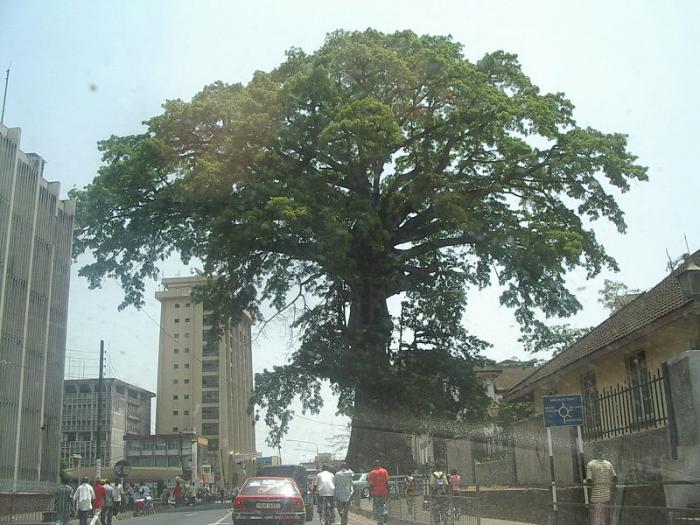
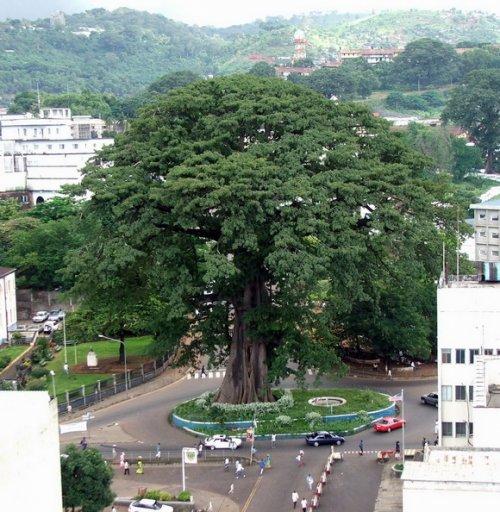
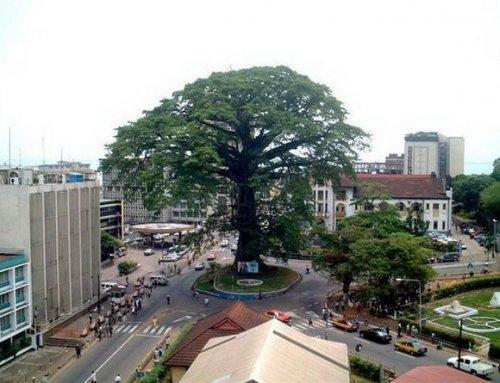
This tree which is hundreds of years old, marks the centre of the city. The original settlement of freed slaves that became the city of Freetown started at this point. This tree has been standing since at least 1787 when the British colony was established.
The Cotton Tree is an historic symbol of Freetown, the capital city of Sierra Leone. According to legend, the "Cotton Tree" gained importance in 1792 when a group of former African American slaves, who had gained their freedom by fighting for the British during the American War of Independence, settled the site of modern Freetown. These Black Loyalist settlers, called "Nova Scotians" or "Navitians" in Sierra Leone, founded Freetown on March 11th 1792. According to tradition, they landed on the shoreline and walked up to a giant tree just above the bay and held a thanksgiving service there, gathering around the tree in a large group and praying and singing hymns to thank God for their deliverance to a free land. Its exact age is unknown, but it is known to have existed in 1787.[1]
Today, a huge Cotton Tree stands in the oldest part of Freetown near the Supreme Court building, music club building and the National Museum. Sierra Leonians believe that this very tree was where the Nova Scotian settlers prayed more than two hundreds years ago, and they regard it as the symbol of their capital city. Sierra Leonians still pray and make offerings to the ancestors for peace and prosperity beneath the great ancestry Cotton Tree. This was especially true during the Sierra Leone civil war (1991-2002).
The Cotton Tree is an historic symbol of Freetown, the capital city of Sierra Leone. According to legend, the "Cotton Tree" gained importance in 1792 when a group of former African American slaves, who had gained their freedom by fighting for the British during the American War of Independence, settled the site of modern Freetown. These Black Loyalist settlers, called "Nova Scotians" or "Navitians" in Sierra Leone, founded Freetown on March 11th 1792. According to tradition, they landed on the shoreline and walked up to a giant tree just above the bay and held a thanksgiving service there, gathering around the tree in a large group and praying and singing hymns to thank God for their deliverance to a free land. Its exact age is unknown, but it is known to have existed in 1787.[1]
Today, a huge Cotton Tree stands in the oldest part of Freetown near the Supreme Court building, music club building and the National Museum. Sierra Leonians believe that this very tree was where the Nova Scotian settlers prayed more than two hundreds years ago, and they regard it as the symbol of their capital city. Sierra Leonians still pray and make offerings to the ancestors for peace and prosperity beneath the great ancestry Cotton Tree. This was especially true during the Sierra Leone civil war (1991-2002).
Wikipedia article: http://en.wikipedia.org/wiki/Cotton_Tree_(Sierra_Leone)
Nearby cities:
Coordinates: 8°29'13"N 13°14'8"W
- Agbogba Juntion 1475 km
- Kawukudi Junction 1477 km
- American House Junction 1479 km
- Talhayte Anass 1584 km
- boundary stone 2753 km
- Légation Américaine 3131 km
- Hotel Baia 3* 3385 km
- Mosteiro dos Jerónimos 3387 km
- Location of former Monsanto Park Circuit 3390 km
- Rossio 3478 km
- Tengbeh Town 2.4 km
- Wilberforce 3.9 km
- Goderich City 8.5 km
- Calaba Towm 10 km
- Lakka 10 km
- Hastings 16 km
- Yema Island 17 km
- Tasso Island 19 km
- Western Area Forest Reserve 20 km
- Tumbi humi 29 km